Overview
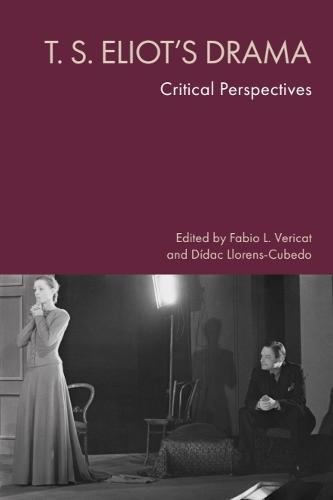
T. S. Eliot's writings for the stage have never competed critically on equal terms with his poetry despite his openly stated conviction that the greatest poetry is invariably dramatic and should speak to all audiences. The essays contained in this volume revolve around the question of Eliot's life-long interest in and later development of verse drama incorporating the latest research and archival resources most importantly, his recently published letters to Emily Hale. This book fills a gaping hole in the critical appreciation of Eliot's commitment to drama from the mid-1920s to the end of his career by principally exploring the tensions in his work between the playwright and the poet. It does so by presenting Eliot's drama as a fruitful ground for the newest critical approaches about an artist who has too long been a prisoner of his persona as the leading poet of Modernism.
Full Product Details
Author: Fabio L. Vericat (Associate Professor in the English Department, Universidad Complutense in Madrid, Spain) ,
Dídac Llorens-Cubedo (Teacher of English and US literature, Spanish Universidad Nacional de Educación a Distancia (UNED), Spain)
Publisher: Edinburgh University Press
Imprint: Edinburgh University Press
ISBN: 9781399541213
ISBN 10: 1399541218
Pages: 272
Publication Date: 30 April 2026
Audience:
College/higher education
,
Postgraduate, Research & Scholarly
Format: Hardback
Publisher's Status: Forthcoming
Availability: Not yet available

This item is yet to be released. You can pre-order this item and we will dispatch it to you upon its release.
Reviews
The first major study of Eliot’s drama in at least a decade, this timely volume revitalizes our understanding of his plays with new archival material, such as his letters to Emily Hale, and fresh approaches including dance history, ecocriticism, and food studies. * Frances Dickey, Co-Editor of The Complete Prose of T.S. Eliot *
Author Information
Fabio L. Vericat is Senior Lecturer in the Department of English Studies at Universidad Complutense de Madrid. He studied English at the University of Edinburgh and the University of Glasgow. His current research interests focus on the sound of writing by exploring the interconnections between reading and performance in the literary text. He writes mainly on the long Modernist period, specifically on T. S. Eliot and Henry James, but also on film and drama. He is currently working on a book project provisionally entitled The Drama of Aural Modernity in T. S. Eliot and Henry James. In the autumn of 2017, he was visiting scholar in the English Department at Harvard University with the aid of a RCC Harvard Research Fellowship. Dídac Llorens-Cubedo teaches English and US literature at the Spanish National University of Distance Education (UNED). He has published T. S. Eliot and Salvador Espriu: Converging Poetic Imaginations (2013) and co-edited New Literatures of Old: Dialogues of Tradition and Innovation in Anglophone Literatures (2008) and a critical edition of Eliot’s drama in Spanish translation, T. S. Eliot. Teatro Completo (2022). His research focuses on Modernism, (neo)Victorianism and comparative literature, across languages and the arts. He has coordinated two publicly funded research projects on Eliot’s drama: 'T. S. Eliot’s Drama from Spain: Translation, Critical Study, Performance' and 'Critical Reassessment of Eliot’s Verse Drama: Influence, Evolution, and Perception', as well as the academic blog 'T. S. Eliot and Drama'. He is also the general editor of the journal Epos. Revista de Filología.