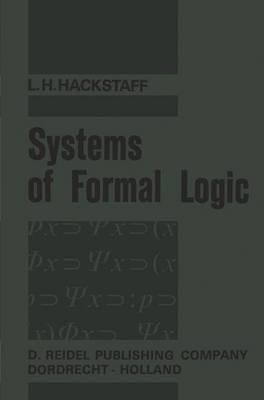
Systems of Formal Logic

Author:   L.H. Hackstaff
Publisher:   Springer
Edition:   1966 ed.
ISBN:  

9789027700773


Pages:   372
Publication Date:   31 July 1966
Format:   Hardback
Availability:   Temporarily unavailable   Availability explained
The supplier advises that this item is temporarily unavailable. It will be ordered for you and placed on backorder. Once it does come back in stock, we will ship it out to you.

Our Price $261.36 Quantity:  
Add to Cart

Share |

Systems of Formal Logic


Overview

The present work constitutes an effort to approach the subject of symbol­ ic logic at the elementary to intermediate level in a novel way. The book is a study of a number of systems, their methods, their rela­ tions, their differences. In pursuit of this goal, a chapter explaining basic concepts of modern logic together with the truth-table techniques of definition and proof is first set out. In Chapter 2 a kind of ur-Iogic is built up and deductions are made on the basis of its axioms and rules. This axiom system, resembling a propositional system of Hilbert and Ber­ nays, is called P +, since it is a positive logic, i. e. , a logic devoid of nega­ tion. This system serves as a basis upon which a variety of further sys­ tems are constructed, including, among others, a full classical proposi­ tional calculus, an intuitionistic system, a minimum propositional calcu­ lus, a system equivalent to that of F. B. Fitch (Chapters 3 and 6). These are developed as axiomatic systems. By means of adding independent axioms to the basic system P +, the notions of independence both for primitive functors and for axiom sets are discussed, the axiom sets for a number of such systems, e. g. , Frege's propositional calculus, being shown to be non-independent. Equivalence and non-equivalence of systems are discussed in the same context. The deduction theorem is proved in Chapter 3 for all the axiomatic propositional calculi in the book.

Full Product Details

Author:   L.H. Hackstaff
Publisher:   Springer
Imprint:   Kluwer Academic Publishers
Edition:   1966 ed.
Dimensions:   Width: 15.60cm , Height: 2.30cm , Length: 23.40cm
Weight:   0.699kg
ISBN:  

9789027700773


ISBN 10:   902770077
Pages:   372
Publication Date:   31 July 1966
Audience:   General/trade ,  General
Format:   Hardback
Publisher's Status:   Active
Availability:   Temporarily unavailable   Availability explained
The supplier advises that this item is temporarily unavailable. It will be ordered for you and placed on backorder. Once it does come back in stock, we will ship it out to you.

Table of Contents

1 Introduction: Some Concepts and Definitions.- 1.0 Arguments and Argument Forms.- 1.1 Symbolic Logic and its Precursors.- 1.2 Symbolization.- 1.3 Logical Functors and Their Definitions.- 1.4 Tests of Validity Using Truth-tables.- 1.5 Proof and Derivation.- 1.6 The Axiomatic Method.- 1.7 Interpreted and Uninterpreted Systems.- 1.8 The Hierarchy of Logical Systems.- 1.9 The Systems of the Present Book.- 1.10 Abbreviations.- 2 The System P+.- 2.1 Summary.- 2.2 Rules of Formation of P+.- 2.3 Rules of Transformation of P+.- 2.4 Axioms of P+.- 2.5 Definitions of P+.- 2.6 Deductions in P+.- 3 Standard Systems with Negation (PLT, PLT’, PLTF, PPM).- 3.1 Summary.- 3.2 Rules of Formation of PLT.- 3.3 Rules of Transformation of PLT.- 3.4 Axioms of PLT.- 3.5 Definitions of PLT.- 3.6 Deductions in PLT.- 3.7 The Deduction Theorem.- 3.8 The System PLT’.- 3.9 Independence of Functors and Axioms.- 4 The System PND. Systems of Natural Deduction.- 4.1 Summary.- 4.2 The Bases of the System PND.- 4.3 Proof and Derivation Techniques in PND.- 4.4 Rules of Formation of PND.- 4.5 The Structure of Proofs in PND.- 4.6 Rules of Transformation of PND.- 4.7 Proofs and Theorems of the System PND.- 4.8 Theorems of the Full System PND.- 4.9 A Decision Procedure for the System PND.- 4.10 A Reduction of PND.- 5 The Consistency and Completeness of Formal Systems.- 5.1 Summary.- 5.2 The Consistency of PLT’.- 5.3 The Completeness of PLT’.- 5.4 Metatheorems on P+.- 6 Some Non-Standard Systems of Propositional Logic.- 6.1 Summary.- 6.2 What is a Non-Standard System?.- 6.3 The Intuitionistic System and the Fitch Calculus (PI and PF).- 6.4 Rules of Formation of PI.- 6.5 Rules of Transformation of PI.- 6.6 Axioms of PI.- 6.7 Definitions of PI.- 6.8 Deductions in PI.- 6.9 The Propositional Logic of F.B.Fitch.- 6.10 The Johansson Minimum Calculus.- 7 The Lower Functional Calculus.- 7.1 Summary and Remarks.- 7.2 Rules of Formation of LFLT’.- 7.3 Transformation of LFLT’.- 7.4 Axioms of LFLT’.- 7.5 Definitions of LFLT’.- 7.6 Some Applications and Illustrations.- 7.7 Rules of Transformation of LFLT’.- 7.8 Axioms of LFLT’.- 7.9 The Propositional Calculus and LFLT’.- 7.10 Deductions in LFLT’.- 8 An Extension of LFLT’ and Some Theorems of the Higher Functional System. The Calculus of Classes.- 8.1 Summary and Modification of the Formation Rules of LFLT’.- 8.2 The Lower Functional Calculus with Identity.- 8.3 Quantification over Predicate Variables. The System 2FLT’=.- 8.4 Abstraction and the Boolean Algebra.- 8.5 The Boolean Algebra and Propositional Logic.- 9 The Logical Paradoxes.- 9.1 Self Membership.- 9.2 The Russell Paradox.- 9.3 Order Distinctions, Levels of Language, and the Semantic Paradoxes.- 9.4 The Consistency of LFLT’.- 9.5 The Decision Problem.- 9.6 Consistency and Decision in Higher Functional Systems.- 10 Non-Standard Functional Systems.- 10.1 Summary.- 10.2 Intuitionistic and Johansson Functional Logics.- 10.3 The Fitch Functional Calculus of the First Order with Identity (LFFF=).

Reviews

Author Information

Tab Content 6

Author Website:  

Countries Available

All regions
Latest Reading Guide

NOV RG 20252


Shopping Cart
Your cart is empty
Shopping cart
Mailing List