|
|
|||
|
||||
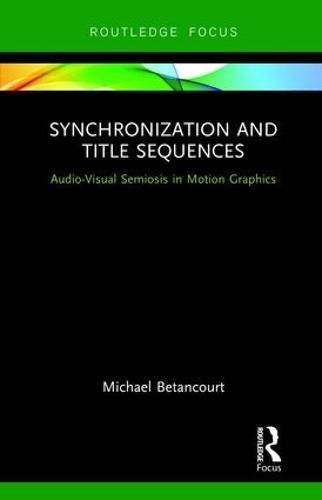
OverviewSynchronization and Title Sequences proposes a semiotic analysis of the synchronization of image and sound in motion pictures using title sequences. Through detailed historical close readings of title designs that use either voice-over, an instrumental opening, or title song to organize their visuals—from Vertigo (1958) to The Player (1990) and X-Men: First Class (2011)—author Michael Betancourt develops a foundational framework for the critique and discussion of motion graphics’ use of synchronization and sound, as well as a theoretical description of how sound-image relationships develop on-screen. Full Product DetailsAuthor: Michael Betancourt (Savannah College of Art and Design, USA)Publisher: Taylor & Francis Ltd Imprint: Routledge Weight: 0.294kg ISBN: 9781138085060ISBN 10: 1138085065 Pages: 142 Publication Date: 17 May 2017 Audience: College/higher education , Tertiary & Higher Education , Undergraduate Format: Hardback Publisher's Status: Active Availability: In Print This item will be ordered in for you from one of our suppliers. Upon receipt, we will promptly dispatch it out to you. For in store availability, please contact us. Table of Contents"List of Figures Notes on the Author 1. INTRODUCTION The Development of Title Sequences Primary Recognition Emergent Identification 2. DIRECT SYNCHRONIZATION The Synchronized Naturalistic Synchronization Diegetic and Non-Diegetic Synchronization 3. NATURAL ARTIFICE The ""Visual Music"" Heritage The Ideology of Synchronization Illustrative Synchronization 4. COUNTERPOINT Reservations about the ""Talkies"" Counterpoint Synchronization Quotational Counterpoint 5. SONGS AND VOICE-OVER Music Title Songs Narrated Montages 6. CONCLUSIONS The Statement of Synchronization The Immanence of Ideology The Role of Music and Theme Songs Index"ReviewsAuthor InformationMichael Betancourt is a theorist, historian, and artist concerned with digital technology and capitalist ideology. He is the author of The ____________ Manifesto, The History of Motion Graphics, Beyond Spatial Montage, Glitch Art in Theory and Practice, Semiotics and Title Sequences, and The Critique of Digital Capitalism. He has exhibited internationally, and his work has been translated into Chinese, French, German, Greek, Italian, Japanese, Persian, Portuguese, and Spanish, and published in journals such as The Atlantic, Make Magazine, CTheory, and Leonardo. Tab Content 6Author Website:Countries AvailableAll regions |
||||