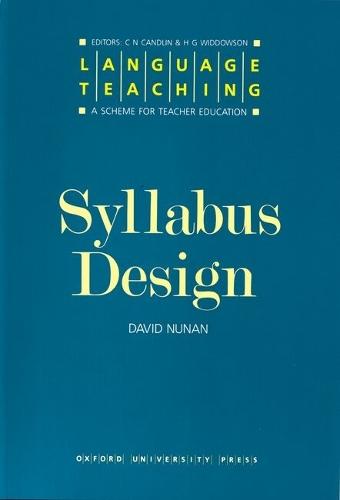
Syllabus Design

Author:   David Nunan (Director, Director, the National Curriculum Resource Centre, Adelaide) ,  C. N. Candlin ,  H. G. Widdowson
Publisher:   Oxford University Press
ISBN:  

9780194371391


Pages:   176
Publication Date:   07 July 1988
Format:   Paperback
Availability:   Awaiting stock   Availability explained


Our Price $50.03 Quantity:  
Add to Cart

Share |

Syllabus Design


Overview

Syllabus Design demonstrates, in a practical way, the principles involved in planning and designing an effective syllabus. It examines important concepts such as needs analysis, goal-setting, and content specification, and serves as an excellent introduction for teachers who want to gain a better understanding of syllabus design in order to evaluate, modify, and adapt the syllabuses with which they work.

Full Product Details

Author:   David Nunan (Director, Director, the National Curriculum Resource Centre, Adelaide) ,  C. N. Candlin ,  H. G. Widdowson
Publisher:   Oxford University Press
Imprint:   Oxford University Press
Dimensions:   Width: 17.30cm , Height: 1.10cm , Length: 24.70cm
Weight:   0.320kg
ISBN:  

9780194371391


ISBN 10:   0194371395
Pages:   176
Publication Date:   07 July 1988
Audience:   ELT/ESL ,  ELT General
Format:   Paperback
Publisher's Status:   Out of Print
Availability:   Awaiting stock   Availability explained

Table of Contents

The author and series editors Introduction Section One: Defining syllabus design 1 The scope of syllabus design: 1.1 Introduction: 1.2 A general curriculum model: 1.3 Defining 'syllabus': 1.4 The role of the classroom teacher: 1.5 Conclusion: 2 Points of departure: 2.1 Introduction: 2.2 Basic orientations: 2.3 Learning purpose: 2.4 Learning goals: 2.5 Conclusion: 3 Product-oriented syllabuses: 3.1 Introduction: 3.2 Analytic and synthetic syllabus planning: 3.3 Grammatical syllabuses: 3.4 Criticizing grammatical syllabuses: 3.5 Functional-notional syllabuses: 3.6 Criticizing functional-notional syllabuses: 3.7 Analytic syllabuses: 3.8 Conclusion: 4 Process-oriented syllabuses: 4.1 Introduction: 4.2 Procedural syllabuses: 4.3 Task-based syllabuses: 4.4 Content syllabuses: 4.5 The natural approach: 4.6 Syllabus design and methodology: 4.7 Grading tasks: 4.8 Conclusion: 5 Objectives: 5.1 Introduction: 5.2 Types of objective: 5.3 Performance objectives in language teaching: 5.4 Criticizing performance objectives: 5.5 Process and product objectives: 5.6 Conclusion: Section Two: Demonstrating syllabus design 6 Needs and goals: 6.1 Introduction: 6.2 Needs analysis: 6.3 From needs to goals: 6.4 Conclusion: 7 Selecting and grading content: 7.1 Introduction: 7.2 Selecting grammatical components: 7.3 Selecting functional and notional components: 7.4 Relating grammatical, functional, and notional components: 7.5 Grading content: 7.6 Conclusion: 8 Selecting and grading learning tasks: 8.1 Introduction: 8.2 Goals, objectives, and tasks: 8.3 Procedural syllabuses: 8.4 The natural approach: 8.5 Content-based syllabuses: 8.6 Levels of difficulty: 8.7 Teaching grammar as process: 8.8 Conclusion: 9 Selecting and grading objectives: 9.1 Introduction: 9.2 Product-oriented objectives: 9.3 Process-oriented objectives: 9.4 Conclusion: Section Three: Exploring syllabus design 10 General principles: 10.1 Curriculum and syllabus models: 10.2 Purposes and goals: 10.3 Syllabus products: 10.4 Experiential content: 10.5 Tasks and activities: 10.6 Objectives: Glossary Further reading Bibliography Acknowledgements

Reviews

Author Information

Tab Content 6

Author Website:  

Countries Available

All regions
Latest Reading Guide

MRGC26


Shopping Cart
Your cart is empty
Shopping cart
Mailing List