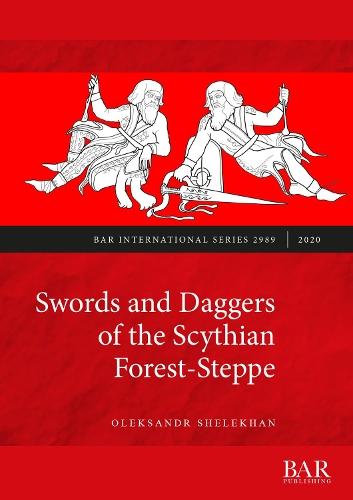
Swords and Daggers of the Scythian Forest-Steppe

Author:   Oleksandr Shelekhan
Publisher:   BAR Publishing
ISBN:  

9781407356440


Pages:   304
Publication Date:   29 June 2020
Format:   Paperback
Availability:   Available To Order   Availability explained
We have confirmation that this item is in stock with the supplier. It will be ordered in for you and dispatched immediately.

Our Price $191.48 Quantity:  
Add to Cart

Share |

Swords and Daggers of the Scythian Forest-Steppe


Overview

Oleksandr Shelekhan comprehensively examines Scythian bladed weapons belonging to farmer tribes who lived in the East European Forest-Steppe from the 7th century to between the 4th and early 3rd centuries BC. The analysis demonstrates a detailed typological and chronological distribution, showing distinctive tendencies of adoption and dissemination of the different weapon types across the period and the region. The author uses this evidence to produce a social and historical reconstruction of Scythian culture. Swords and daggers found in burials are connected with certain sex and age groups. The correlation of swords and daggers with other prestigious artefacts and ritual features indicate the high social status of a majority of swordsmen. The Scythians were high ranking amongst the social structure of farmer tribes, and the Forest-Steppe region was included in the military-political structure of Great Scythia during the Early Iron Age.

Full Product Details

Author:   Oleksandr Shelekhan
Publisher:   BAR Publishing
Imprint:   BAR Publishing
Weight:   1.212kg
ISBN:  

9781407356440


ISBN 10:   1407356445
Pages:   304
Publication Date:   29 June 2020
Audience:   Professional and scholarly ,  Professional & Vocational
Format:   Paperback
Publisher's Status:   Active
Availability:   Available To Order   Availability explained
We have confirmation that this item is in stock with the supplier. It will be ordered in for you and dispatched immediately.

Table of Contents

Abstract Introduction 1. Historiography and source base 1.1 Source base 1.1.1 Written sources 1.1.2 Antique art traditions 1.1.3 Scythian anthropomorphic sculpture 1.1.4 Anthropological sources 1.1.5 Archaeological sources 1.2 Historiography of research into the Scythian bladed weapon 1.2.1 Initial period 1.2.2 Advanced period 1.2.2.1 The origin of the Scythian bladed weapon 1.2.2.2 Examining the production of swords and daggers 1.2.2.3 Outlining of the functional groups 1.2.2.4 Experience in the systematisation 1.2.2.5 Studying the dissemination of bladed weapons 1.2.2.6 Examining the decoration of the swords and daggers 1.2.2.7 The bladed weapon in ethnic and social research 1.2.2.8 Recent comprehensive works 2. Systematisation of the Scythian bladed weapons from the Forest-Steppe 2.1 General considerations 2.1.1 Terminological questions 2.1.2 Functional groups 2.2 Typology 2.2.1 Common grounds for typological research 2.2.2 Typology of single-bladed swords and daggers 2.2.3 Typology of double-edged swords and daggers 2.2.4 Equipment and accessories 3. Chronology of the Scythian bladed weapon 3.1. Common grounds for chronological research 3.2. The chronology of the Early-period bladed weapon 3.3. The Chronology of the Middle-period bladed weapon 3.4. Chronology of the Late-period bladed weapon 3.5 General development of the Scythian bladed weapon in the Forest-Steppe 4. Spatial analysis 4.1 Common grounds for the spatial analysis 4.2 Mapping of the burial finds 4.3 Mapping of those finds without archaeological context 4.4 Mapping of the settlement finds 4.5 General patterns of the spreading of Scythian bladed weapon in the Forest-Steppe 5. Warrior burials with swords and daggers 5.1 Common grounds for social stratification 5.2 First social group (common warriors) 5.3 Second social group (professional warriors) 5.4 Third social group (elite warriors) 5.5 Fourth social group (war aristocracy) 5.6 Main features of the social and cultural patterns 5.6.1 Age and sex characteristics 5.6.2 The bladed weapon as a source in Scythian history Conclusions Bibliography List of abbreviations Appendix 1. Catalogue of Scythian-time bladed weapons from the East-European Forest-Steppe Appendix 2. Measurements of examined blade weaponry Appendix 3. Short description of examined graves with blade weapons

Reviews

{\rtf1\fbidis\ansi\ansicpg1252\deff0\deflang2057{\fonttbl{\f0\fswiss\fprq2\fcharset0 Calibri;}{\f1\fnil\fcharset0 Verdana;}} \viewkind4\uc1\pard\ltrpar\sa160\sl252\slmult1\f0\fs22\lquote Oleksandr Shelekhan\rquote s contribution is very original and the whole corpus of records is vital for the further development of the study of the Scythian weaponry.\rquote Dr Denis Topal, National Museum of History of Moldova\fs24\par \pard\ltrpar\lquote\fs22 There is a growing interest in the Scythian world, and daggers of these types appear in Eastern Europe as well as in Iran (Persepolis, reliefs of Apadana). This research will find large interest all over without any doubt.\rquote Professor Hermann Parzinger, Stiftung Preu\'dfischer Kulturbesitz\par \par \pard\ltrpar\sa160\sl252\slmult1\fs24\par \pard\ltrpar\f1\fs17\par }


Author Information

Oleksandr Shelekhan is a research fellow at the Institute of Archaeology at the National Academy of Sciences of Ukraine. He is interested in Iron Age archaeology, Scythian weaponry, fortification and warfare and is the author and co-author of more than 80 papers.

Tab Content 6

Author Website:  

Countries Available

All regions
Latest Reading Guide

April RG 26_2


Shopping Cart
Your cart is empty
Shopping cart
Mailing List