Overview
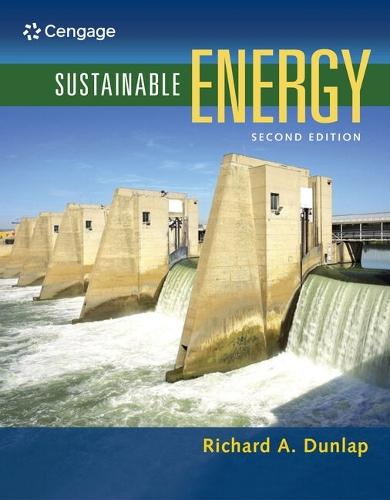
Help students explore present and future energy needs as well as options for continued use of fossil fuels and alternative energy sources with Dunlap's SUSTAINABLE ENERGY, 2nd Edition. Individual chapters thoroughly investigate each energy approach as the book covers both current energy production and future strategies. Readers only need to be familiar with freshman-level physics and chemistry. The text emphasizes the complexity of energy issues and the need for a multidisciplinary approach to solve today's energy problems. Quantitative end-of-chapter problems require students to analyze information, use material from previous chapters, correlate data from various sources, and interpret graphical data and interpolate values. Students see real problems encountered in producing and using energy and realize that while exact calculations are important, a broad-based analysis is often most appropriate.
Full Product Details
Author: Richard Dunlap
Publisher: Cengage Learning, Inc
Imprint: CENGAGE Learning Custom Publishing
Edition: 2nd Revised edition
Dimensions:
Width: 20.30cm
, Height: 2.30cm
, Length: 25.10cm
Weight: 1.089kg
ISBN: 9781337551663
ISBN 10: 133755166
Pages: 736
Publication Date: 01 January 2018
Audience:
College/higher education
,
Tertiary & Higher Education
Format: Paperback
Publisher's Status: Active
Availability: Available To Order

We have confirmation that this item is in stock with the supplier. It will be ordered in for you and dispatched immediately.
Reviews
Photos are excellent, tables are easy to read....Book has good coverage of many energy topics. This is a good book to start one's study of energy, its sources, uses, and prospects for future technologies. I think the author pays great attention to defining even simple terms (at least for physicists) to have even the arts student happy. The energy extra boxes are excellent, they provide a sort of build up for the curiousness of the students. The examples are great and enough in numbers, students like to do them. I like the flow of arguments and the arrangement of topics a lot. The solutions given are clear in their methodology and point back to the relevant equations so the topic can be studied again. I think the numbers of the colorful pictures as well as some very appropriate black and white pictures help to make the topics easier and accessible. Students love it. One of the salient features of this textbook is its extensive use of pictures. Those examples are excellent. I really like this book. This is one of the best textbooks on this subject.
""Photos are excellent, tables are easy to read....Book has good coverage of many energy topics. This is a good book to start one's study of energy, its sources, uses, and prospects for future technologies."" ""I think the author pays great attention to defining even simple terms (at least for physicists) to have even the arts student happy. The energy extra boxes are excellent, they provide a sort of build up for the curiousness of the students. The examples are great and enough in numbers, students like to do them. I like the flow of arguments and the arrangement of topics a lot. The solutions given are clear in their methodology and point back to the relevant equations so the topic can be studied again. I think the numbers of the colorful pictures as well as some very appropriate black and white pictures help to make the topics easier and accessible."" ""Students love it. One of the salient features of this textbook is its extensive use of pictures. Those examples are excellent. I really like this book. This is one of the best textbooks on this subject.""
Photos are excellent, tables are easy to read....Book has good coverage of many energy topics. This is a good book to start one's study of energy, its sources, uses, and prospects for future technologies. Students love it. One of the salient features of this textbook is its extensive use of pictures. Those examples are excellent. I really like this book. This is one of the best textbooks on this subject. I think the author pays great attention to defining even simple terms (at least for physicists) to have even the arts student happy. The energy extra boxes are excellent, they provide a sort of build up for the curiousness of the students. The examples are great and enough in numbers, students like to do them. I like the flow of arguments and the arrangement of topics a lot. The solutions given are clear in their methodology and point back to the relevant equations so the topic can be studied again. I think the numbers of the colorful pictures as well as some very appropriate black and white pictures help to make the topics easier and accessible.
Author Information
Richard A. Dunlap is a research professor in the Department of Physics and Atmospheric Science at Dalhousie University. He received a B.S. in Physics from Worcester Polytechnic Institute (1974), an A.M. in Physics from Dartmouth College (1976) and a Ph.D. in Physics from Clark University (1981). Since 1981 he has been on the faculty at Dalhousie University. From 2001 to 2006 he was Killam Research Professor of Physics and from 2009 to 2015 he was Director of the Dalhousie University Institute for Research in Materials. Professor Dunlap is author of three previous textbooks: EXPERIMENTAL PHYSICS: MODERN METHODS (Oxford 1988), THE GOLDEN RATIO AND FIBONACCI NUMBERS (World Scientific 1997), and AN INTRODUCTION TO THE PHYSICS OF NUCLEI AND PARTICLES (Brooks/Cole 2004). Over the years his research interests have included critical phenomena, magnetic materials, amorphous materials, quasicrystals, hydrogen storage, superconductivity, and materials for advanced rechargeable batteries. He has published more than 300 refereed research papers.