Overview
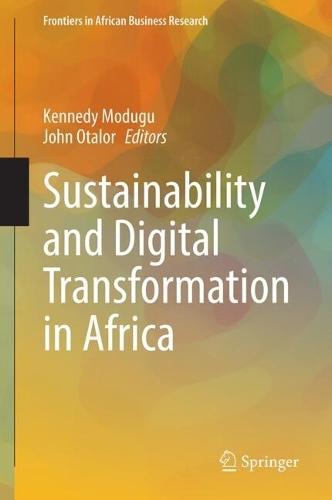
This book explores how artificial intelligence, digital transformation, and sustainability intersect in Africa and how they can reshape business practices, economic development, and environmental stewardship across the continent. Drawing on multidisciplinary perspectives, it analyses the role of emerging technologies in advancing sustainable business models, responsible governance, and inclusive growth. Case studies, data-driven analysis, and policy discussions illustrate how AI, blockchain, and digital platforms are influencing sectors such as finance, manufacturing, education, public administration, and entrepreneurship. The chapters explore themes such as technology adoption, sustainability education, and ethical technology governance while also addressing regulatory, capacity, and infrastructure challenges facing African economies. By combining empirical insight with practical policy reflection, the book offers guidance for business leaders, policymakers, researchers, and students seeking to understand how digital innovation can support sustainable development across Africa.
Full Product Details
Author: Kennedy Modugu ,
John Otalor
Publisher: Springer Verlag, Singapore
Imprint: Springer Verlag, Singapore
ISBN: 9789819594993
ISBN 10: 9819594995
Pages: 155
Publication Date: 12 May 2026
Audience:
Professional and scholarly
,
Professional & Vocational
Format: Hardback
Publisher's Status: Active
Availability: In Print

This item will be ordered in for you from one of our suppliers. Upon receipt, we will promptly dispatch it out to you. For in store availability, please contact us.
Author Information
Kennedy Modugu is Professor of Accounting and Analytics at Middlesex University Mauritius. He holds a Ph.D. in Accounting with a special interest in corporate disclosure. His scholarship sits at the confluence of accounting research, data analytics, and institutional change. His work spans corporate reporting, governance, forensic accounting, taxation, accounting education, and business analytics, with an increasing focus on sustainability reporting and the digitalisation of accounting systems. He has published extensively in reputable peer-reviewed journals and has authored multiple book chapters. His recent works engage questions of transparency, accountability, regulation, and the role of digital technology in decision-making. He is a chartered accountant and a member of several international professional bodies. John Otalor is a Senior Lecturer in Accounting at the University of Calabar, Nigeria. He holds a PhD in Accounting and specialises in budgeting and public finance management. His research examines fiscal governance, budgeting systems, and public sector accountability. He is a certified member of the Institute of Chartered Accountants of Nigeria and the Chartered Institute of Bankers of Nigeria. He has published studies on public financial management, mentoring, change management, accounting education, environmental accounting, fiscal responsibility, and taxation. His current research explores need-based budgeting and sustainability-oriented public finance reform in developing economies while contributing to debates on accountable governance and effective resource allocation in public institutions.