Overview
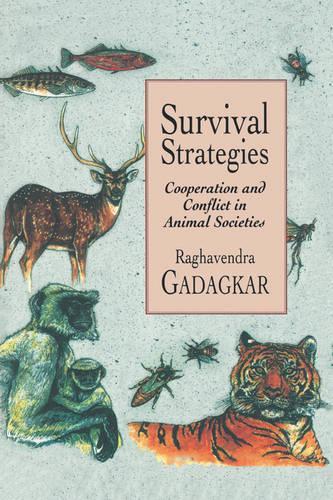
Did you know that Tasmanian hens have two husbands? That cellular slime molds commit suicide? That vampire bats will share food with hungry fellow bats and that hanuman langurs commit infanticide? Why creatures great and small behave in such fascinating and seemingly perplexing ways is explained in this delightful account of the evolutionary foundations of animal social behavior. Only in recent years have biologists and ethologists begun to apply careful evolutionary thinking to the study of animal societies--and with spectacular results. This book presents the choicest of these findings, with a remarkable wealth of insights into the myriad strategies that animals have developed to perpetuate their kind. In an irresistible style, Raghavendra Gadagkar explores the strategies of cooperation and conflict adopted by animals--from the lordly lion to the primitive wasp worker--as they choose mates, raise their young, communicate with others, and establish the division of labor necessary to feed and protect the group and safeguard their territory. Whether focusing on the birds or the bees, this book offers both superb descriptions and lucid explanations of many different behaviors encountered in the animal world: why a ground squirrel will sound an alarm--even risk its own safety--to warn fellow squirrels of impending danger; why weaver ant larvae donate silk for nest building; why house mice raise their offspring in a communal nursery; and how animals can recognize the relatives they want to favor--or avoid. Illustrated with both photographs and explanatory diagrams, this expert and inviting tour of the social world of animals will inform and charm anyone curious about the motivations behind the amazing range of activity in the animal kingdom.
Full Product Details
Author: Raghavendra Gadagkar
Publisher: Harvard University Press
Imprint: Harvard University Press
Edition: New edition
Dimensions:
Width: 14.30cm
, Height: 1.10cm
, Length: 20.20cm
Weight: 0.263kg
ISBN: 9780674005570
ISBN 10: 0674005570
Pages: 212
Publication Date: 15 May 2001
Audience:
College/higher education
,
Professional and scholarly
,
Undergraduate
,
Postgraduate, Research & Scholarly
Format: Paperback
Publisher's Status: Active
Availability: Out of stock

The supplier is temporarily out of stock of this item. It will be ordered for you on backorder and shipped when it becomes available.
Reviews
Happily, Survival Strategies makes sure that the reader never gets wrapped up in the human connotations of cooperation, conflict and society and never loses sight of natural selection as the arbiter of all things natural and no things moral...[It is] a well-presented exposition of the fundamentals of sociobiology...[and] would be an excellent course companion for introductory lectures...The author also tackles the more paradigmatic aspects of ethology, including the relationship between the causes of a behavior and its function, the antagonism between different levels of selection (gene, animal, group), the question of genetic determinism, evolutionarily stable strategies, and the relevance of conscious experience to adaptive behavior. These are perennial and oft-muddled issues...of general interest beyond ethology. -- Thomas Sambrook Times Higher Education Supplement Altruism, selfishness, nepotism: such typically human characteristics appear to exist in the animal world, too. Raghavendra Gadagkar's Survival Strategies is an elegantly written discussion of whether they really do, and what could account for this kind of social behavior in animals. The author weaves in the most recent evolutionary explanations of the strategies animals adopt for their survival. Irresistible and well illustrated. New Scientist [A] surprisingly up-to-date and thorough review of survival behavior mechanisms of animals...[It includes] intriguing cameos of examples of how different species survive, [focussing] on insects, mammals, birds, and fish. A very readable and inspiring volume. Northeastern Naturalist [An] easy to read introduction to the evolutionary principles that control the evolution of social strategies of conflict and cooperation...This can be an excellent reading for people interested in the deeper origins of complex social cognition. Infancia y Aprendizaje Why ever would an animal do something nice, when the popular conception of survival-of-the-fittest implies every animal behaves as selfishly as possible? In this insightful and cogently written work, Gadagkar explores that paradox and proposes that making nice means living longer and therefore increasing the individual's chance of reproducing. Natural selection of genes, then, and not some learned behavior, is at work...Presenting a rich lode of examples and incorporating then with evolutionary theory, Gadagker delivers a lecture sure to energize budding bugologists. -- Gilbert Taylor Booklist Gadagkar examines the fine balance of cooperation and conflict inherent in the social behavior that leads to such diverse phenomena as sterile worker bees, suicidal cellular slime molds, and alarm calls among ground squirrels. While it is easy to see, for example, how queen bees exploit sterile workers, Gadagkar shows how worker bees also exploit the queen...Gadagkar's clear prose avoids heavy mathematical digression. Highly recommended for both general and academic collections. -- Bruce Neville Library Journal
Happily, Survival Strategies makes sure that the reader never gets wrapped up in the human connotations of cooperation, conflict and society and never loses sight of natural selection as the arbiter of all things natural and no things moral...[It is] a well-presented exposition of the fundamentals of sociobiology...[and] would be an excellent course companion for introductory lectures...The author also tackles the more paradigmatic aspects of ethology, including the relationship between the causes of a behavior and its function, the antagonism between different levels of selection (gene, animal, group), the question of genetic determinism, evolutionarily stable strategies, and the relevance of conscious experience to adaptive behavior. These are perennial and oft-muddled issues...of general interest beyond ethology. -- Thomas Sambrook Times Higher Education Supplement Altruism, selfishness, nepotism: such typically human characteristics appear to exist in the animal world, too. Raghavendra Gadagkar's Survival Strategies is an elegantly written discussion of whether they really do, and what could account for this kind of social behavior in animals. The author weaves in the most recent evolutionary explanations of the strategies animals adopt for their survival. Irresistible and well illustrated. New Scientist [A] surprisingly up-to-date and thorough review of survival behavior mechanisms of animals...[It includes] intriguing cameos of examples of how different species survive, [focussing] on insects, mammals, birds, and fish. A very readable and inspiring volume. Northeastern Naturalist [An] easy to read introduction to the evolutionary principles that control the evolution of social strategies of conflict and cooperation...This can be an excellent reading for people interested in the deeper origins of complex social cognition. Infancia y Aprendizaje Why ever would an animal do something nice, when the popular conception of survival-of-the-fittest implies every animal behaves as selfishly as possible? In this insightful and cogently written work, Gadagkar explores that paradox and proposes that making nice means living longer and therefore increasing the individual's chance of reproducing. Natural selection of genes, then, and not some learned behavior, is at work...Presenting a rich lode of examples and incorporating then with evolutionary theory, Gadagker delivers a lecture sure to energize budding bugologists. -- Gilbert Taylor Booklist Gadagkar examines the fine balance of cooperation and conflict inherent in the social behavior that leads to such diverse phenomena as sterile worker bees, suicidal cellular slime molds, and alarm calls among ground squirrels. While it is easy to see, for example, how queen bees exploit sterile workers, Gadagkar shows how worker bees also exploit the queen...Gadagkar's clear prose avoids heavy mathematical digression. Highly recommended for both general and academic collections. -- Bruce Neville Library Journal
Happily, Survival Strategies makes sure that the reader never gets wrapped up in the human connotations of cooperation, conflict and society and never loses sight of natural selection as the arbiter of all things natural and no things moral. - Thomas Sambrook, Times Higher Education Supplement I am sure my undergraduate students will enjoy this ancillary textbook in my next animal behavior course. I suspect that Gadagkar's 'little book' could become a cult classic. I obviously enjoyed it. - Patricia Adair Gowaty, Quarterly Review of Biology [Gadagkar], a leading contributor to the subject, ranges smoothly from the natural history to the genetic basis of the many phenomena that have surfaced during the past two decades. - E. O. Wilson
Author Information
Raghavendra Gadagkar is Professor and Chairman of the Centre for Ecological Sciences, Indian Institute of Science, and Honorary Professor at the Jawaharlal Nehru Centre for Advanced Scientific Research in Bangalore, India.