Overview
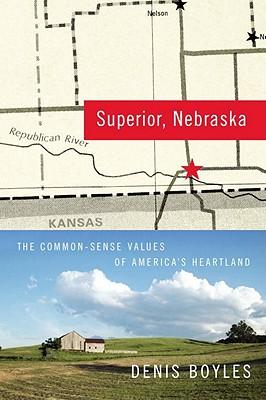
Since the days of Bleeding Kansas, people from someplace else have been telling midwesterners how to live, how to vote, and what to believe. In Superior Nebraska, Denis Boyles explodes the myth that hapless Midwesterners have been duped into voting against their own economic interests in order to support right-wing crusades mounted by wily conservatives.
Every election cycle, the angry people who live on America' s blue coasts smugly ridicule those who live in the mystifying heartland of their own country, an exotic, faraway place many of them have seen only from the window of an aircraft. From up there, those who live in so-called red states appear to be prisoners of desolation and failure, with their twisters and blizzards, their vanishing small towns, and their odd obsession with social values. Easterners look down upon Jesusland and pronounce it not only empty but ignorant.
In this leisurely exploration of civic life along the meandering course of the Republican River, Boyles argues that, in fact, the people living in those big, blue cities have a lot to learn from the Midwest's core values of industriousness, vigor, neighborliness, optimism, moderation, and, above all, self-reliance. Those strengths, Boyles points out, are what made it possible to settle the Great Plains in the first place and have sustained life there since.
Deftly demolishing the elitist portrait of rural Republican voters as religious zealots and misguided simpletons, Boyles shows how the interests of red and blue staters actually coincide. Like their coastal, mostly Democratic, cousins, they too want better schools, less intrusive bureaucracies, lower taxes, some moral common sense, a little respect for tradition and faith, some civility in public debate, and support for their belief that personal responsibility always trumps government programs.
For more than a century, writers and critics have been asking, What' s the matter with Kansas? In this affecting love letter to Kansas, Nebraska, and the entire American Midwest, Denis Boyles responds by holding up the common-sense values of America's heartland as a model for us all.
Full Product Details
Author: Denis Boyles
Publisher: Doubleday Books
Imprint: Doubleday Books
Dimensions:
Width: 16.10cm
, Height: 2.70cm
, Length: 24.20cm
Weight: 0.544kg
ISBN: 9780385516747
ISBN 10: 0385516746
Pages: 278
Publication Date: 12 February 2008
Audience:
General/trade
,
General
Format: Undefined
Publisher's Status: Unknown
Availability: Out of stock

Reviews
From Kirkus Reviews <br>To the question posed by Thomas Frank's bestselling What's the Matter with Kansas? (2004), a journalist responds, much as the Emporia Gazette 's William Allen White did in 1896: Nothing under the shining <br>sun. The Republican River (no, it's not named after the Party) meanders along the Kansas/Nebraska border, and from the small towns along its banks Boyles ( Vile France: Fear, Duplicity, Cowardice and Cheese, 2005, etc.) casually reports for an oftentimes clueless coastal America on the state of political and anthropological affairs. He begins by supplying some geography and history, both personal--the family homestead in Superior, Neb.--and regional-snapshots of pre-Civil War Bleeding Kansas, the flood of 1935, the sheer scale of the Midwest as a determinant, the orphan trains that brought 200,000 city kids to the plains between 1853 and 1930. But the author mostly focuses on putting right a number of misconceptions commonly held by cultural elites who never tire of telling Midwesterners what they ought to be thinking and doing. Aren't all the people out there moss-backed Republicans who, unaccountably it seems, vote against their own proper interests? No, voting patterns are not at all monolithic-indeed, they are quite sophisticated. Aren't all the small towns rapidly depopulating? Yes, though not nearly as quickly as most of the eastern seaboard's major cities. Aren't the newspapers dying? The regional dailies, sure, but the local weeklies, specializing in hometown news, are doing quite well. Isn't Wal-Mart an unalloyed disaster for Main Street? No. Aren't the people religious fanatics? Yes, from the perspective of a reporter for the AP, NPR orthe New York Times, No, if you're a native accustomed to the Midwest tradition of respect for religious belief, where even a proud Democrat can unashamedly attribute the region's mostly civil politics to Christ-taught values of love and forgiveness and a deep confidence in the ideas that make democracy work. Except for some occasional vitriol infecting his discussion of the educational, judicial and political establishment, Boyles is a good-natured guide, shaking his head not so much in anger but rather in bemusement at the academics, commentators and rabid partisans who get so much of the Midwest so wrong. A conversational, amusing, instructive look at a landscape too many Americans merely fly over or--if they think of it at all--misunderstand. <br>From the Superior (Nebraska) Express <br> After being repeatedly told by reporters from both coasts that there is something wrong with those of us who have chosen to live here along the banks of the Republican River, I'm glad to find at least one writer who has found nothing wrong with our choice. Boyles lived, worked and reported from the small towns along the Republican and concluded we are not the dim, hoodwinked constituents some would like to make us out to be.