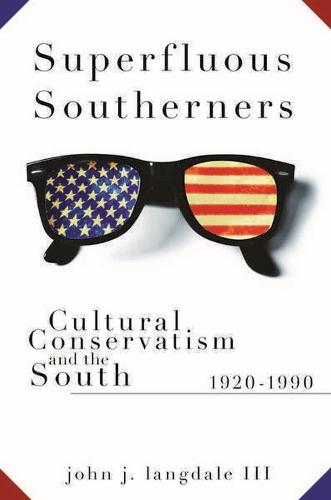
Full Product Details
Author: John Langdale
Publisher: University of Missouri Press
Imprint: University of Missouri Press
Dimensions:
Width: 16.20cm
, Height: 2.20cm
, Length: 23.60cm
Weight: 0.456kg
ISBN: 9780826219855
ISBN 10: 0826219853
Pages: 200
Publication Date: 07 December 2012
Audience:
General/trade
,
General
Format: Hardback
Publisher's Status: Active
Availability: Available To Order

We have confirmation that this item is in stock with the supplier. It will be ordered in for you and dispatched immediately.
Reviews
Although brief, this is an elegantly crafted history of this particular aspect of southern intellectualism during a significant 70-year span. -- M. Daniel, Piedmont, CHOICE John Langdale s Superfluous Southerners significantly contributes to our understanding of not only a particular group of writers and the principles which united them, but also the political, historical and cultural era in which they wrote. Many scholars will find this study useful in their own work on this period and also a great aid toward helping them to understand better the development of conservative ideas in America during the first half of the twentieth-century. W. Wesley McDonald, author of Russell Kirk and the Age of Ideology John J. Langdale III has produced a well-written, thought-provoking monograph that examines the oft-debated relationship between twentieth-century southern cultural conservatives and their mainstream political counterparts. --Thomas A. Underwood, The Journal of American History
""Although brief, this is an elegantly crafted history of this particular aspect of southern intellectualism during a significant 70-year span.""--M. Daniel, Piedmont, CHOICE ""The tradition of intellectual dissent in America has long been associated with the political Left, but in his book Superfluous Southerners: Cultural Conservatism and the South, 1920-1990, John J. Langdale III recovers a powerful tradition of dissent in the twentieth-century Right. He argues that six Southern Agrarian intellectuals--Allen Tate, John Crowe Ransom, Donald Davidson, Cleanth Brooks, Richard M. Weaver, and M. E. Bradford--offered a critique of modernity that opposed American materialism, conformism, industrialism, and, especially, gnosticism--the hubris that humans can remold the world without limits.""--Journal of Southern History ""John J. Langdale III has produced a well-written, thought-provoking monograph that examines the oft-debated relationship between twentieth-century southern cultural conservatives and their mainstream political counterparts.""--Thomas A. Underwood, The Journal of American History ""John Langdale's Superfluous Southernerssignificantly contributes to our understanding of not only a particular group of writers and the principles which united them, but also the political, historical and cultural era in which they wrote. Many scholars will find this study useful in their own work on this period and also a great aid toward helping them to understand better the development of conservative ideas in America during the first half of the twentieth-century.""--W. Wesley McDonald, author of Russell Kirk and the Age of Ideology
John J. Langdale III has produced a well-written, thought-provoking monograph that examines the oft-debated relationship between twentieth-century southern cultural conservatives and their mainstream political counterparts. --Thomas A. Underwood, The Journal of American History John Langdale's Superfluous Southernerssignificantly contributes to our understanding of not only a particular group of writers and the principles which united them, but also the political, historical and cultural era in which they wrote. Many scholars will find this study useful in their own work on this period and also a great aid toward helping them to understand better the development of conservative ideas in America during the first half of the twentieth-century. --W. Wesley McDonald, author of Russell Kirk and the Age of Ideology Although brief, this is an elegantly crafted history of this particular aspect of southern intellectualism during a significant 70-year span. --M. Daniel, Piedmont, CHOICE The tradition of intellectual dissent in America has long been associated with the political Left, but in his book Superfluous Southerners: Cultural Conservatism and the South, 1920-1990, John J. Langdale III recovers a powerful tradition of dissent in the twentieth-century Right. He argues that six Southern Agrarian intellectuals--Allen Tate, John Crowe Ransom, Donald Davidson, Cleanth Brooks, Richard M. Weaver, and M. E. Bradford--offered a critique of modernity that opposed American materialism, conformism, industrialism, and, especially, gnosticism--the hubris that humans can remold the world without limits. --Journal of Southern History The tradition of intellectual dissent in America has long been associated with the political Left, but in his book Superfluous Southerners: Cultural Conservatism and the South, 1920-1990, John J. Langdale III recovers a powerful tradition of dissent in the twentieth-century Right. He argues that six Southern Agrarian intellectuals Allen Tate, John Crowe Ransom, Donald Davidson, Cleanth Brooks, Richard M. Weaver, and M. E. Bradford offered a critique of modernity that opposed American materialism, conformism, industrialism, and, especially, gnosticism the hubris that humans can remold the world without limits. Journal of Southern History Although brief, this is an elegantly crafted history of this particular aspect of southern intellectualism during a significant 70-year span. M. Daniel, Piedmont, CHOICE John Langdale s Superfluous Southernerssignificantly contributes to our understanding of not only a particular group of writers and the principles which united them, but also the political, historical and cultural era in which they wrote. Many scholars will find this study useful in their own work on this period and also a great aid toward helping them to understand better the development of conservative ideas in America during the first half of the twentieth-century. W. Wesley McDonald, author of Russell Kirk and the Age of Ideology John J. Langdale III has produced a well-written, thought-provoking monograph that examines the oft-debated relationship between twentieth-century southern cultural conservatives and their mainstream political counterparts. Thomas A. Underwood, The Journal of American History Although brief, this is an elegantly crafted history of this particular aspect of southern intellectualism during a significant 70-year span. -- M. Daniel, Piedmont, CHOICE John Langdale s Superfluous Southerners significantly contributes to our understanding of not only a particular group of writers and the principles which united them, but also the political, historical and cultural era in which they wrote. Many scholars will find this study useful in their own work on this period and also a great aid toward helping them to understand better the development of conservative ideas in America during the first half of the twentieth-century. W. Wesley McDonald, author of Russell Kirk and the Age of Ideology John J. Langdale III has produced a well-written, thought-provoking monograph that examines the oft-debated relationship between twentieth-century southern cultural conservatives and their mainstream political counterparts. --Thomas A. Underwood, The Journal of American History John Langdale's Superfluous Southerners significantly contributes to our understanding of not only a particular group of writers and the principles which united them, but also the political, historical and cultural era in which they wrote. Many scholars will find this study useful in their own work on this period and also a great aid toward helping them to understand better the development of conservative ideas in America during the first half of the twentieth-century. --W. Wesley McDonald, author of Russell Kirk and the Age of Ideology
<p> Although brief, this is an elegantly crafted history of this particular aspect of southern intellectualism during a significant 70-year span. -- M. Daniel, Piedmont, CHOICE John Langdale's Superfluous Southerners significantly contributes to our understanding of not only a particular group of writers and the principles which united them, but also the political, historical and cultural era in which they wrote. Many scholars will find this study useful in their own work on this period and also a great aid toward helping them to understand better the development of conservative ideas in America during the first half of the twentieth-century. --W. Wesley McDonald, author of Russell Kirk and the Age of Ideology <p>
<p> John Langdale's Superfluous Southerners significantly contributes to our understanding of not only a particular group of writers and the principles which united them, but also the political, historical and cultural era in which they wrote. Many scholars will find this study useful in their own work on this period and also a great aid toward helping them to understand better the development of conservative ideas in America during the first half of the twentieth-century. --W. Wesley McDonald, author of Russell Kirk and the Age of Ideology
Author Information
John J. Langdale III is Assistant Professor of History at Andrew College and lives in Eufaula, Alabama.