Overview
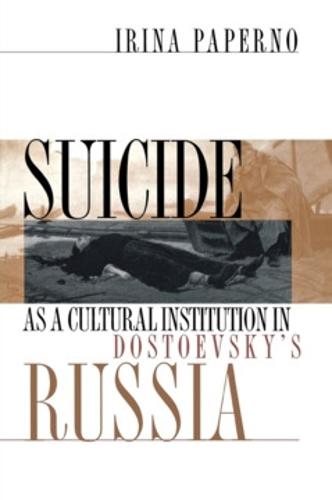
In the popular and scientific imagination, suicide has always been an enigmatic act which defies yet demands explanation. Throughout the centuries, philosophers and writers, journalists and scientists have attempted to endow this act with meaning. In the 19th century, and especially in Russia, suicide became the focus for discussion of such issues as the immortality of the soul, free will and determinism, the physical and the spiritual, the individual and the social. Analyzing a variety of sources - medical reports, social treatises, legal codes, newspaper articles, fiction, private documents left by suicides - Irina Paperno describes the search for the meaning of suicide. Paperno focuses on the Russian of the 1860s to 1880s, when suicide was at the centre of public attention. Because Russian thought was influenced by Western European models, she examines how Western european science in the 19th century discussed suicide and human action in general. Throughout her book, Paperno offers glimpses of the men behind the interpretations, from Fyodor Dostoevsky and the German pathologist Rudolf Virchow, to the anonymous journalists who reported suicides in Russian newspapers and magazines.
Full Product Details
Author: Irina Paperno
Publisher: Cornell University Press
Imprint: Cornell University Press
Dimensions:
Width: 15.20cm
, Height: 2.80cm
, Length: 22.90cm
Weight: 0.907kg
ISBN: 9780801433979
ISBN 10: 0801433975
Pages: 336
Publication Date: 19 February 1998
Audience:
College/higher education
,
Professional and scholarly
,
Undergraduate
,
Postgraduate, Research & Scholarly
Format: Hardback
Publisher's Status: Active
Availability: Manufactured on demand

We will order this item for you from a manufactured on demand supplier.
Reviews
A comprehensive study. (Choice) A pathbreaking book.... Paperno's research is impeccable, and the information amassed is invaluable. (The Russian Review) An exciting book. In it Paperno discusses ideas about the meaning of suicide from classical times to the late nineteenth century, when Russia was said to have experienced 'a epidemic of suicides. - A. S. Byatt (The Threepenny Review) As a contribution to Doestoevskii studies, this book will be of primary importance.... Irina Paperno has written fruitful book. (The Slavonic Review) As Irina Paperno demonstrates in this fascinating look at Russian fiction, newspaper articles, suicide notes, and medical reports, the act of suicide in 19th century Russia became the source of discussions on immortality, religion, free will, and the relationship between the individual and society, among other topics.... Paperno concludes that suicide became a cultural artifact in 19th-century Russian and thus served as a symbol of the age. (Virginia Quarterly Review) This book will make an important contribution to nineteenth-century Russian studies. It is not for literary scholars alone; by examining suicide as a cultural institution, Paperno brings together the history of medicine, law, literature, and philosophy in a meaningful way. (Slavic Review)
This book will make an important contribution to nineteenth-century Russian studies. It is not for literary scholars alone; by examining suicide as a cultural institution, Paperno brings together the history of medicine, law, literature, and philosophy in a meaningful way. --Slavic Review Inspired by the interpretive dilemma of suicide in nineteenth-century Russia, Paperno offers a superb reading of contemporary responses, across genres and philosophical divides. A fascinating view of the symbolic recesses of a culture in transition. --Laura Engelstein, author of The Keys to Happiness: Sex and the Search for Modernity in Fin-de-Si cle Russia As Irina Paperno demonstrates in this fascinating look at Russian fiction, newspaper articles, suicide notes, and medical reports, the act of suicide in 19th century Russia became the source of discussions on immortality, religion, free will, and the relationship between the individual and society, among other topics.... Paperno concludes that suicide became a cultural artifact in 19th-century Russian and thus served as a symbol of the age. --Virginia Quarterly Review As a contribution to Doestoevskii studies, this book will be of primary importance.... Irina Paperno has written fruitful book. --The Slavonic Review An exciting book. In it Paperno discusses ideas about the meaning of suicide from classical times to the late nineteenth century, when Russia was said to have experienced 'a epidemic of suicides. --A. S. Byatt The Threepenny Review A pathbreaking book.... Paperno's research is impeccable, and the information amassed is invaluable. --The Russian Review A comprehensive study. --Choice
Author Information
Irina Paperno is Professor of Slavic Languages and Literatures at the University of California, Berkeley. A graduate of Tartu University in the former Soviet Union, she holds advanced degrees in Slavic languages and literatures and in psychology from Stanford University. She is the author of Chernyshevsky and the Age of Realism: A Study in the Semiotics of Behavior.