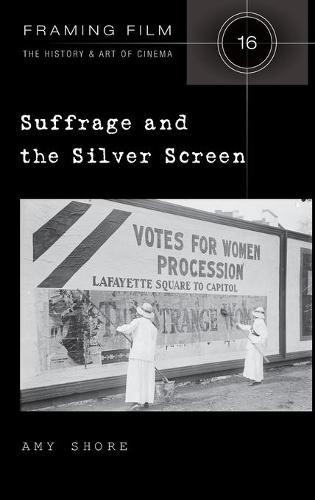
Overview
In the 1910s, the American woman suffrage movement became a modern mass movement by using visual culture to transform consciousness and gain adherents. As part of this transformation, suffrage organizations produced several films and related cinematic projects, including four full-length, nationally distributed feature productions. This activist use was one of the first instances in the United States that a social movement recognized and harnessed the power of cinema to transform consciousness and, in turn, the social order. Suffrage and the Silver Screen discusses how the suffrage movement accomplished this formidable goal through analysis of the local and national uses of cinema by the movement. Amy Shore argues that these works must be considered as part of a political filmmaking tradition among feminists. The book contextualizes the films within the politics and practices of the suffrage organizations that produced them in order to understand and assess the strategic role of these films. By examining these works, the history of both suffrage and cinema is necessarily reconsidered and expanded. Suffrage and the Silver Screen is an essential resource for those studying early cinema, women and cinema, the woman suffrage movement, and the use of visual media in social movements.
Full Product Details
Author: Frank Eugene Beaver ,
Amy Shore
Publisher: Peter Lang Publishing Inc
Imprint: Peter Lang Publishing Inc
Edition: New edition
Volume: 16
Dimensions:
Width: 15.50cm
, Height: 2.30cm
, Length: 23.00cm
Weight: 0.460kg
ISBN: 9781433117817
ISBN 10: 1433117819
Pages: 242
Publication Date: 31 March 2014
Audience:
Professional and scholarly
,
Professional & Vocational
Format: Hardback
Publisher's Status: Active
Availability: Manufactured on demand

We will order this item for you from a manufactured on demand supplier.
Reviews
Amy Shore has uncovered a wealth of new information to document the enormous impact of early motion pictures on the campaign for women's suffrage. In doing so, she challenges conventional histories of the suffrage movement which have tended to view cinema and other visual media as, at best, footnotes to the larger campaign. A phenomenal study, 'Suffrage and the Silver Screen' is essential reading for anyone interested in histories of feminism, activist cinema, and the role of visual culture in modern politics. (Shelley Stamp, Author of 'Movie-Struck Girls: Women and Motion Picture Culture after the Nickelodeon') Die Dissertation von Amy Shore besticht nicht nur durch die gelungene Bundelung verschiedener Diskursebenen (soziale und kulturelle Produktionsbedinungen, Filmasthetik und Filmrezeption), sondern vor allem durch die Erweiterung des Forschungsfeldes der Filmgeschichtsschreibung auf eine bisher lediglich rudimentar entwickelte gender-basierte Filmhistoriografie. Die Studie ist damit sowohl fur Filmwissenschaftler wie fur Historiker und Geschlechterforscher gleichermassen interessant und relevant. (Katarina Saalfeld, rkm, April 2015
Amy Shore has uncovered a wealth of new information to document the enormous impact of early motion pictures on the campaign for women's suffrage. In doing so, she challenges conventional histories of the suffrage movement which have tended to view cinema and other visual media as, at best, footnotes to the larger campaign. A phenomenal study, 'Suffrage and the Silver Screen' is essential reading for anyone interested in histories of feminism, activist cinema, and the role of visual culture in modern politics. (Shelley Stamp, Author of 'Movie-Struck Girls: Women and Motion Picture Culture after the Nickelodeon')
Author Information
Amy Shore is Director and Associate Professor in the Cinema & Screen Studies Program at the State University of New York at Oswego. Shore holds a PhD in cinema studies from New York University and a BA in Spanish literature from the University of Delaware. Her research on media and social movements has been published in Camera Obscura and Afterimage as well as in a 2010 collection of essays that re-examines the relationship between feminism, history, and feminist theory in film.