Overview
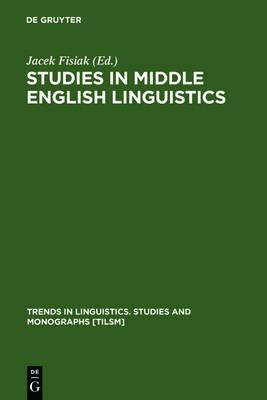
This book, a collection of papers on various aspects of Middle English, is the only work of the kind ever published in the history of English studies. Ranging from phonology to dialectology and more general matters, such as the chronological delimination of the period, the book contains a selection of papers prepared for the First International Conference on Middle English, held at Rydzyna (Poland) in 1994. Besides theoretical and abstract contributions the reader will also find more traditional, data-oriented, treatments. The volume represents a successful attempt to move Middle English studies a step forward and will be appreciated by students of Middle English.
Full Product Details
Author: Jacek Fisiak
Publisher: De Gruyter
Imprint: De Gruyter Mouton
Edition: Reprint 2011
Volume: 103
Dimensions:
Width: 15.50cm
, Height: 3.50cm
, Length: 23.00cm
Weight: 1.068kg
ISBN: 9783110152425
ISBN 10: 3110152428
Pages: 632
Publication Date: 10 June 1997
Recommended Age: College Graduate Student
Audience:
Professional and scholarly
,
Professional and scholarly
,
Professional & Vocational
,
Professional & Vocational
Format: Hardback
Publisher's Status: Active
Availability: Awaiting stock 
The supplier is currently out of stock of this item. It will be ordered for you and placed on backorder. Once it does come back in stock, we will ship it out for you.
Table of Contents
"The development of 'an impersonal' verb in Middle English - the case of behoove, Cynthia L. Allen; Double trouble - geminate versus simplex graph in the Ormulum, John M. Anderson, Derek Britton; Language and style in additions to ""The Canterbury Tales"", Norman F. Blake; The Middle English creolization hypothesis revisited, Andrei Danchev; Infinitive marking in the late Middle English - transitivity and changes in the English system of case, Olga Fisher; From syntax to discourse - the function of object-verb order in late Middle English, Tony Foster, Wim van der Wurff; The words in -ate and the history stress, Piotr Gasiorowski; Assessing the relative status of languages in medieval Ireland, Raymond Hickey; Using the future to predict the past - Old English dialectology in the light of Middle English place-names, Richard M. Hogg; When did Middle English begin? later than you think! Peter R. Kitson; The Old English Anglian/saxon boundary revisited, Gillis Kristensson; Stress, survival and change - Old to Middle English, Christopher B. McCully; Against the emergence of the nuclear stress rule in Middle English, Donka Minkova, Robert P. Stockwell; -ing constructions in Middle English, Lilo Moessner; Concessive clauses in Chaucer's prose, Rafat Molencki; Middle English nonrestrictive expository apposition with an explicit marker, Saara Nevanlinna, Paivi Pahta; On the beginning and development of the begin to construction, Michiko Ogura; The Peterborough Chronicle diphthongs, Betty S. Philipps; Middle English phonetics - a systematic survey including notes on Irish and Welsh loanwords, Herbert Pilch; Quasi-impersonal verbs in Old and Middle English, George G. Pocheptsov; Like father (un)like son - a sociolinguistic approach to the language of the Cely family, Helena Raumolin-Brunberg, Terttu Navalinen; Whatever happened to the Middle English indefinitive pronoun?, Matti Rissanen; Mutation, variation and selection in phonological evolution - a sketch based on the case of late Middle English a>au/_l)C/#), Nicolaus Ritt; Handmade tales - the implications of linguistic variation in two early manuscripts of Chaucer's ""Canterbury Tales"", Jeremy Smith; Middle ( and Old) English prerequisites for the great vowel shift, Albertas Steponavicius; Exclamations in late Middle English, Irma Taavitsainen."
Reviews
Author Information
Tab Content 6
Author Website:
Countries Available
All regions
|