Overview
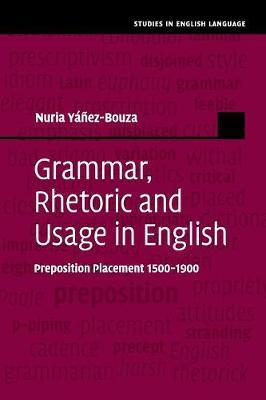
The preposition is of particular interest to syntacticians, historians and sociolinguists of English, as its placement within a sentence is influenced by syntactic and sociolinguistic constraints, and by how the 'rules' regarding prepositions have changed over time, as a result of language change, of change in attitudes towards language, and of processes such as standardization. This book investigates preposition placement in the early and late Modern English periods (1500–1900), with a special focus on preposition stranding (The house which I live in) in opposition to pied piping (The house in which I live). Based on a large-scale analysis of precept and usage data, this study reassesses the alleged influence of late eighteenth-century normative works on language usage. It also sheds new light on the origins of the stigmatisation of preposition stranding. This study will be of interest to scholars working on syntax and grammar, corpus linguistics, historical linguistics and sociolinguistics.
Full Product Details
Author: Nuria Yáñez-Bouza (University of Manchester)
Publisher: Cambridge University Press
Imprint: Cambridge University Press
Dimensions:
Width: 15.00cm
, Height: 2.00cm
, Length: 23.00cm
Weight: 0.550kg
ISBN: 9781108713177
ISBN 10: 1108713173
Pages: 392
Publication Date: 21 March 2019
Audience:
Professional and scholarly
,
Professional & Vocational
Format: Paperback
Publisher's Status: Active
Availability: Manufactured on demand

We will order this item for you from a manufactured on demand supplier.
Reviews
'Nuria Yanez-Bouza offers a theoretically and empirically rich exploration of the relationship between linguistic practice and precept in the usage of that notorious grammatical shibboleth, preposition stranding, in late modern English. The result is a comprehensive account of eighteenth century attitudes and linguistic habits in the period.' Susan Fitzmaurice, University of Sheffield 'Comprehensively researched and rigorously analyzed, this brilliantly definitive work mines linguistic, grammatical, rhetorical and literary sources to reveal the complex, interconnected histories of preposition stranding and the developing prescriptive tradition.' Carol Percy, University of Toronto 'All in all, Yanez-Bouza's Grammar, Rhetoric and Usage in English fits in nicely with other research in the field and adds an important piece to the socio-historical study of effects of prescriptivism on actual language use. It is a well-structured study which benefits greatly from a combination of qualitative and quantitative approaches. This book is suitable for researchers as well as students with a background in syntax.' Carmen Ebner, The Linguist List (linguistlist.org) 'Nuria Yanez-Bouza offers a theoretically and empirically rich exploration of the relationship between linguistic practice and precept in the usage of that notorious grammatical shibboleth, preposition stranding, in late modern English. The result is a comprehensive account of eighteenth century attitudes and linguistic habits in the period.' Susan Fitzmaurice, University of Sheffield 'Comprehensively researched and rigorously analyzed, this brilliantly definitive work mines linguistic, grammatical, rhetorical and literary sources to reveal the complex, interconnected histories of preposition stranding and the developing prescriptive tradition.' Carol Percy, University of Toronto 'All in all, Yanez-Bouza's Grammar, Rhetoric and Usage in English fits in nicely with other research in the field and adds an important piece to the socio-historical study of effects of prescriptivism on actual language use. It is a well-structured study which benefits greatly from a combination of qualitative and quantitative approaches. This book is suitable for researchers as well as students with a background in syntax.' Carmen Ebner, The Linguist List (linguistlist.org)
Author Information
Nuria Yáñez-Bouza is a lecturer in English Language at the University of Manchester, and currently holds a Senior Research Fellowship at Universidade de Vigo, Spain.