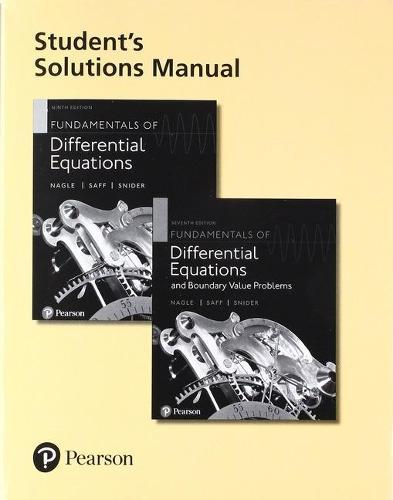
Student Solutions Manual for Fundamentals of Differential Equations and Fundamentals of Differential Equations and Boundary Value Problems

Author:   R. Nagle ,  Edward Saff ,  Arthur Snider
Publisher:   Pearson Education (US)
Edition:   7th edition
ISBN:  

9780321977212


Pages:   880
Publication Date:   08 May 2018
Format:   Paperback
Availability:   Available To Order   Availability explained
We have confirmation that this item is in stock with the supplier. It will be ordered in for you and dispatched immediately.

Our Price $246.36 Quantity:  
Add to Cart

Share |

Student Solutions Manual for Fundamentals of Differential Equations and Fundamentals of Differential Equations and Boundary Value Problems


Overview

For one-semeseter sophomore- or junior-level courses in Differential Equations. Fundamentals of Differential Equations presents the basic theory of differential equations and offers a variety of modern applications in science and engineering. Also available in the version Fundamentals of Differential Equations with Boundary Value Problems, these flexible texts offer the instructor many choices in syllabus design, course emphasis (theory, methodology, applications, and numerical methods), and in using commercially available computer software.

Full Product Details

Author:   R. Nagle ,  Edward Saff ,  Arthur Snider
Publisher:   Pearson Education (US)
Imprint:   Pearson
Edition:   7th edition
Dimensions:   Width: 10.00cm , Height: 10.00cm , Length: 10.00cm
Weight:   0.100kg
ISBN:  

9780321977212


ISBN 10:   0321977211
Pages:   880
Publication Date:   08 May 2018
Audience:   College/higher education ,  Tertiary & Higher Education
Format:   Paperback
Publisher's Status:   Active
Availability:   Available To Order   Availability explained
We have confirmation that this item is in stock with the supplier. It will be ordered in for you and dispatched immediately.

Table of Contents

1. Introduction 1.1 Background 1.2 Solutions and Initial Value Problems 1.3 Direction Fields 1.4 The Approximation Method of Euler 2. First-Order Differential Equations 2.1 Introduction: Motion of a Falling Body 2.2 Separable Equations 2.3 Linear Equations 2.4 Exact Equations 2.5 Special Integrating Factors 2.6 Substitutions and Transformations 3. Mathematical Models and Numerical Methods Involving First Order Equations 3.1 Mathematical Modeling 3.2 Compartmental Analysis 3.3 Heating and Cooling of Buildings 3.4 Newtonian Mechanics 3.5 Electrical Circuits 3.6 Improved Euler's Method 3.7 Higher-Order Numerical Methods: Taylor and Runge-Kutta 4. Linear Second-Order Equations 4.1 Introduction: The Mass-Spring Oscillator 4.2 Homogeneous Linear Equations: The General Solution 4.3 Auxiliary Equations with Complex Roots 4.4 Nonhomogeneous Equations: The Method of Undetermined Coefficients 4.5 The Superposition Principle and Undetermined Coefficients Revisited 4.6 Variation of Parameters 4.7 Variable-Coefficient Equations 4.8 Qualitative Considerations for Variable-Coefficient and Nonlinear Equations 4.9 A Closer Look at Free Mechanical Vibrations 4.10 A Closer Look at Forced Mechanical Vibrations 5. Introduction to Systems and Phase Plane Analysis 5.1 Interconnected Fluid Tanks 5.2 Elimination Method for Systems with Constant Coefficients 5.3 Solving Systems and Higher-Order Equations Numerically 5.4 Introduction to the Phase Plane 5.5 Applications to Biomathematics: Epidemic and Tumor Growth Models 5.6 Coupled Mass-Spring Systems 5.7 Electrical Systems 5.8 Dynamical Systems, Poincaré Maps, and Chaos 6. Theory of Higher-Order Linear Differential Equations 6.1 Basic Theory of Linear Differential Equations 6.2 Homogeneous Linear Equations with Constant Coefficients 6.3 Undetermined Coefficients and the Annihilator Method 6.4 Method of Variation of Parameters 7. Laplace Transforms 7.1 Introduction: A Mixing Problem 7.2 Definition of the Laplace Transform 7.3 Properties of the Laplace Transform 7.4 Inverse Laplace Transform 7.5 Solving Initial Value Problems 7.6 Transforms of Discontinuous Functions 7.7 Transforms of Periodic and Power Functions 7.8 Convolution 7.9 Impulses and the Dirac Delta Function 7.10 Solving Linear Systems with Laplace Transforms 8. Series Solutions of Differential Equations 8.1 Introduction: The Taylor Polynomial Approximation 8.2 Power Series and Analytic Functions 8.3 Power Series Solutions to Linear Differential Equations 8.4 Equations with Analytic Coefficients 8.5 Cauchy-Euler (Equidimensional) Equations 8.6 Method of Frobenius 8.7 Finding a Second Linearly Independent Solution 8.8 Special Functions 9. Matrix Methods for Linear Systems 9.1 Introduction 9.2 Review 1: Linear Algebraic Equations 9.3 Review 2: Matrices and Vectors 9.4 Linear Systems in Normal Form 9.5 Homogeneous Linear Systems with Constant Coefficients 9.6 Complex Eigenvalues 9.7 Nonhomogeneous Linear Systems 9.8 The Matrix Exponential Function 10. Partial Differential Equations 10.1 Introduction: A Model for Heat Flow 10.2 Method of Separation of Variables 10.3 Fourier Series 10.4 Fourier Cosine and Sine Series 10.5 The Heat Equation 10.6 The Wave Equation 10.7 Laplace's Equation Appendices Newton’s Method Simpson’s Rule Cramer’s Rule Method of Least Squares Runge-Kutta Procedure for n Equations

Reviews

Author Information

R. Kent Nagle (deceased) taught at the University of South Florida. He was a research mathematician and an accomplished author. His legacy is honored in part by the Nagle Lecture Series which promotes mathematics education and the impact of mathematics on society. He was a member of the American Mathematical Society for 21 years. Throughout his life, he imparted his love for mathematics to everyone, from students to colleagues.   Edward B. Saff received his B.S. in applied mathematics from Georgia Institute of Technology and his Ph.D. in Mathematics from the University of Maryland. After his tenure as Distinguished Research Professor at the University of South Florida, he joined the Vanderbilt University Mathematics Department faculty in 2001 as Professor and Director of the Center for Constructive Approximation. His research areas include approximation theory, numerical analysis, and potential theory. He has published more than 240 mathematical research articles, co-authored 9 books, and co-edited 11 volumes. Other recognitions of his research include his election as a Foreign Member of the Bulgarian Academy of Sciences (2013); and as a Fellow of the American Mathematical Society (2013). He is particularly active on the international scene, serving as an advisor and NATO collaborator to a French research team at INRIA Sophia-Antipolis; a co-director of an Australian Research Council Discovery Award; an annual visiting research collaborator at the University of Cyprus in Nicosia; and as an organizer of a sequence of international research conferences that helps foster the careers of mathematicians from developing countries.   Arthur David Snider has 50+ years of experience in modeling physical systems in the areas of heat transfer, electromagnetics, microwave circuits, and orbital mechanics, as well as the mathematical areas of numerical analysis, signal processing, differential equations, and optimization. He holds degrees in mathematics (BS, MIT; PhD, NYU) and physics (MA, Boston U), and is a registered professional engineer. He served 45 years on the faculties of mathematics, physics, and electrical engineering at the University of South Florida. He worked 5 years as a systems analyst at MIT's Draper Instrumentation Lab, and has consulted for General Electric, Honeywell, Raytheon, Texas, Instruments, Kollsman, E-Systems, Harris, and Intersil. He has authored nine textbooks and roughly 100 journal articles. Hobbies include bluegrass fiddle, acting, and handball.

Tab Content 6

Author Website:  

Countries Available

All regions
Latest Reading Guide

NOV RG 20252


Shopping Cart
Your cart is empty
Shopping cart
Mailing List