Overview
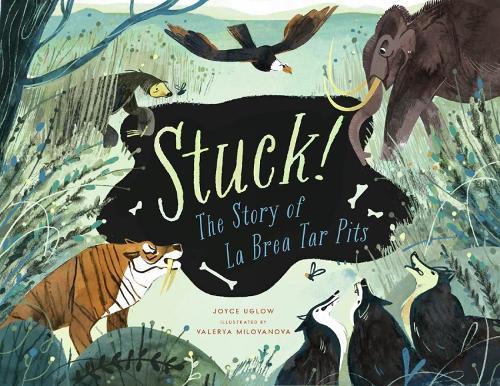
A one-of-a-kind STEM gem! Join fellow science lovers in this creative non-fiction, poetical exploration surrounding the history, and little known origins, of the ice age and the La Brea Tar Pits--including what scientists are learning about climate change. For tens of thousands of years, animals and plants fell into the natural trap of what we now call the La Brea Tar Pits in Los Angeles. Millions of fossils, from hundreds of species, have been collected in this one unique site. Follow author Joyce Uglow's lyrical lines and Valerya Milovanova's evocative illustrations, guiding readers into an entire ecosystem of plants and animals--stuck! Thousands of years ago... Surrounded by sagebrush, Mugwort, and water fleas, Sloth searched: Browsing, Munching on grass and twigs, Seeking water. But stepped into sticky stuff instead. Sloth struggled. Slowed. Stopped. Stuck! Sidebars include details such as how changes in the shape of the dire wolf's skull and snout are tied to climate changes and that there are no dinosaurs among the fossils because they died out 63 million years ago. An author's note at the end provides additional historical and scientific details.
Full Product Details
Author: Joyce Uglow ,
Valerya Milovanova
Publisher: Bushel & Peck Books
Imprint: Bushel & Peck Books
ISBN: 9781638191889
ISBN 10: 1638191883
Pages: 40
Publication Date: 04 March 2025
Recommended Age: From 7 to 10 years
Audience:
Children/juvenile
,
Children / Juvenile
Format: Hardback
Publisher's Status: Active
Availability: Available To Order

We have confirmation that this item is in stock with the supplier. It will be ordered in for you and dispatched immediately.
Reviews
Like a sort of prehistoric rubbish bin filled to the brim, the sticky La Brea Tar Pits have been ""collecting"" victims and natural detritus since the Pleistocene epoch. Here Uglow invites readers to marvel at the amazing bulk and diversity of the well-preserved lode--over 3.5 million specimens, from microfossils to megafauna, have been extracted to date--and think about what researchers can learn from, as she puts it, an ""entire ecosystem jumbled together,"" including ""unlucky predators and prey in stacks."" Along with cross-sectional views of thick subsurface tangles of bones, bugs, and plant material, Milovanova depicts both reconstructed ancient scenes of a giant ground sloth, dire wolves, and other dismayed, now-extinct creatures stuck in black tar and of modern workers systematically excavating and reconstructing skeletons. The author closes with more on how the tar pits were formed and have been explored, accompanied by an eye-widening list of plant and animal species that have been found in them. ""The Tar Pits time capsule tells millions of stories,"" she writes, and cannot fail to ""fill our hearts with wonder."" Thousands of years ago, animals that no longer roam our planet, like a Harlan's Ground Sloth, a saber-toothed Smilodon, and a pack of Dire wolves, approach what looks like a pond of water, only to find themselves trapped in the gooey syrup of the La Brea Tar Pits. The pits soften in the sun, trapping more and more creatures, and as time passes, they are covered with sediment, causing the remains of a myriad of creatures and plants to mix together in the goo. Discovered by oil field workers eons later outside of modern-day Los Angeles and then excavated, the remains found in the Tar Pits have helped scientists learn more about the Pleistocene Epoch--and may tell us not just about the past, but also the future, especially when it's revealed that the Pits are still active and evolving. Playful language and masterful illustrations make for a compelling read instead of a dry scientific tale, and while the list of animals that get stuck is long, the story never feels tedious. Milovanova's illustrations, which suggest cut paper and oil pastel, are rendered in rich earthy tones befitting a tar pit, with animals that leap at angles across and almost off the page until they get ""Stuck! Trapped! Sunk!"" in that sticky, powerful ooze. This stirring story and its dynamic illustrations may manage to enthrall even the least nature-focused kiddo, but any budding scientist will be thrilled to discover the informative and accessible backmatter, where more information includes a timeline, glossary, and list of trapped animals, potentially sparking a desire to learn even more about this viscous part of our planet.
Author Information
Joyce Uglow has been asking questions and collecting words since an early age. Retired, she now writes picture books and poetry for children who are also intrigued by words and our wondrous world, books that educators, librarians, and kids tell each other about. She currently serves as SCBWI Wisconsin's Assistant Regional Advisor and is on the Board of the Wisconsin Center for the Book. She digs in on topics from whales, rocks, bees, trees, and families to ancient cave art and fossils trapped in asphalt seeps and everything in between, and is unwaveringly committed to sparking kids' interests.