Overview
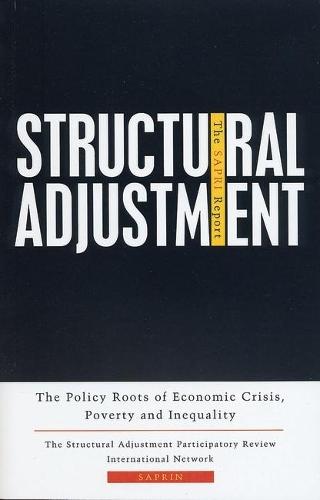
Structural adjustment programmes are the largest single cause of increased poverty, inequality and hunger in developing countries. This book is the most comprehensive, real-life assessment to date of the impacts of the liberalisation, deregulation, privatisation and austerity that constitute structural adjustment. It is the result of a unique five year collaboration among citizens‘ groups, developing country governments, and the World Bank itself. Its authors, the members of the Structural Adjustment Participatory Review International Network (SAPRIN), reveal the practical consequences for manufacturing, small enterprise, wages and conditions, social services, health, education, food security, poverty and inequality. The stark conclusion emerges: if there is to be any hope for meaningful development, structural adjustment and neoliberal economics must be jettisoned.
Full Product Details
Author: Bloomsbury Publishing
Publisher: Bloomsbury Publishing PLC
Imprint: Zed Books Ltd
Dimensions:
Width: 14.50cm
, Height: 1.60cm
, Length: 20.50cm
Weight: 0.354kg
ISBN: 9781842773895
ISBN 10: 1842773895
Pages: 256
Publication Date: 01 February 2004
Audience:
College/higher education
,
Professional and scholarly
,
Tertiary & Higher Education
,
Professional & Vocational
Format: Paperback
Publisher's Status: Active
Availability: Manufactured on demand 
We will order this item for you from a manufactured on demand supplier.
Table of Contents
1. SAPRI/CASA Experience 2. Trade Liberalization Policies and Their Impact on the Manufacturing Sector - Bangladesh, Ecuador, Ghana, Hungary, Mexico, the Philippines and Zimbabwe 3. Financial Sector Liberalization, Effects on Production and the Small Enterprise Sector - Bangladesh, Ecuador, El Salvador and Zimbabwe 4. Employment under Adjustment and the Effects of Labor Market Reform on Working People - Ecuador, El Salvador, Mexico and Zimbabwe 5. The Economic and Social Impact of Privatization Programs - Bangladesh, El Salvador, Hungary and Uganda 6. The Impact of Agricultural Sector Adjustment Policies on Small Farmers and Food Security - Bangladesh, Mexico, the Philippines, Uganda and Zimbabwe 7. The Socioeconomic and Environmental Impact of Mining Sector Reform - Ghana and the Philippines 8. The Effects of Public Expenditure Policies on Education and Health Care under Structural Adjustment - Ecuador, Ghana, Hungary, Mexico, the Philippines, Uganda and Zimbabwe 9. Structural Adjustment, Poverty and Inequality
Reviews
Structural adjustment has been the most controversial economic and social policy model foisted onto a reluctant Third World in the past two to three decades. SAPRIN has been a pioneering network tracking, critiquing and acting on its damaging effects. This vitally important book cogently summarizes the various effects of structural adjustment and should be read by all who care about the developing world.' Martin Khor, Third World Network 'Structural Adjustment: The SAPRI Report illustrates the devastating impact that structural adjustment policies, undemocratically imposed by the international financial institutions, have had on national productive capacity, employment, wages and the growing number of people in poverty. It captures what we in Mexico and Latin America have fought against for the past two decades and is all the more pertinent given the intensifying challenges to neoliberalism in the region.' Cuauhtemoc Cardenas, former Senator, Governor and Mexican presidential candidate 'An excellent expose of how people's human rights are being sacrificed on the altar of the free market in the name of development.' Fantu Cheru, former UN Special Rapporteur on Structural Adjustment 'This book documents a unique exercise in broad-based civil society participation, collaboration and engagement with official institutions. It represents a strong challenge to governments and the World Bank to open up economic policymaking to reflect local knowledge and realities.' Lidy Nacpil, Jubilee South and Secretary General, Freedom from Debt Coalition (Philippines) 'We urgently need to change the way the aid business is conducted, including structural adjustment. This global report contains findings that warrant close examination by the international financial institutions, development agencies, and national governments.' Jan Vandemoortele, Bureau for Development Policy, UNDP '...is an excellent and important book, one that helps to illuminate and further problematize a critical concept in contemporary international development. The book should be of keen interest to economists, development practitioners and theorists, and social movement activists alike. The introductory chapter is particularly fascinating and insightful.' Pablo S. Bose, York University, Toronto 'Exposes a human reality among the poor in developing countries, which may belittle or even falsify official statistics...it is high time that the report is finally available as a book.' Modern African Studies
Structural adjustment has been the most controversial economic and social policy model foisted onto a reluctant Third World in the past two to three decades. SAPRIN has been a pioneering network tracking, critiquing and acting on its damaging effects. This vitally important book cogently summarizes the various effects of structural adjustment and should be read by all who care about the developing world.' - Martin Khor, Third World Network 'Structural Adjustment: The SAPRI Report illustrates the devastating impact that structural adjustment policies, undemocratically imposed by the international financial institutions, have had on national productive capacity, employment, wages and the growing number of people in poverty. It captures what we in Mexico and Latin America have fought against for the past two decades and is all the more pertinent given the intensifying challenges to neoliberalism in the region.' - Cuauhtemoc Cardenas, former Senator, Governor and Mexican presidential candidate 'An excellent expose of how people's human rights are being sacrificed on the altar of the free market in the name of development.' - Professor Fantu Cheru, former UN Special Rapporteur on Structural Adjustment 'This book documents a unique exercise in broad-based civil society participation, collaboration and engagement with official institutions. It represents a strong challenge to governments and the World Bank to open up economic policymaking to reflect local knowledge and realities.' - Lidy Nacpil, International Coordinator, Jubilee South and Secretary General, Freedom from Debt Coalition (Philippines) 'We urgently need to change the way the aid business is conducted, including structural adjustment. This global report contains findings that warrant close examination by the international financial institutions, development agencies, and national governments.' - Jan Vandemoortele, Bureau for Development Policy, UNDP '...is an excellent and important book, one that helps to illuminate and further problematize a critical concept in contemporary international development. The book should be of keen interest to economists, development practitioners and theorists, and social movement activists alike. The introductory chapter is particularly fascinating and insightful.' - Pablo S. Bose, Centre for Refugee Studies, York University, Toronto 'Exposes a human reality among the poor in developing countries, which may belittle or even falsify official statistics...it is high time that the report is finally available as a book.' - Modern African Studies
'Structural adjustment has been the most controversial economic and social policy model foisted onto a reluctant Third World in the past two to three decades. SAPRIN has been a pioneering network tracking, critiquing and acting on its damaging effects. This vitally important book cogently summarizes the various effects of structural adjustment and should be read by all who care about the developing world.' - Martin Khor, Third World Network 'Structural Adjustment: The SAPRI Report illustrates the devastating impact that structural adjustment policies, undemocratically imposed by the international financial institutions, have had on national productive capacity, employment, wages and the growing number of people in poverty. It captures what we in Mexico and Latin America have fought against for the past two decades and is all the more pertinent given the intensifying challenges to neoliberalism in the region.' - Cuauhtemoc Cardenas, former Senator, Governor and Mexican presidential candidate 'An excellent expose of how people's human rights are being sacrificed on the altar of the free market in the name of development.' - Professor Fantu Cheru, former UN Special Rapporteur on Structural Adjustment 'This book documents a unique exercise in broad-based civil society participation, collaboration and engagement with official institutions. It represents a strong challenge to governments and the World Bank to open up economic policymaking to reflect local knowledge and realities.' - Lidy Nacpil, International Coordinator, Jubilee South and Secretary General, Freedom from Debt Coalition (Philippines) 'We urgently need to change the way the aid business is conducted, including structural adjustment. This global report contains findings that warrant close examination by the international financial institutions, development agencies, and national governments.' - Jan Vandemoortele, Bureau for Development Policy, UNDP
Author Information
SAPRIN is a global network established to expand and legitimize the role of civil society in economic policymaking and to strengthen the organized challenge to structural adjustment programs by citizens around the globe. It is composed of broad-based civil society networks in Argentina, Bangladesh, Ecuador, El Salvador, Ghana, Hungary, Mexico, the Philippines, Uganda and Zimbabwe, which along with non-governmental organizations based in Europe, Canada and the United States comprise SAPRIN's Steering Committee. The network has brought together trade unions, small business and farmers' associations, environmental and indigenous peoples' organizations, women's and community groups, religious and human rights organizations, development and research institutes, NGOs, and associations of youth, pensioners and the disabled. SAPRIN's diverse program has included extensive citizen mobilization, local workshops and national public fora, participatory field research, economic literacy training, and the development and promotion of alternative economic policy proposals at the country level on four continents. At the global level, SAPRIN's advocacy work vis-a-vis the World Bank, United Nations agencies and national governments has focused on the elimination of adjustment conditionality and on the democratization of the economic policymaking process and on opening it to new policy options. The SAPRIN Secretariat is based at The Development GAP in Washington, D.C.
Tab Content 6
Author Website:
Countries Available
All regions
|