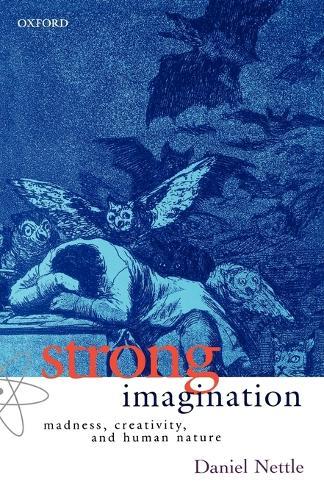
Full Product Details
Author: Daniel Nettle
Publisher: Oxford University Press
Imprint: Oxford University Press
Dimensions:
Width: 13.00cm
, Height: 1.40cm
, Length: 19.60cm
Weight: 0.265kg
ISBN: 9780198605003
ISBN 10: 0198605005
Pages: 244
Publication Date: 07 March 2002
Audience:
College/higher education
,
Professional and scholarly
,
Undergraduate
,
Professional & Vocational
Format: Paperback
Publisher's Status: Active
Availability: To order

Stock availability from the supplier is unknown. We will order it for you and ship this item to you once it is received by us.
Reviews
Review from previous edition [a] fascinating, pithy little book The Sunday Times, Books, March 2001 His thesis is both subtle and concise Sunday Times 19/05/2002 Nettle gives a clear and convincing summary of the argument that traits associated with mental illness have evolutionary advantages as awell as drawbacks ...This is an excellent summary of the state of research into mental disorders and human nature The Observer 24/03/02 Nettle writes well. He enlivens the scientific data with fascinating clinical vignettes, anthropological observations and well-chosen quotations from Shakespeare...a readable and up-to-date review of a very large body of literature on a fascinating subject. Nature, Vol 409, Jan 2001
Nettle writes well. He enlivens the scientific data with fascinating clinical vignettes, anthropological observations and well-chosen quotations from Shakespeare...a readable and up-to-date review of a very large body of literature on a fascinating subject. * Nature, Vol 409, Jan 2001 * Nettle gives a clear and convincing summary of the argument that traits associated with mental illness have evolutionary advantages as awell as drawbacks . . .This is an excellent summary of the state of research into mental disorders and human nature * The Observer 24/03/02 * His thesis is both subtle and concise * Sunday Times 19/05/2002 * Review from previous edition [a] fascinating, pithy little book * The Sunday Times, Books, March 2001 *
This fascinating, lucid book is surprisingly short, in view of the breadth and depth of information covered. --BMJ<br> David Nettle has ... written a stimulating book which ... make[s] the very important point that a dimensional, rather than categorical, perspective is likely to be much more rewarding for psychiatry. --The London Times<br>
`Review from previous edition [a] fascinating, pithy little book' The Sunday Times, Books, March 2001 `His thesis is both subtle and concise' Sunday Times 19/05/2002 `Nettle gives a clear and convincing summary of the argument that traits associated with mental illness have evolutionary advantages as awell as drawbacks . . .This is an excellent summary of the state of research into mental disorders and human nature' The Observer 24/03/02 `Nettle writes well. He enlivens the scientific data with fascinating clinical vignettes, anthropological observations and well-chosen quotations from Shakespeare...a readable and up-to-date review of a very large body of literature on a fascinating subject.' Nature, Vol 409, Jan 2001
Author Information
Daniel Nettle studied psychology at the University of Oxford and then moved to University College London to carry out his PhD research in anthropology. He has written widely across several areas in the human sciences and has lectured in London, Oxford, Cambridge, and Nigeria. He lives in Oxford.