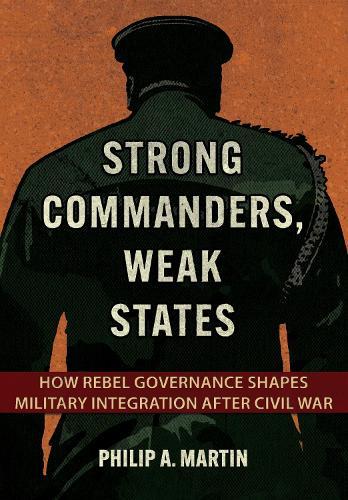
Strong Commanders, Weak States: How Rebel Governance Shapes Military Integration After Civil War

Author:   Philip A. Martin
Publisher:   Cornell University Press
ISBN:  

9781501779015


Pages:   270
Publication Date:   15 January 2025
Format:   Hardback
Availability:   Out of stock   Availability explained
The supplier is temporarily out of stock of this item. It will be ordered for you on backorder and shipped when it becomes available.

Our Price $104.00 Quantity:  
Add to Cart

Share |

Strong Commanders, Weak States: How Rebel Governance Shapes Military Integration After Civil War


Overview

In Strong Commanders, Weak States, Philip A. Martin investigates a fundamental political challenge faced by post-conflict states: how to create obedient national militaries from the remnants of insurgent forces. When civil wars end, non-state armed groups often integrate into post-conflict militaries. Yet rebel-military integration does not always happen smoothly. In some cases, former rebels cooperate with new leaders, forming powerful national armies that underpin postwar stability. In others, they resist the authority of new leaders, maintaining clandestine armed networks that disrupt centralized state-building. Martin argues that how field commanders of non-state armed groups governed during the war explains this variation. Rebel commanders who build accountable governance systems gain strong social support from rebel-ruled communities, becoming locally embedded. Thanks to these community ties, which persist after the war, these embedded commanders have the leverage to push the central government for concessions, resist directives to disarm fighters, or even orchestrate coup d'états. Conversely, rebel commanders who governed coercively are less likely to sustain community ties. Without the ability to mobilize collective action after the war, these non-embedded commanders have stronger incentives to cooperate with new regime leaders. Wielding in-depth evidence from Côte d'Ivoire and cases of rebel-military integration elsewhere, Martin shows that good governance during wartime can—ironically—lead to poor postwar state consolidation. Rather than preparing insurgents to be successful state builders, effective rebel governance can hinder post-conflict state-building. As costly peace operations come under increasing scrutiny, Strong Commanders, Weak States offers fresh guidance on how transitions to peace can better succeed.

Full Product Details

Author:   Philip A. Martin
Publisher:   Cornell University Press
Imprint:   Cornell University Press
Weight:   0.907kg
ISBN:  

9781501779015


ISBN 10:   150177901
Pages:   270
Publication Date:   15 January 2025
Audience:   College/higher education ,  Postgraduate, Research & Scholarly
Format:   Hardback
Publisher's Status:   Active
Availability:   Out of stock   Availability explained
The supplier is temporarily out of stock of this item. It will be ordered for you on backorder and shipped when it becomes available.

Table of Contents

Introduction: Rebels, Commanders, and Military Integration after War 1. A Theory of Commander Embeddedness 2. Rebel Rule in the Ivorian Civil War (2002–2011) 3. Commander Embeddedness in Postwar Côte d'Ivoire (2011–2017) 4. Ex-Rebel Commanders and the Ivorian State 5. Tracing Commander Embeddedness in Four Case Studies 6. Commander Resistance after Rebel-Military Integration (1946–2019) Conclusion: Field Commanders, War, and the State

Reviews

Author Information

Philip A. Martin is Assistant Professor at the Schar School of Policy and Government at George Mason University, where he is also the Assistant Director of the Center for Security Policy Studies.

Tab Content 6

Author Website:  

Countries Available

All regions
Latest Reading Guide

April RG 26_2


Shopping Cart
Your cart is empty
Shopping cart
Mailing List