Overview
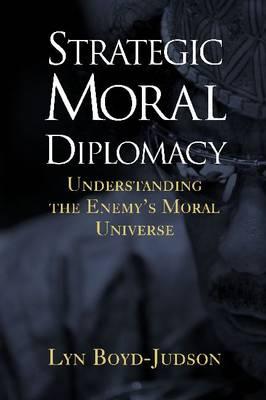
Strategic Moral Diplomacy addresses the most critical political problem of our time: how to negotiate seemingly incompatible moral values between nations. Normative and rational choice theories tend to simplify the actions and motives of leaders at the best, and paint enemies as immoral or evil at the worst. Boyd-Judson argues that it can be both strategically useful, as well as ethical, to assume an enemy has just moral concerns and give these claims credence.
Full Product Details
Author: Lyn Boyd-Judson
Publisher: Kumarian Press
Imprint: Kumarian Press
Dimensions:
Width: 15.20cm
, Height: 1.80cm
, Length: 22.90cm
Weight: 0.295kg
ISBN: 9781565492905
ISBN 10: 1565492900
Pages: 240
Publication Date: 30 May 2011
Audience:
General/trade
,
General
Format: Paperback
Publisher's Status: Active
Availability: In Print

This item will be ordered in for you from one of our suppliers. Upon receipt, we will promptly dispatch it out to you. For in store availability, please contact us.
Reviews
A timely and welcome reminder to politicians, pundits, and the public: peace processes involve more than resolving conflicting interests and require the presence of justice. As Boyd-Judson suggests in four compelling case studies, just solutions to complex and dangerous conflicts are possible when antagonists are able to comprehend not only each other's vital interests but also the particular moral values behind those interests. After defining strategic moral diplomacy as involving the acknowledgment of an enemy's moral universe as valid per philosopher Barbara Hermann's rules of moral salience, Boyd-Judson (U. of Southern California Institute for Humanities and Ethics) presents case studies addressing key questions regarding moral justification of positions in international conflicts. Based on interviews with negotiators and other participants, case studies discussed include the exile of the Shah of Iran (1979), negotiations with Libya's Qaddafi over the plane downing in Lockerbie (1997), and appropriations of land in Zimbabwe (1980-2000). Boyd-Judson's message is a well-researched, deeply personal plea ( the personal pronoun litters the book) for an ideal international diplomatic arena, surely to be a long time in coming. Voltaire's sentiment, 'I may disagree with what you have to say, but I shall defend to the death your right to say it, ' may apply here for iconclastic readers. Summing Up: Recommended. Lyn Boyd-Judson has addressed a major issue of our times -- Inclusive vs. Exclusive Diplomacy. She debates the benefits of allowing an adversary his own 'moral universe, ' and concludes that utilizing inclusive diplomacy creates greater space for negotiations and softens adversarial 'positions.' Dr. Boyd-Judson s vast policy experience coupled with her impeccable training in Political Science has produced a volume that is both highly readable, pertinent, and academically sound. Scholars and practitioners alike will find tremendous food for thought in Dr. Boyd-Judson s work! Lyn Boyd-Judson s fine book draws on fascinating, well-presented case studies involving Iran, Libya, Haiti and Zimbabwe to show that it is smart diplomacy to take seriously the moral concerns of one s adversary and to address them pragmatically. Drawing on deep knowledge of the cases and on original comparative arguments, Boyd-Judson provides a balanced and nuanced assessment of when and how moral considerations shape international negotiation.
Lyn Boyd-Judson has addressed a major issue of our times -- Inclusive vs. Exclusive Diplomacy. She debates the benefits of allowing an adversary his own 'moral universe, ' and concludes that utilizing inclusive diplomacy creates greater space for negotiations and softens adversarial 'positions.' Dr. Boyd-Judson s vast policy experience coupled with her impeccable training in Political Science has produced a volume that is both highly readable, pertinent, and academically sound. Scholars and practitioners alike will find tremendous food for thought in Dr. Boyd-Judson s work!
A timely and welcome reminder to politicians, pundits, and the public: peace processes involve more than resolving conflicting interests and require the presence of justice. As Boyd-Judson suggests in four compelling case studies, just solutions to complex and dangerous conflicts are possible when antagonists are able to comprehend not only each other's vital interests but also the particular moral values behind those interests. After defining strategic moral diplomacy as involving the acknowledgment of an enemy's moral universe as valid per philosopher Barbara Hermann's rules of moral salience, Boyd-Judson (U. of Southern California Institute for Humanities and Ethics) presents case studies addressing key questions regarding moral justification of positions in international conflicts. Based on interviews with negotiators and other participants, case studies discussed include the exile of the Shah of Iran (1979), negotiations with Libya's Qaddafi over the plane downing in Lockerbie (1997), and appropriations of land in Zimbabwe (1980-2000). Boyd-Judson's message is a well-researched, deeply personal plea ( the personal pronoun litters the book) for an ideal international diplomatic arena, surely to be a long time in coming. Voltaire's sentiment, 'I may disagree with what you have to say, but I shall defend to the death your right to say it, ' may apply here for iconclastic readers. Summing Up: Recommended. Lyn Boyd-Judson s fine book draws on fascinating, well-presented case studies involving Iran, Libya, Haiti and Zimbabwe to show that it is smart diplomacy to take seriously the moral concerns of one s adversary and to address them pragmatically. Drawing on deep knowledge of the cases and on original comparative arguments, Boyd-Judson provides a balanced and nuanced assessment of when and how moral considerations shape international negotiation. Lyn Boyd-Judson has addressed a major issue of our times -- Inclusive vs. Exclusive Diplomacy. She debates the benefits of allowing an adversary his own 'moral universe, ' and concludes that utilizing inclusive diplomacy creates greater space for negotiations and softens adversarial 'positions.' Dr. Boyd-Judson s vast policy experience coupled with her impeccable training in Political Science has produced a volume that is both highly readable, pertinent, and academically sound. Scholars and practitioners alike will find tremendous food for thought in Dr. Boyd-Judson s work!
Author Information
Boyd-Judson uses the US and UN negotiations with Iran, Libya, Zimbabwe and Haiti to illustrate the practical application of strategic moral diplomacy. Through personal interviews with negotiators and those close to them, she unearths the complex moral positions held by those involved and arrives at workable suggestions for future diplomatic dilemmas. Critical to the education of global citizens and future diplomats, Strategic Moral Diplomacy is an irreplaceable teaching tool for discussing social justice, rogue states, and the importance of understanding moral psychology in international relations.