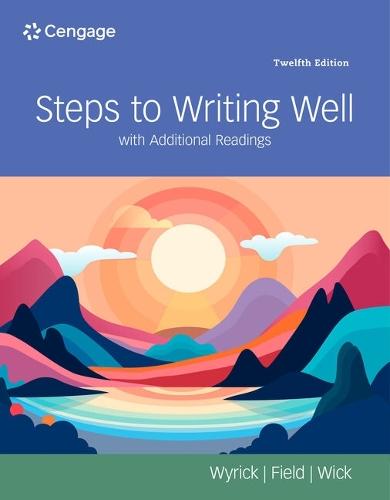
Steps to Writing Well with Additional Readings

Author:   Jean Wyrick (Professor Emerita, Colorado State University) ,  Chris Field (Associate Professor, Tennessee State University) ,  Audrey Wick (Blinn College)
Publisher:   Cengage Learning, Inc
Edition:   12th edition
ISBN:  

9798214156729


Pages:   764
Publication Date:   01 February 2026
Format:   Paperback
Availability:   Not yet available   Availability explained
This item is yet to be released. You can pre-order this item and we will dispatch it to you upon its release.

Our Price $340.43 Quantity:  
Pre-Order

Share |

Steps to Writing Well with Additional Readings


Overview

Combining coverage of the writing process with professional readings, Wyrick/Field/Wick's 'Steps to Writing Well with Additional Readings' has helped students learn to write academic essays. It presents rhetorical strategies for composing essays in an easy-to-follow progression of useful lessons and activities. With over 70 student and professional readings and hands-on activities, it gives writers the models and practice they need to write essays with confidence. The 12th edition features visual learning aids, student writing samples on timely topics, assignments using sources and rhetorical strategies and discussions of multimodal texts and online databases. It also reflects guidelines from latest 9th edition 'Manual of the Modern Language Association' and 7th edition '2020 Publication Manual of the American Psychological Association.' Now available: MindTap digital learning solution.

Full Product Details

Author:   Jean Wyrick (Professor Emerita, Colorado State University) ,  Chris Field (Associate Professor, Tennessee State University) ,  Audrey Wick (Blinn College)
Publisher:   Cengage Learning, Inc
Imprint:   Wadsworth Publishing Co Inc
Edition:   12th edition
ISBN:  

9798214156729


Pages:   764
Publication Date:   01 February 2026
Audience:   College/higher education ,  Tertiary & Higher Education
Format:   Paperback
Publisher's Status:   Forthcoming
Availability:   Not yet available   Availability explained
This item is yet to be released. You can pre-order this item and we will dispatch it to you upon its release.

Table of Contents

Part I: THE BASICS OF THE SHORT ESSAY. 1. The Reading-Writing Connection. How Can Reading Well Help Me Become a Better Writer? Becoming an Analytical Reader. Steps to Reading Well. Sample Annotated Essay: College for Grown-Ups. Practicing What You've Learned. Assignment: Reading Multimodal Texts Analytically. Steps to Reading Multimodal Texts Well. Sample Annotated Advertisement. Writing a Summary. Practicing What You've Learned. Benefiting from Class Discussions. Practicing What You've Learned. Chapter 1 Summary. 2. Prewriting. Getting Started. Selecting a Subject. Finding Your Essay's Purpose and Focus. Prewriting Techniques. After You've Found Your Focus. Practicing What You've Learned. Discovering Your Audience. How to Identify Your Readers. Practicing What You've Learned. Assignment. Keeping a Journal (Talking to Yourself Does Help). Chapter 2 Summary. 3. The Thesis Statement. What Is a Thesis? What Does a Working Thesis Do? Can a Working Thesis Change? Guidelines for Writing a Good Thesis. Avoiding Common Errors in Thesis Statements. Practicing What You've Learned. Assignment. Using the Essay Map. Practicing What You've Learned. Assignment. Chapter 3 Summary. 4. The Body Paragraphs. Planning the Body of Your Essay. Composing the Body Paragraphs. The Topic Sentence. Focusing Your Topic Sentence. Placing Your Topic Sentence. Practicing What You've Learned. Assignment. Applying What You've Learned to Your Writing. Paragraph Development. Paragraph Length. Practicing What You've Learned. Assignment. Applying What You've Learned to Your Writing. Paragraph Unity. Practicing What You've Learned. Applying What You've Learned to Your Writing. Paragraph Coherence. Practicing What You've Learned. Paragraph Sequence. Transitions between Paragraphs. Applying What You've Learned to Your Writing. Chapter 4 Summary. 5. Beginnings and Endings. Suggestions for Writing a Good Lead-In. Avoiding Errors in Lead-Ins. Practicing What You've Learned. Assignment. How to Write a Good Concluding Paragraph. Avoiding Errors in Conclusions. Practicing What You've Learned. Assignment. How to Write a Good Title. Practicing What You've Learned. Assignment. Applying What You've Learned to Your Writing. Chapter 5 Summary. 6. Drafting and Revising: Creative Thinking, Critical Thinking. What Is Revision? When Does Revision Occur? Myths about Revision. Can I Learn to Improve My Revision Skills? Preparing to Draft. Some Basic Tips for Drafting. Some Hints When Drafting on a Computer. Some Hints When Handwriting a Draft. Writing Centers, Computer Classrooms, and Electronic Networks. Procrastination: Enemy of Critical Thinking, Thief of Time. I. Revising for Purpose, Thesis, and Audience. II. Revising for Ideas and Evidence. What Is Critical Thinking? Thinking Critically as a Writer. Critical Thinking and Visual Literacy. III. Revising for Organization. IV. Revising for Clarity and Style. V. Editing for Errors. VI. Proofreading. A Final Checklist for Your Essay. Sample Student Essay: The Fear No One Talks About. Practicing What You've Learned. Assignment. Applying What You've Learned to Your Writing. Collaborative Activities: Group Work, Peer Revision Workshops, and Team Projects. Benefiting from Collaborative Activities. Guidelines for Peer Revision Workshops. Guidelines for Small-Group Work. Practicing What You've Learned. Assignment. Some Last Advice: How to Minimize Frustration. Chapter 6 Summary. 7. Effective Sentences. Developing a Clear Style. Practicing What You've Learned. Developing a Concise Style. Practicing What You've Learned. Assignment. Developing an Engaging Style. Practicing What You've Learned. Assignment. Developing an Emphatic Style. Practicing What You've Learned. Assignment. Applying What You've Learned to Your Writing. Chapter 7 Summary. 8. Word Logic. Selecting the Correct Words. Practicing What You've Learned. Selecting the Best Words. Practicing What You've Learned. Assignment. Applying What You've Learned to Your Writing. Chapter 8 Summary. Part One Summary: The Basics of the Short

Reviews

Author Information

Jean Wyrick is Professor Emerita of English at Colorado State University, where she was director of composition for 11 years. She has more than 25 years of experience teaching writing, training writing teachers, and designing writing/writing-across-the-curriculum programs. Her other textbooks include THE RINEHART READER and DISCOVERING IDEAS. She has presented over 100 workshops and papers on the teaching of writing, American literature, American studies, and women's studies. Chris Field is an Associate Professor of English in the Languages, Literature, and Philosophy department at Tennessee State University, where he has served as the First-Year Composition Coordinator since 2016. In his more than 20 years of teaching at the collegiate level, he has taught a variety of composition and literature courses, and he has mentored countless students and colleagues. His previous works include Beyond the Frontier, Volume IV: Innovations in First-Year Composition (2025), Tell Me a Story: Using Narratives to Break Down Barriers in Composition Courses (2017), and ""I'm Just a Comic Book Boy"": Essays on the Intersection of Comics and Punk (2019). Audrey Wick is Professor of English at Blinn College in Texas. She has teaching experience in a wide range of modalities but currently splits her time with face-to-face and online instruction. She was honored with an annual Teaching Excellence Award at her institution. In addition to academia, she enjoys fiction writing with a variety of contemporary novels to her name.

Tab Content 6

Author Website:  

Countries Available

All regions
Latest Reading Guide

NOV RG 20252


Shopping Cart
Your cart is empty
Shopping cart
Mailing List