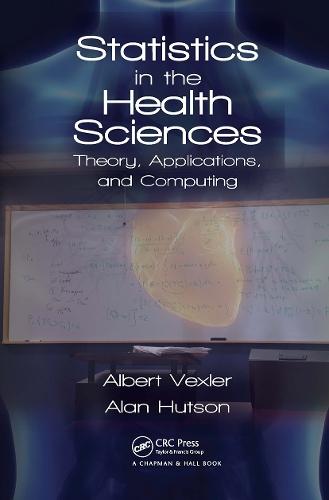
Full Product Details
Author: Albert Vexler ,
Alan Hutson (Roswell Park Cancer Institute, Buffalo, New York, USA)
Publisher: Taylor & Francis Ltd
Imprint: Chapman & Hall/CRC
Weight: 0.539kg
ISBN: 9781032402000
ISBN 10: 1032402008
Pages: 416
Publication Date: 29 August 2022
Audience:
College/higher education
,
General/trade
,
Tertiary & Higher Education
,
General
Format: Paperback
Publisher's Status: Active
Availability: In Print

This item will be ordered in for you from one of our suppliers. Upon receipt, we will promptly dispatch it out to you. For in store availability, please contact us.
Reviews
""This very informative book introduces classical and novel statistical methods that can be used by theoretical and applied biostatisticians to develop efficient solutions for real-world problems encountered in clinical trials and epidemiological studies. The authors provide a detailed discussion of methodological and applied issues in parametric, semi-parametric and nonparametric approaches, including computationally extensive data-driven techniques, such as empirical likelihood, sequential procedures, and bootstrap methods. Many of these techniques are implemented using popular software such as R and SAS. "" —Vlad Dragalin, Vice President and Scientific Fellow, Quantitative Sciences, Johnson and Johnson ""It is always a pleasure to come across a new book that covers nearly all facets of a branch of science one thought was so broad, so diverse, and so dynamic that no single book could possibly hope to capture all of the fundamentals as well as directions of the field. Biostatistics is just such a branch of science and Statistics in the Health Sciences: Theory, Applications, and Computing is just such a book. Written by ""lions"" of the field, the book is an excellent piece of work that establishes an important bridge between Biostatistics and its numerous interfaces. The topics within the book’s purview—fundamentals of measure-theoretic probability; parametric and non-parametric statistical inference; central limit theorems; basics of martingale theory; Monte Carlo methods; sequential analysis; sequential change-point detection—are all covered with inspiring clarity and precision. The authors are also very thorough and avail themselves of the most recent scholarship. They provide a detailed account of the state of the art, and bring together results that were previously scattered across disparate disciplines. This makes the book more than just a textbook: it is a panoramic companion to the field of Biostatistics. The book is self-contained, and the concise but careful exposition of material makes it accessible to a wide audience. The book also offers numerous problems and computer projects, including data processing exercises, which range in complexity and degree of sophistication from introductory to fairly advanced. This is appealing to graduate students interested in getting into the field, and also to professors looking to design a course on the subject. To sum up, the book is a valuable addition to the literature, and certainly deserves a spot in the library. Perhaps the best way to express one’s gratitude to the authors would be to read the book."" —Aleksey S. Polunchenko, Ph.D., Department of Mathematical Sciences, State University of New York at Binghamton
"""This very informative book introduces classical and novel statistical methods that can be used by theoretical and applied biostatisticians to develop efficient solutions for real-world problems encountered in clinical trials and epidemiological studies. The authors provide a detailed discussion of methodological and applied issues in parametric, semi-parametric and nonparametric approaches, including computationally extensive data-driven techniques, such as empirical likelihood, sequential procedures, and bootstrap methods. Many of these techniques are implemented using popular software such as R and SAS. "" —Vlad Dragalin, Vice President and Scientific Fellow, Quantitative Sciences, Johnson and Johnson ""It is always a pleasure to come across a new book that covers nearly all facets of a branch of science one thought was so broad, so diverse, and so dynamic that no single book could possibly hope to capture all of the fundamentals as well as directions of the field. Biostatistics is just such a branch of science and Statistics in the Health Sciences: Theory, Applications, and Computing is just such a book. Written by ""lions"" of the field, the book is an excellent piece of work that establishes an important bridge between Biostatistics and its numerous interfaces. The topics within the book’s purview—fundamentals of measure-theoretic probability; parametric and non-parametric statistical inference; central limit theorems; basics of martingale theory; Monte Carlo methods; sequential analysis; sequential change-point detection—are all covered with inspiring clarity and precision. The authors are also very thorough and avail themselves of the most recent scholarship. They provide a detailed account of the state of the art, and bring together results that were previously scattered across disparate disciplines. This makes the book more than just a textbook: it is a panoramic companion to the field of Biostatistics. The book is self-contained, and the concise but careful exposition of material makes it accessible to a wide audience. The book also offers numerous problems and computer projects, including data processing exercises, which range in complexity and degree of sophistication from introductory to fairly advanced. This is appealing to graduate students interested in getting into the field, and also to professors looking to design a course on the subject. To sum up, the book is a valuable addition to the literature, and certainly deserves a spot in the library. Perhaps the best way to express one’s gratitude to the authors would be to read the book."" —Aleksey S. Polunchenko, Ph.D., Department of Mathematical Sciences, State University of New York at Binghamton"
This very informative book introduces classical and novel statistical methods that can be used by theoretical and applied biostatisticians to develop efficient solutions for real-world problems encountered in clinical trials and epidemiological studies. The authors provide a detailed discussion of methodological and applied issues in parametric, semi-parametric and nonparametric approaches, including computationally extensive data-driven techniques, such as empirical likelihood, sequential procedures, and bootstrap methods. Many of these techniques are implemented using popular software such as R and SAS. -Vlad Dragalin, Vice President and Scientific Fellow, Quantitative Sciences, Johnson and Johnson It is always a pleasure to come across a new book that covers nearly all facets of a branch of science one thought was so broad, so diverse, and so dynamic that no single book could possibly hope to capture all of the fundamentals as well as directions of the field. Biostatistics is just such a branch of science and Statistics in the Health Sciences: Theory, Applications, and Computing is just such a book. Written by lions of the field, the book is an excellent piece of work that establishes an important bridge between Biostatistics and its numerous interfaces. The topics within the book's purview-fundamentals of measure-theoretic probability; parametric and non-parametric statistical inference; central limit theorems; basics of martingale theory; Monte Carlo methods; sequential analysis; sequential change-point detection-are all covered with inspiring clarity and precision. The authors are also very thorough and avail themselves of the most recent scholarship. They provide a detailed account of the state of the art, and bring together results that were previously scattered across disparate disciplines. This makes the book more than just a textbook: it is a panoramic companion to the field of Biostatistics. The book is self-contained, and the concise but careful exposition of material makes it accessible to a wide audience. The book also offers numerous problems and computer projects, including data processing exercises, which range in complexity and degree of sophistication from introductory to fairly advanced. This is appealing to graduate students interested in getting into the field, and also to professors looking to design a course on the subject. To sum up, the book is a valuable addition to the literature, and certainly deserves a spot in the library. Perhaps the best way to express one's gratitude to the authors would be to read the book. -Aleksey S. Polunchenko, Ph.D., Department of Mathematical Sciences, State University of New York at Binghamton
Author Information
Albert Vexler is a tenured professor in the Department of Biostatistics at the State University of New York (SUNY) at Buffalo. Dr. Vexler is the associate editor of Biometrics and BMC Medical Research Methodology. He is the author and coauthor of various publications that contribute to the theoretical and applied aspects of statistics in medical research. Many of his papers and statistical software developments have appeared in statistical and biostatistical journals that have top-rated impact factors and are historically recognized as leading scientific journals. Dr. Vexler was awarded a National Institutes of Health grant to develop novel nonparametric data analysis and statistical methodology. His research interests include receiver operating characteristic curve analysis, measurement error, optimal designs, regression models, censored data, change point problems, sequential analysis, statistical epidemiology, Bayesian decision-making mechanisms, asymptotic methods of statistics, forecasting, sampling, optimal testing, nonparametric tests, empirical likelihoods, renewal theory, Tauberian theorems, time series, categorical analysis, multivariate analysis, multivariate testing of complex hypotheses, factor and principal component analysis, statistical biomarker evaluations, and best combinations of biomarkers. Alan D. Hutson is the chair of biostatistics and bioinformatics at Roswell Park Cancer Institute. He is also the biostatistical, epidemiological, and research design director for SUNY’s National Institutes of Health–funded Clinical and Translational Research Award. Dr. Hutson is a fellow of the American Statistical Association, the associate editor of Communications in Statistics and the Sri Lankan Journal of Applied Statistics, and a New York State NYSTAR Distinguished Professor. He has written more than 200 peer-reviewed publications. Dr. Hutson’s methodological work focuses on nonparametric methods for biostatistical applications as they pertain to statistical functionals. He also has several years of experience in the design and analysis of clinical trials.