Overview
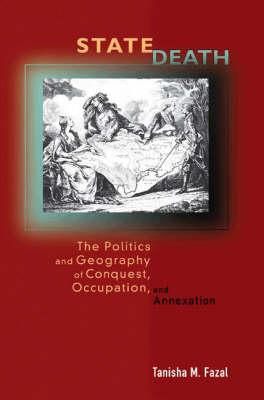
If you were to examine an 1816 map of the world, you would discover that half the countries represented there no longer exist. Yet since 1945, the disappearance of individual states from the world stage has become rare. ""State Death"" is the first book to systematically examine the reasons why some states die while others survive, and the remarkable decline of state death since the end of World War II. Grappling with what is a core issue of international relations, Tanisha Fazal explores two hundred years of military invasion and occupation, from eighteenth-century Poland to present-day Iraq to derive conclusions that challenge conventional wisdom about state death. The fate of sovereign states, she reveals, is largely a matter of political geography and changing norms of conquest. Fazal shows how buffer states - those that lie between two rivals - are the most vulnerable and likely to die except in rare cases that constrain the resources or incentives of neighboring states. She argues that the United States has imposed such constraints with its global norm against conquest - an international standard that has largely prevented the violent takeover of states since 1945. ""State Death"" serves as a timely reminder that should there be a shift in U.S. power or preferences that erodes the norm against conquest, violent state death may once again become commonplace in international relations.
Full Product Details
Author: Tanisha Fazal
Publisher: Princeton University Press
Imprint: Princeton University Press
Weight: 0.567kg
ISBN: 9780691129860
ISBN 10: 069112986
Pages: 320
Publication Date: 09 September 2007
Audience:
Professional and scholarly
,
College/higher education
,
Professional & Vocational
,
Tertiary & Higher Education
Replaced By: 9781400841448
Format: Hardback
Publisher's Status: Out of Print
Availability: Awaiting stock
 Language:
 English
Reviews
This excellent study begins with the counterintuitive fact that 'of all the states on the map of the world in 1816, nearly half no longer exist today.' The first part of the book details the history of state death, a modest contribution but one heretofore absent from scholarly analysis. More important are the contributions relating to explaining state death and charting the impact of changes in the international system of states... This is a first-rate book with importance for both international relations and geography scholars alike. F. Diehl, University of Illinois at Urbana-Champaign, for Choice Given the importance of state death to theorizing about international politics, it is surprising that Tanisha Fazal is the first scholar to offer a systematic study of the phenomenon. The wait has been worth it, thought, because Fazal has written an excellent introduction to the topic. -- Douglas Lemke Political Science Quarterly Fazal outlines a plausible mechanism for state death and supports it with a persuasive combination of statistics and well-executed case studies. -- Alexander B. Downes International History Review State Death is well written. It is extremely interesting in that it attempts to systematically approach a subject that has barely been thought about in systematic terms to date. Its main strength is its almost textbook-like demonstration of how to approach a subject matter by devising a meticulous methodology, discussing and refining the data sets used, and combining quantitative analysis with qualitative case studies in a fruitful fashion... State Death presents an interesting and valuable argument developed in a methodologically creative way. -- Mathias Albert Perspectives on Politics
Author Information
Tanisha M. Fazal is assistant professor of political science at Columbia University.