Overview
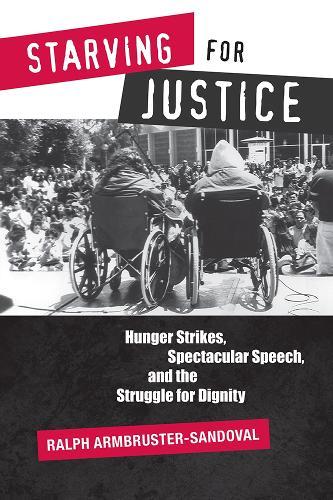
In the 1990s three college campuses in California exploded as Chicano/a and Latino/a students went on hunger strikes. Through courageous self-sacrifice, these students risked their lives to challenge racial neoliberalism, budget cuts, and fee increases. The strikers acted and spoke spectacularly and, despite great odds, produced substantive change. Social movement scholars have raised the question of why some people risk their lives to create a better world. In Starving for Justice, Ralph Armbruster-Sandoval uses interviews and archival material to examine people’s willingness to make the extreme sacrifice and give their lives in order to create a more just society. Popular memory and scholarly discourse around social movements have long acknowledged the actions of student groups during the 1960s. Now Armbruster-Sandoval extends our understanding of social justice and activism, providing one of the first examinations of Chicana/o and Latina/o student activism in the 1990s. Students at University of California, Los Angeles; University of California, Santa Barbara; and Stanford University went on hunger strikes to demand the establishment and expansion of Chicana/o studies departments. They also had even broader aspirations—to obtain dignity and justice for all people. These students spoke eloquently, making their bodies and concerns visible. They challenged anti-immigrant politics. They scrutinized the rapid growth of the prison-industrial complex, racial and class polarization, and the university’s neoliberalization. Though they did not fully succeed in having all their demands met, they helped generate long-lasting social change on their respective campuses, making those learning institutions more just.
Full Product Details
Author: Ralph Armbruster-Sandoval
Publisher: University of Arizona Press
Imprint: University of Arizona Press
Dimensions:
Width: 14.90cm
, Height: 1.70cm
, Length: 22.60cm
Weight: 0.460kg
ISBN: 9780816537938
ISBN 10: 0816537933
Pages: 328
Publication Date: 30 August 2017
Audience:
Professional and scholarly
,
Professional & Vocational
Format: Paperback
Publisher's Status: Active
Availability: Temporarily unavailable

The supplier advises that this item is temporarily unavailable. It will be ordered for you and placed on backorder. Once it does come back in stock, we will ship it out to you.
Reviews
The author bases his book on historical archival and oral interviews, making it original and organic. This is the first scholarship that investigates the Chicana/o studies social movements of the 1990s, and [it] is a major contribution for future scholarly development of this critical subject. --Choice This book vividly captures the urgency of a time when Mexican American students and faculty--almost all the first generation in either role--were trying to maintain a presence at California universities in the face of growing hostility to people of color, the so-called culture wars. --American Journal of Sociology Starving for Justice is helpful in understanding an underrepresented perspective in sociology and is an invitation for dialogue. --Contemporary Sociology A lucid, original, and fascinating analysis of Chicana/o and Latina/o activism in the '90s. This is the book I have been waiting for--a book that builds on and extends beyond the Chicano movement(s) of the '60s and early '70s. --Rodolfo D. Torres, Professor of Urban Planning and Chicano and Latino Studies, University of California, Irvine A well-researched and well-written book that should be adopted in courses across various disciplines that deal with issues of justice: from sociology and political science to law and women's studies. --Celestino Fern ndez, Distinguished Professor Emeritus, University of Arizona A courageous book, offering an important addition to critical higher education studies and bringing up to date the scholarship on Chicana/o studies. --Laura Pulido, co-editor of Black and Brown in Los Angeles: Beyond Conflict and Coalition
The author bases his book on historical archival and oral interviews, making it original and organic. This is the first scholarship that investigates the Chicana/o studies social movements of the 1990s, and [it] is a major contribution for future scholarly development of this critical subject. --Choice A lucid, original, and fascinating analysis of Chicana/o and Latina/o activism in the '90s. This is the book I have been waiting for--a book that builds on and extends beyond the Chicano movement(s) of the '60s and early '70s. --Rodolfo D. Torres, Professor of Urban Planning and Chicano and Latino Studies, University of California, Irvine A well-researched and well-written book that should be adopted in courses across various disciplines that deal with issues of justice: from sociology and political science to law and women's studies. --Celestino Fernandez, Distinguished Professor Emeritus, University of Arizona A courageous book, offering an important addition to critical higher education studies and bringing up to date the scholarship on Chicana/o studies. --Laura Pulido, co-editor of Black and Brown in Los Angeles: Beyond Conflict and Coalition
The author bases his book on historical archival and oral interviews, making it original and organic. This is the first scholarship that investigates the Chicana/o studies social movements of the 1990s, and [it] is a major contribution for future scholarly development of this critical subject. --Choice This book vividly captures the urgency of a time when Mexican American students and faculty--almost all the first generation in either role--were trying to maintain a presence at California universities in the face of growing hostility to people of color, the so-called culture wars. --American Journal of Sociology A lucid, original, and fascinating analysis of Chicana/o and Latina/o activism in the '90s. This is the book I have been waiting for--a book that builds on and extends beyond the Chicano movement(s) of the '60s and early '70s. --Rodolfo D. Torres, Professor of Urban Planning and Chicano and Latino Studies, University of California, Irvine A well-researched and well-written book that should be adopted in courses across various disciplines that deal with issues of justice: from sociology and political science to law and women's studies. --Celestino Fern�ndez, Distinguished Professor Emeritus, University of Arizona A courageous book, offering an important addition to critical higher education studies and bringing up to date the scholarship on Chicana/o studies. --Laura Pulido, co-editor of Black and Brown in Los Angeles: Beyond Conflict and Coalition
Author Information
Ralph Armbruster-Sandoval is an associate professor in the Chicana and Chicano Studies Department at the University of California, Santa Barbara (UCSB). He is the author of Globalization and Cross-Border Labor Solidarity in the Americas: The Anti-Sweatshop Movement and the Struggle for Social Justice. He has been actively involved in struggles for human rights, labor rights, and social justice on the national, state, and local level.