Overview
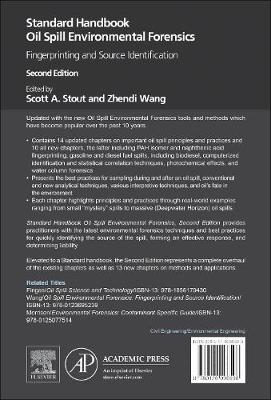
Standard Handbook Oil Spill Environmental Forensics: Fingerprinting and Source Identification, Second Edition, provides users with the latest information on the tools and methods that have become popular over the past ten years. The book presents practitioners with the latest environmental forensics techniques and best practices for quickly identifying the sources of spills, how to form an effective response, and how to determine liability. This second edition represents a complete overhaul of the existing chapters, and includes 13 new chapters on methods and applications, such as emerging application of PAHi isomers in oil spill forensics, development and application of computerized oil spill identification (COSI), and fingerprinting of oil in biological and passive sampling devices.
Full Product Details
Author: Scott Stout (NewFields Environmental Forensics Practice LLC, Rockland, MA) ,
Zhendi Wang (Senior Research Scientist and Head of Oil Spill Research, Emergencies, Science and Technology Division, Environment Canada)
Publisher: Elsevier Science Publishing Co Inc
Imprint: Academic Press Inc
Edition: 2nd edition
Dimensions:
Width: 15.20cm
, Height: 5.80cm
, Length: 22.90cm
Weight: 1.880kg
ISBN: 9780128096598
ISBN 10: 0128096594
Pages: 1142
Publication Date: 17 February 2016
Audience:
Professional and scholarly
,
Professional & Vocational
Format: Hardback
Publisher's Status: Active
Availability: Manufactured on demand

We will order this item for you from a manufactured on demand supplier.
Author Information
Dr. Stout has more than 20 years of petroleum and coal industry experience. He specializes in chemical compositions of fuel-derived sources of contamination in terrestrial and marine environments, which includes crude oil, coal, gasoline and other substances. His research has been used for decision making by the United States Departments of Justice and Defense, and by the forest products, utility, railroad, wood treatment, maritime shipping, port operations, and oil and gas industries. Dr. Stout has authored or co-authored nearly 120 scientific papers and edited a textbook on the environmental forensics aspects of maritime oil spills. Dr. Zhendi Wang is a senior research scientist and Head of Oil Spill Research of Environment Canada, working in the oil and toxic chemical spill research field. His specialties and research interests include: development of oil spill fingerprinting and tracing technology, environmental forensics of oil spill; oil properties, fate and behavior of oil and other hazardous organics in the environment; oil burn emission and products study; oil bioremediation; identification and characterization of oil hydrocarbons; and, spill treatment studies; applications of modern analytical techniques (such as GC, GC/MS, HPLC, LC/MS, SFE and SFC, and IC) to oil spill studies and other environmental science and technology. Dr. Wang has continually and extensively led and been involved in various scientific projects, technology transfer, and national and international cooperative researches with the total funding over 3 million dollars. He has authored over 270 academic publications including 72 peer-reviewed articles and 4 invited reviews in the most respected journals in the environmental science and chemistry, and 8 books and book chapters. The productivity, excellence and achievements of Dr. Wang have established him as a national and international “leading authority on the topic. He has won a number of national and international scientific honours and awards. Wang is also a member of America Chemical Society (ACS), the Canadian Society for Chemistry (CSC), and the International Society of Environmental Forensics.