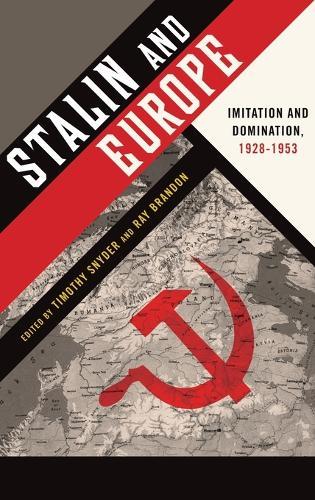
Full Product Details
Author: Timothy Snyder (Housum Professor of History, Housum Professor of History, Yale University) ,
Ray Brandon (, Germany)
Publisher: Oxford University Press Inc
Imprint: Oxford University Press Inc
Dimensions:
Width: 23.60cm
, Height: 2.50cm
, Length: 16.00cm
Weight: 0.748kg
ISBN: 9780199945566
ISBN 10: 019994556
Pages: 352
Publication Date: 10 July 2014
Audience:
General/trade
,
General
,
Postgraduate, Research & Scholarly
Format: Hardback
Publisher's Status: Active
Availability: Manufactured on demand

We will order this item for you from a manufactured on demand supplier.
Reviews
I read this fascinating, lively collection through from beginning to end in one sitting. That speaks highly for the quality and the challenges that each of the pieces offers. The contributions are primarily from top national and international experts in the field, including a number of rising stars and scholars from Central Europe. All of the essays are grounded in the archives and based on original research. The volume features a variety of methods, perspectives, and approaches, from newer social history to more traditional military and diplomatic history. The collection as a whole reminds us of the seamless transition from the 1930s in the Soviet Union, into war and conquest, and on into the Cold War. * Robert Gellately, author of Stalin's Curse: Battling for Communism in War and Cold War * Stalin and Europe continues a process of reorientation that seeks to incorporate Eastern European and Russian history into European history. The issue of Stalinism and its place in Europe is a particularly treacherous challenge, which this volume resolves in a series of probing essays that explore the Soviet Union's paradoxical relation to the rest of Europe. A diverse group of historians on Germany, Eastern Europe, and the Soviet Union presents the results of voluminous, recent research on the subject. They are an important reminder, and provide ample food for thought, on Russia as a force in European history. * Michael Geyer, University of Chicago *
Stalin and Europe continues a process of reorientation that seeks to incorporate Eastern European and Russian history into European history. The issue of Stalinism and its place in Europe is a particularly treacherous challenge, which this volume resolves in a series of probing essays that explore the Soviet Union's paradoxical relation to the rest of Europe. A diverse group of historians on Germany, Eastern Europe, and the Soviet Union presents the results of voluminous, recent research on the subject. They are an important reminder, and provide ample food for thought, on Russia as a force in European history. --Michael Geyer, University of Chicago I read this fascinating, lively collection through from beginning to end in one sitting. That speaks highly for the quality and the challenges that each of the pieces offers. The contributions are primarily from top national and international experts in the field, including a number of rising stars and scholars from Central Europe. All of the essays are grounded in the archives and based on original research. The volume features a variety of methods, perspectives, and approaches, from newer social history to more traditional military and diplomatic history. The collection as a whole reminds us of the seamless transition from the 1930s in the Soviet Union, into war and conquest, and on into the Cold War. --Robert Gellately, author of Stalin's Curse: Battling for Communism in War and Cold War
Stalin and Europe continues a process of reorientation that seeks to incorporate Eastern European and Russian history into European history. The issue of Stalinism and its place in Europe is a particularly treacherous challenge, which this volume resolves in a series of probing essays that explore the Soviet Union's paradoxical relation to the rest of Europe. A diverse group of historians on Germany, Eastern Europe, and the Soviet Union presents the results of voluminous, recent research on the subject. They are an important reminder, and provide ample food for thought, on Russia as a force in European history. Michael Geyer, University of Chicago I read this fascinating, lively collection through from beginning to end in one sitting. That speaks highly for the quality and the challenges that each of the pieces offers. The contributions are primarily from top national and international experts in the field, including a number of rising stars and scholars from Central Europe. All of the essays are grounded in the archives and based on original research. The volume features a variety of methods, perspectives, and approaches, from newer social history to more traditional military and diplomatic history. The collection as a whole reminds us of the seamless transition from the 1930s in the Soviet Union, into war and conquest, and on into the Cold War. Robert Gellately, author of Stalin's Curse: Battling for Communism in War and Cold War
One of the merits of this volume to bring Eastern European and Western historians together and to present their research to a broad public in an English-language publication. -- Peter Ruggenthaler, H-Diplo Stalin and Europe continues a process of reorientation that seeks to incorporate Eastern European and Russian history into European history. The issue of Stalinism and its place in Europe is a particularly treacherous challenge, which this volume resolves in a series of probing essays that explore the Soviet Union's paradoxical relation to the rest of Europe. A diverse group of historians on Germany, Eastern Europe, and the Soviet Union presents the results of voluminous, recent research on the subject. They are an important reminder, and provide ample food for thought, on Russia as a force in European history. --Michael Geyer, University of Chicago I read this fascinating, lively collection through from beginning to end in one sitting. That speaks highly for the quality and the challenges that each of the pieces offers. The contributions are primarily from top national and international experts in the field, including a number of rising stars and scholars from Central Europe. All of the essays are grounded in the archives and based on original research. The volume features a variety of methods, perspectives, and approaches, from newer social history to more traditional military and diplomatic history. The collection as a whole reminds us of the seamless transition from the 1930s in the Soviet Union, into war and conquest, and on into the Cold War. --Robert Gellately, author of Stalin's Curse: Battling for Communism in War and Cold War
Author Information
Timothy Snyder is the Bird White Housum Professor of History at Yale University, specializing in the history of central and eastern Europe. He is the author of numerous books, including Bloodlands: Europe Between Hitler and Stalin. Ray Brandon is a freelance translator, historian, and researcher based in Berlin. He is the co-editor of The Shoah in Ukraine: History, Testimony, Memorialization.