Overview
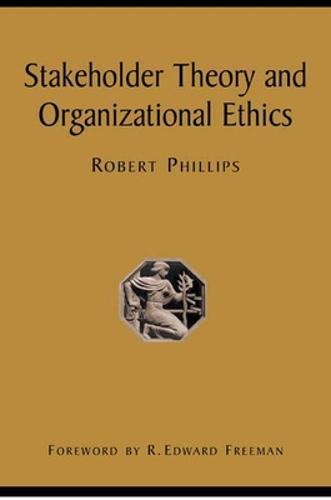
Business ethics is a staple in the news today. One of the most difficult ethical questions facing managers is to whom are they responsible? Organizations can affect and are affected by many different constituencies-or stakeholders -but who are these stakeholders? What sort of managerial attention should they receive? Is there a legal duty to attend to stakeholders or is such a duty legally prohibited due to the shareholder wealth maximization imperative? In short, for whose benefit ought a firm be managed? Stakeholder Theory and Organizational Ethics provides the most comprehensive, theoretical treatment of the stakeholder framework to date. Robert Phillips provides an extended defense of stakeholder theory as the preeminent theory of organizational ethics today.
Full Product Details
Author: Phillips ,
R. Edward Freeman
Publisher: Berrett-Koehler
Imprint: Berrett-Koehler
Dimensions:
Width: 6.50cm
, Height: 0.90cm
, Length: 9.60cm
Weight: 0.001kg
ISBN: 9781576752685
ISBN 10: 1576752682
Pages: 216
Publication Date: 16 September 2003
Audience:
General/trade
,
General
Format: Hardback
Publisher's Status: No Longer Our Product
Availability: In Print

This item will be ordered in for you from one of our suppliers. Upon receipt, we will promptly dispatch it out to you. For in store availability, please contact us.
Author Information
Robert Phillips currently holds joint appointments between the Social/Legal and Management faculty areas at the University of San Diego School of Business Administration. He has been interested in the study of organizational and business ethics since his undergraduate years. As a marketing major and philosophy minor, he was stuck by the fact that the same comment was taken as some form of socialism when uttered among business school students and faculty, and some form of fascism when suggested around philosophy students and faculty. He has been trying to figure out why ever since. During his MBA studies, he was able to take a course in the philosophy department on social justice. This was his first exposure to the work of John Rawls, and it made an impression that has continued to this day. And the perception that he was destined to run a sweatshop among the philosophers and a commune among the business students continued unabated (if not more intensely) during graduate studies. Upon taking his MBA, he was accepted into the first cohort of Ph.D. candidates at the brand new business ethics program at the University of Virginia's Darden Graduate School of Business Administration. He completed his doctoral program in three years to become the first graduate of this program and perhaps the first person in the United States to be granted a Ph.D. explicitly in business ethics from a school of business administration. His work has appeared in the Business Ethics Quarterly, Journal of Business Ethics, Business & Society, and Teaching Business Ethics among others. He has previously taught at Georgetown University (McDonough School), the University of Virginia (The McIntire & Darden Schools), and the University of Pennsylvania (The Wharton School.)