Overview
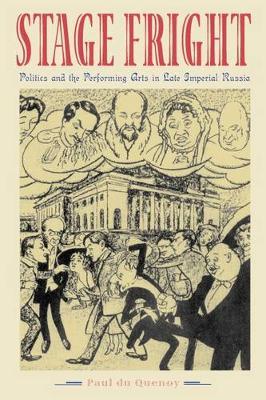
In June 1920, assessing the international significance of the revolutionary era that had brought him to power in Russia, Vladimir Lenin adopted a theatrical idiom for one of its most important events, the Revolution of 1905. ""Without the 'dress rehearsal' of 1905,"" he wrote, ""the victory of the October Revolution in 1917 would have been impossible."" According to Lenin's statement, political anatomy borrowed in a teleological sense from the performing arts. This book explores an inversion of Lenin's statement. Rather than question how politics took after the performing arts, Paul du Quenoy assesses how culture responded to power in late imperial Russia. Exploring the impact of this period's rapid transformation and endemic turmoil on the performing arts, he examines opera, ballet, concerts, and ""serious"" drama while not overlooking newer artistic forms thriving at the time, such as ""popular"" theater, operetta, cabaret, satirical revues, pleasure garden entertainments, and film. He also analyzes how participants in the Russian Empire's cultural life articulated social and political views. Du Quenoy proposes that performing arts culture in late imperial Russia-traditionally assumed to be heavily affected by and responsive to contemporary politics-was often apathetic and even hostile to involvement in political struggles. Stage Fright offers a similar refutation of the view that the late imperial Russian government was a cultural censor prefiguring Soviet control of the arts. Through a clear picture of the relationship between culture and power, this study presents late imperial Russia as a modernizing polity with a vigorous civil society capable of weathering the profound changes of the twentieth century rather than lurching toward an ""inevitable"" disaster of revolution and civil war.
Full Product Details
Author: Paul du Quenoy (Amerian University of Beruit)
Publisher: Pennsylvania State University Press
Imprint: Pennsylvania State University Press
Dimensions:
Width: 15.20cm
, Height: 1.80cm
, Length: 22.90cm
Weight: 0.567kg
ISBN: 9780271034676
ISBN 10: 027103467
Pages: 304
Publication Date: 06 April 2009
Audience:
General/trade
,
General
Format: Hardback
Publisher's Status: Active
Availability: Out of stock

The supplier is temporarily out of stock of this item. It will be ordered for you on backorder and shipped when it becomes available.
Reviews
Grounded in extensive research in archival, primary and secondary sources, Stage Fright is an important contribution to recent studies of Russian theatre and its conclusions will spark fruitful debate. It should be read by anyone interested in the relationship of politics and the arts. --Anthony Swift, Revolutionary Russia
Author Information
Paul du Quenoy is a professor in the Department of History and Archaeology at the American University of Beirut.