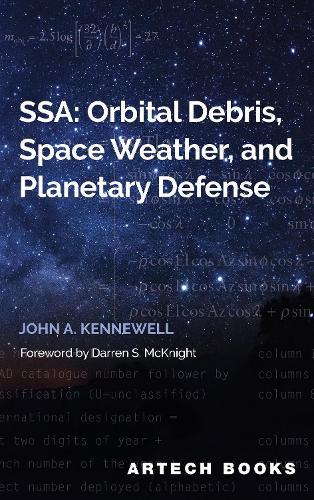
SSA: Orbital Debris, Space Weather and Planetary Defense

Author:   John Kennewell
Publisher:   Artech House Publishers
Edition:   Unabridged edition
ISBN:  

9781685691110


Pages:   410
Publication Date:   30 November 2025
Format:   Hardback
Availability:   In Print   Availability explained
This item will be ordered in for you from one of our suppliers. Upon receipt, we will promptly dispatch it out to you. For in store availability, please contact us.

Our Price $269.10 Quantity:  
Add to Cart

Share |

SSA: Orbital Debris, Space Weather and Planetary Defense


Overview

SSA: Orbital Debris, Space Weather, and Planetary Defense provides a complete blueprint for understanding and managing space situational awareness (SSA). Actionable tools, models, and code are enhanced by policy discussions to provide a unified SSA framework addressing the technical, strategic, and legal realities shaping space security and planetary defense.   The fundamentals of SSA are presented and help define the history and core components, including space debris, orbiting objects, and space weather. Early chapters explore how SSA data is acquired and interpreted. Dive deep into the types, causes, and risks of orbital debris with practical classifications, data-driven models, and quick-reference summaries. Explore the mechanics of orbiting bodies with deep coverage of orbital parameters, satellite collisions, low-Earth orbit (LEO) decay, and atmospheric reentry. Gain hands-on tools for modeling reentry probabilities, analyzing radioactive risks, and understanding debris dynamics like the Kessler syndrome. Detailed technical sections provide formulas, graphs, and runnable code to simulate debris propagation, locate geostationary satellites, and interpret their optical behavior. The final section expands the scope, tackling electromagnetic interference, solar activity, and nuclear-generated space weather, offering both quick rules and in-depth models for forecasting their effects. Critical perspectives on planetary defense, international space law, and the growing role of SSA in global security support compliance efforts and ensure policy makers stay legally and strategically informed.   From engineering threats to legal and military realities, this book gives satellite and aerospace engineers, mission planners, space security professionals, and legal professionals in the space domain a complete toolkit for managing the full technical, operational, and strategic spectrum of SSA.

Full Product Details

Author:   John Kennewell
Publisher:   Artech House Publishers
Imprint:   Artech House Publishers
Edition:   Unabridged edition
ISBN:  

9781685691110


ISBN 10:   1685691110
Pages:   410
Publication Date:   30 November 2025
Audience:   General/trade ,  General
Format:   Hardback
Publisher's Status:   Active
Availability:   In Print   Availability explained
This item will be ordered in for you from one of our suppliers. Upon receipt, we will promptly dispatch it out to you. For in store availability, please contact us.

Table of Contents

1 PROLOGUE   2 OVERVIEW OF SSA 2.1 Definitions 2.2 SSA Awareness 2.3 Three Components of SSA 2.4 Space Weather 2.5 Natural Space Debris 2.6 Orbiting Space Objects - Man-made Space Debris 2.7 Tracking Orbital Space Objects 2.8 Summary 2.9 Bookshelf   3 ORBITAL SPACE DEBRIS 3.1 Classification of Space Debris 3.2 Generating Space Debris 3.3 Natural Space Debris and Space Travel 3.4 Components of Orbital Space Debris 3.5 Debris Measurements and Models 3.6 Data Analysis and Availability 3.7 Problems with Orbital Space Debris 3.8 Collisional Cascade 3.9 Debris Visual Magnitude 3.10 Current Issues in Space Debris 3.11 Early Space Debris People 3.12 Space Debris Places and Organisations 3.13 Bookshelf   4 FAST FACTS ON SPACE DEBRIS   5 ORBITS - PARAMETERS AND SPECIFICATIONS 5.1 Low Earth Circular Orbits 5.2 Geosynchronous Satellites 5.3 Specifying Satellite Orbits in General 5.4 Orbital Ephemeris Programs 5.5 Orbit Determination 5.6 Solar Locational Algorithms 5.7 Bookshelf   6 COLLISIONS 6.1 Collisional Damage 6.2 Space Debris Penetration 6.3 Collisional Velocities 6.4 Hypervelocity Collision Analysis 6.5 Fragment Mass Distribution 6.6 Fragment Velocity Distribution 6.7 Orbital Parameter Changes 6.8 Gabbard Diagrams 6.9 CONASS and COLA - Protecting Current Assets 6.10 Bookshelf   7 ORBITAL DECAY IN LOW EARTH ORBIT 7.1 Introduction 7.2 An Isothermal Atmosphere 7.3 The Real Atmosphere 7.4 The CIRA Model 7.5 Models to 180 km 7.6 A Model from 180 to 500 km 7.7 A LEO Orbital Decay Model 7.8 Model Equations 7.9 Model Output 7.10 Lifetime Predictions 7.11 Practicalities 7.12 Bookshelf   8 SPACE DEBRIS REENTRY HAZARDS 8.1 Introduction 8.2 Satellite Lifetimes 8.3 Only Large Bodies Pose a Reentry Hazard 8.4 Reentry Statistics 8.5 Survival Statistics 8.6 Reality 8.7 Estimated Relative Risks 8.8 Debris reentry Survival 8.9 The reentry Process 8.10 Reentry Predictions - Agencies 8.11 Reentry Predictions - Models 8.12 Reentry Prediction Accuracy 8.13 Debris Reentry Hazard Criteria 8.14 Special Reentry Events 8.15 Planned Reentries 8.16 Suggested Debris Reentry Hazard Response 8.17 Post Impact Object Location 8.18 Satellite, Meteor or Reentry? 8.19 Bookshelf   9 A DEBRIS REENTRY MODEL 9.1 Space Debris Flight Through the Atmosphere 9.2 Classical Debris Ablation Theory 9.3 The Flight Equations 9.4 Atmospheric Density 9.5 Model Output 9.6 Exploring the Model 9.7 Theory and Observations 9.8 Orbital Space Debris Reentries 9.9 Reentry Latitudinal Probability Prediction 9.10 Bookshelf   10 SPACE DEBRIS DYNAMICS 10.1 Population Dynamics 10.2 Models 10.3 Bookshelf   11 GEOSTATIONARY AND GEOSYNCHRONOUS ORBITS 11.1 History 11.2 The Geosynchronous Orbit 11.3 Geosat Classification and Operations 11.4 Imaging Geosats 11.5 The Brightness of Geosats 11.6 Geosat Communication 11.7 The Geosat Environment 11.8 The Asteroid Hazard to Geosats 11.9 Geosynchronous Orbital Debris 11.10 Bookshelf   12 ELECTROMAGNETIC AWARENESS IN SSA 12.1 Satellite Beacons 12.2 Communication Delay 12.3 Radio Frequencies for Space Communication 12.4 Space Communication Calculations 12.5 Spacecraft Reentry Communications Blackout 12.6 Solar Radio Interference to Geosat Signals 12.7 The Doppler Effect 12.8 Space Radar 12.9 Bookshelf   13 RULES OF THUMB FOR SPACE DEBRIS   14 SPACE WEATHER FOR SPACE SITUATIONAL AWARENESS 14.1 Introduction 14.2 Overview 14.3 The Earth 14.4 The Sun 14.5 The Quiet Sun 14.6 The Active Sun 14.7 The Solar System 14.8 The Galaxy 14.9 Summary of Natural Space Weather 14.10 Anthropogenic Space Weather 14.11 High Altitude Nuclear Explosions 14.12 HANE Preparation and Mitigation 14.13 Radiation Belt Remediation 14.14 Bookshelf   15 RULES OF THUMB FOR SPACE WEATHER PREDICTION   16 NEAR EARTH OBJECTS AND PLANETARY DEFENCE 16.1 Introduction 16.2 Early History 16.3 The First Near Earth Asteroid 16.4 Continuing Discovery 16.5 Asteroid Mining and Planetary Defence 16.6 Awareness and Acknowledgement 16.7 Surveillance 16.8 Mitigation 16.9 The International Asteroid Warning Network 16.10 Bookshelf   17 LEGAL ISSUES IN SSA 17.1 The Beginnings of Space Law 17.2 Issues in Space Law 17.3 Definition and Delineation 17.4 Jurisprudence and Jurisdiction 17.5 The Five United Nations Treaties 17.6 The Five United Nations Principles 17.7 Space Debris 17.8 Space Law Compliance 17.9 The Future of International Space Law 17.10 Multilateral Space Agreements 17.11 National Space Law 17.12 Current Issues 17.13 International Institute of Space Law 17.14 Bookshelf   18 SPACE SECURITY 18.1 Definitions 18.2 Opportunities 18.3 Threats 18.4 Legal Issues 18.5 Political Issues 18.6 Space Security - The Big Picture 18.7 Space Security Organisations 18.8 Counterspace Continuum 18.9 Space War 18.10 Bookshelf   19 EPILOGUE 19.1 Summary 19.2 Space Traffic Management 19.3 The Australian Connection 19.4 SSA update ACRONYMS

Reviews

Author Information

John A. Kennewell is a respected Australian physicist and researcher specializing in Space Situational Awareness (SSA), space weather, and observational astronomy. Dr. Kennewell holds an adjunct senior lecturer position at the University of Western Australia (UWA) in the School of Physics, Mathematics, and Computing and is also affiliated with the Australian Space Academy. His research interests include space surveillance and tracking (SST), space weather (SWE), near-Earth object (NEO) monitoring, optical and radio astronomy, and data fusion and visualization for SSA systems. Dr. Kennewell has collaborated on international projects involving asteroid tracking and transient astronomical events, and has contributed to the development of SSA frameworks that integrate both natural and artificial space object monitoring. He is also known for his work with the Zadko Telescope in Western Australia, contributing to studies of gamma-ray bursts and gravitational wave counterparts.

Tab Content 6

Author Website:  

Countries Available

All regions
Latest Reading Guide

April RG 26_2


Shopping Cart
Your cart is empty
Shopping cart
Mailing List