Overview
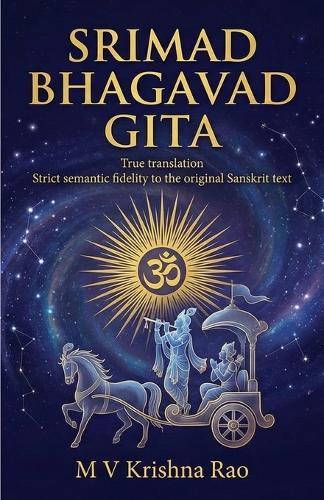
The Srimad Bhagavad Gita, often referred to simply as the Gita, is widely regarded as the ""Veda Saramsha"" and constitutes one of the most significant spiritual classics in world literature. Textually, it appears as a philosophical dialogue nested within the Bhishma Parva (Chapters 25-42) of the great Indian epic, the Mahabharata, attributed to the sage Veda Vyasa. This edition of the Srimad Bhagavad Gita presents a ""true translation"" aiming for strict semantic fidelity to the original Sanskrit text. Unlike many popular renditions that prioritise poetic flow or sectarian interpretation, this work focuses on the precise, literal meaning of each shloka (verse). The translation method employed here is critical and philological; it seeks to convey the exact intent of the original syntax while retaining key philosophical terms-such as Dharma (duty/cosmic law), Yoga (discipline/union), and Guna (mode of nature)-where English equivalents fail to capture the necessary depth. The text covers all 700 verses across the 18 chapters, maintaining the dialogue format between Prince Arjuna and Lord Krishna. This book is designed for the serious student of Vedanta and the independent seeker who wishes to engage with the raw, unadorned power of the scripture, stripped of the ""weeds and underbrush"" of later theological overlays. The Structure The 700 verses are traditionally divided into three hexads (shatkas), or sections of six chapters, mirroring the Vedantic aphorism ""Tat Tvam Asi"" (Thou Art That): Karma Yoga (Chapters 1-6): Focuses on the ""Thou"" (Tvam), or the individual soul (Jiva), teaching the discipline of selfless action and the path to self-realisation. Bhakti Yoga (Chapters 7-12): Focuses on the ""That"" (Tat), or the Supreme Lord (Ishvara), elucidating the nature of God and the path of devotion. Jnana Yoga (Chapters 13-18): Focuses on the identity (Asi) between the Self and the Supreme, analysing the distinction between Matter (Prakriti) and Spirit (Purusha). I. Textual Methodology and Philological Context The Bhagavad Gita, comprising 700 verses (shlokas) arranged in 18 chapters (adhyayas), constitutes a philosophical dialogue nested within the Bhishma Parva (Chapters 23-40) of the Indian epic, the Mahabharata. The text functions as a ""spiritual dictionary,"" synthesising the divergent streams of Vedic ritualism, Upanishadic metaphysics, and the dualistic cosmology of Sankhya philosophy into a cohesive soteriological framework. This report provides an exhaustive, verse-by-verse literal translation of the complete text. The translation methodology employed here prioritises semantic precision and fidelity to the original Sanskrit syntax. It eschews sectarian commentary in favour of a ""true translation"" that reflects the literal meaning of the pada (word) and vakya (sentence). Where English vocabulary lacks the conceptual granularity of Sanskrit-particularly regarding terms like Dharma (duty/cosmic law), Yoga (union/discipline), and Guna (mode of nature)-the original Sanskrit term is retained or noted to preserve philosophical integrity. The text is traditionally divided into three hexads (shatkas), each addressing a distinct theological and distinct pedagogical arc. The translation below adheres to this structural division, presenting the dialogue between Prince Arjuna and Lord Krishna (Hrishikesha) as reported by the visionary narrator Sanjaya to the blind King Dhritarashtra.
Full Product Details
Author: Krishna Rao M V
Publisher: Independently Published
Imprint: Independently Published
Dimensions:
Width: 14.00cm
, Height: 0.60cm
, Length: 21.60cm
Weight: 0.150kg
ISBN: 9798241880154
Pages: 120
Publication Date: 30 December 2025
Audience:
General/trade
,
General
Format: Paperback
Publisher's Status: Active
Availability: Available To Order

We have confirmation that this item is in stock with the supplier. It will be ordered in for you and dispatched immediately.