Awards
- "Winner of Winner of the 1988 ""Electronic Media Book of the Year Award""."
- Winner of Winner of the 1988 Electronic Media Book of the Year Award .
- Winner of Winner of the 1988 ""Electronic Media Book of the Year Award"".
Overview
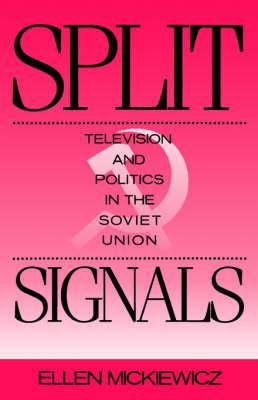
Television has changed drastically in the Soviet Union over the last three decades. In 1960, only five percent of the population had access to TV, but now the viewing population has reached near total saturation. Today's main source of information in the USSR, television has become Mikhail Gorbachev's most powerful instrument for paving the way for major reform. Containing a wealth of interviews with major Soviet and American media figures and fascinating descriptions of Soviet TV shows, Ellen Mickiewicz's wide-ranging, vividly written volume compares over one hundred hours of Soviet and American television, covering programs broadcast during both the Chernenko and Gorbachev governments. Mickiewicz describes the enormous significance and popularity of news programs and discusses how Soviet journalists work in the United States. Offering a fascinating depiction of the world seen on Soviet TV, she also explores the changes in programming that have occurred as a result of glasnost.
Full Product Details
Author: Ellen Mickiewicz (Alben W. Barkley Professor of Political Science, Alben W. Barkley Professor of Political Science, Emory University)
Publisher: Oxford University Press Inc
Imprint: Oxford University Press Inc
Edition: New edition
Dimensions:
Width: 12.90cm
, Height: 2.20cm
, Length: 20.40cm
Weight: 0.354kg
ISBN: 9780195063196
ISBN 10: 0195063198
Pages: 304
Publication Date: 25 June 1992
Audience:
Professional and scholarly
,
Professional & Vocational
Format: Paperback
Publisher's Status: Active
Availability: To order

Stock availability from the supplier is unknown. We will order it for you and ship this item to you once it is received by us.
Reviews
A scholarly but readable study of television under Chernenko and Gorbachev....Draws illuminating comparisons with American television and will prove very valuable for those studying Soviet-American relations, as well as anyone interested in the Soviet media. --International Affairs<br> A good guide to the recent past, but also useful for its descriptions of reality below politics and politically based contention....The thoughts at the end on the possibilities and strains within glasnost are also illuminating. --Intermedia<br> Likely to raise eyebrows in the West, especially among those who continue to think of life behind the Iron Curtain as a sort of backwater--but Mickiewicz demonstrates conclusively that there may be, indeed, more to glasnost than many believe. --Kirkus Reviews<br> With systematic analysis of the content of television programs, interviews with media people, extensive use of Soviet sources, and fascinating material comparing Soviet and American cases, Mickiewicz has produced the first study of television in the Soviet Union. --Zbigniew Brzezinski<br> Mickiewicz, America's foremost student of Soviet media, has conducted a detailed exploration in terra incognita and returned with fascinating, useful, and timely insights....Split Signals makes it possible to appreciate the impact of glasnost on television and, in turn, of television on perestroika--and does it in a readable and comprehensive manner. --Ambassador Ralph Earle II<br>
"""A scholarly but readable study of television under Chernenko and Gorbachev....Draws illuminating comparisons with American television and will prove very valuable for those studying Soviet-American relations, as well as anyone interested in the Soviet media.""--International Affairs ""A good guide to the recent past, but also useful for its descriptions of reality below politics and politically based contention....The thoughts at the end on the possibilities and strains within glasnost are also illuminating.""--Intermedia ""Likely to raise eyebrows in the West, especially among those who continue to think of life behind the Iron Curtain as a sort of backwater--but Mickiewicz demonstrates conclusively that there may be, indeed, more to glasnost than many believe.""--Kirkus Reviews ""With systematic analysis of the content of television programs, interviews with media people, extensive use of Soviet sources, and fascinating material comparing Soviet and American cases, Mickiewicz has produced the first study of television in the Soviet Union.""--Zbigniew Brzezinski ""Mickiewicz, America's foremost student of Soviet media, has conducted a detailed exploration in terra incognita and returned with fascinating, useful, and timely insights....Split Signals makes it possible to appreciate the impact of glasnost on television and, in turn, of television on perestroika--and does it in a readable and comprehensive manner.""--Ambassador Ralph Earle II ""A scholarly but readable study of television under Chernenko and Gorbachev....Draws illuminating comparisons with American television and will prove very valuable for those studying Soviet-American relations, as well as anyone interested in the Soviet media.""--International Affairs ""A good guide to the recent past, but also useful for its descriptions of reality below politics and politically based contention....The thoughts at the end on the possibilities and strains within glasnost are also illuminating.""--Intermedia ""Likely to raise eyebrows in the West, especially among those who continue to think of life behind the Iron Curtain as a sort of backwater--but Mickiewicz demonstrates conclusively that there may be, indeed, more to glasnost than many believe.""--Kirkus Reviews ""With systematic analysis of the content of television programs, interviews with media people, extensive use of Soviet sources, and fascinating material comparing Soviet and American cases, Mickiewicz has produced the first study of television in the Soviet Union.""--Zbigniew Brzezinski ""Mickiewicz, America's foremost student of Soviet media, has conducted a detailed exploration in terra incognita and returned with fascinating, useful, and timely insights....Split Signals makes it possible to appreciate the impact of glasnost on television and, in turn, of television on perestroika--and does it in a readable and comprehensive manner.""--Ambassador Ralph Earle II ""A groundbreaking effort....[It] comes at a very important time when both the Soviets and the U.S. are telling their people a lot more about each other.""--Flora Lewis, Foreign Affairs Columnist for The New York Times ""A fascinating study of Soviet television....Detailed and thoroughly documented....An authoritative study.""--American Political Science Review ""Though Mickiewicz's academic credentials are impeccable...Split Signals is a very readable book, almost completely devoid of professional jargon.""--The Village Voice Literary Supplement ""The intent and implications of glasnost come alive in Mickiewicz's examination of new television programs, old political controls, and a mix of restraints and opportunities involved in Mikhail Gorbachev's economic, political, and media reforms....Impressive...a solid study.""--Journalism Quarterly"
Author Information
Ellen Mickiewicz is Alben W. Barkley Professor of Political Science at Emory University and Director of the Soviet Media and International Communications Program at The Carter Center. Former President of the American Association for the Advancement of Slavic Studies, she is also the author of Media and the Russian Public.