Awards
- Winner of Winner of the 2018 Kraszna-Krausz Best Moving Image Book Award.
Overview
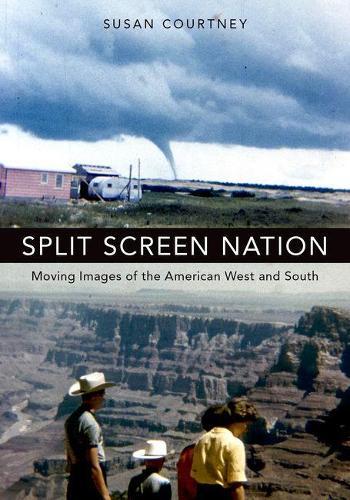
Split Screen Nation traces an oppositional dynamic between the screen West and the screen South that was unstable and dramatically shifting in the decades after WWII, and has marked popular ways of imagining the U.S. ever since. If this dynamic became vivid in Quentin Tarantino's Django Unchained (2012), itself arguably a belated response to Easy Rider (1969), this book helps us understand those films, and much more, through an eclectic history of U.S. screen media from the postwar era. It deftly analyzes not only Hollywood films and television, but also educational and corporate films, amateur films (aka ""home movies""), and military and civil defense films featuring ""tests"" of the atomic bomb in the desert. Attentive to sometimes profoundly different contexts of production and consumption shaping its varied examples, Split Screen Nation argues that in the face of the Cold War and the civil rights struggle an implicit, sometimes explicit, opposition between the screen West and the screen South nonetheless mediated the nation's most paradoxical narratives--namely, ""land of the free""/land of slavery, conquest, and segregation. Whereas confronting such contradictions head-on could capsize cohesive conceptions of the U.S., by now familiar screen forms of the West and the South split them apart to offer convenient, discrete, and consequential imaginary places upon which to collectively project avowed aspirations and dump troubling forms of national waste. Pinpointing some of the most severe yet understudied postwar trends fueling this dynamic--including non-theatrical film road trips, feature films adapted from Tennessee Williams, and atomic test films--and mining their potential for more complex ways of thinking and feeling the nation, Split Screen Nation considers how the vernacular screen forms at issue have helped shape how we imagine not only America's past, but also the limits and possibilities of its present and future.
Full Product Details
Author: Susan Courtney (Associate Professor, Film and Media Studies, Associate Professor, Film and Media Studies, University of South Carolina)
Publisher: Oxford University Press Inc
Imprint: Oxford University Press Inc
Dimensions:
Width: 25.70cm
, Height: 2.30cm
, Length: 18.30cm
Weight: 0.774kg
ISBN: 9780190459963
ISBN 10: 0190459964
Pages: 328
Publication Date: 30 March 2017
Audience:
General/trade
,
General
Format: Hardback
Publisher's Status: Active
Availability: Manufactured on demand

We will order this item for you from a manufactured on demand supplier.
Reviews
""Split Screen Nation is a model of rigorous historical scholarship committed to critiquing racist ideology and practices."" -- Jennifer Peterson, Journal of Cinema and Media Studies ""Split Screen Nation explores the crucial ideological gains and risks that arise from the imaginary splitting of the nation into West and South, into the screen's realizations of 'national promise' in one landscape and of 'national disgrace' in the other. Susan Courtney brings together varied cultural documents, reading each with subtlety and finesse; along with her expert analyses of key Westerns and Southerns, she studies the filmed record of atomic bomb tests, maps, photographs, advertisements, found footage, and TV. This is a rich, smart, and original interdisciplinary work."" -- Steven Cohan, author of Masked Men: Masculinity and the Movies in the Fifties and Incongruous Entertainment: Camp, Cultural Value, and the MGM Musical ""This book delivers a genuinely original and insightful rethinking of how a multilayered mediascape shaped the ways in which Americans thought about and imagined the nation's defining regions, identities, and landscapes. Courtney's study of mid-twentieth-century culture takes full advantage of the new tools of twenty-first century historiography. Split Screen Nation reaches broadly to synthesize an impressive variety of cinematic and televisual source material. It deftly demonstrates how popular Hollywood films must be seen as works ever in dialogue with their far more numerous contemporaries--amateur films, home movies, government films, newsreels, local television, sponsored films, and other productions only now being intellectually mapped."" -- Dan Streible, New York University
Split Screen Nation explores the crucial ideological gains and risks that arise from the imaginary splitting of the nation into West and South, into the screen's realizations of 'national promise' in one landscape and of 'national disgrace' in the other. Susan Courtney brings together varied cultural documents, reading each with subtlety and finesse; along with her expert analyses of key Westerns and Southerns, she studies the filmed record of atomic bomb tests, maps, photographs, advertisements, found footage, and TV. This is a rich, smart, and original interdisciplinary work. -- Steven Cohan, author of Masked Men: Masculinity and the Movies in the Fifties and Incongruous Entertainment: Camp, Cultural Value, and the MGM Musical This book delivers a genuinely original and insightful rethinking of how a multilayered mediascape shaped the ways in which Americans thought about and imagined the nation's defining regions, identities, and landscapes. Courtney's study of mid-twentieth-century culture takes full advantage of the new tools of twenty-first century historiography. Split Screen Nation reaches broadly to synthesize an impressive variety of cinematic and televisual source material. It deftly demonstrates how popular Hollywood films must be seen as works ever in dialogue with their far more numerous contemporaries--amateur films, home movies, government films, newsreels, local television, sponsored films, and other productions only now being intellectually mapped. -- Dan Streible, New York University
Split Screen Nation explores the crucial ideological gains and risks that arise from the imaginary splitting of the nation into West and South, into the screens realizations of national promise in one landscape and of national disgrace in the other. Susan Courtney brings together varied cultural documents, reading each with subtlety and finesse; along with her expert analyses of key Westerns and Southerns, she studies the filmed record of atomic bomb tests, maps, photographs, advertisements, found footage, and TV. This is a rich, smart, and original interdisciplinary work. Steven Cohan, author of Masked Men: Masculinity and the Movies in the Fifties and Incongruous Entertainment: Camp, Cultural Value, and the MGM Musical This book delivers a genuinely original and insightful rethinking of how a multilayered mediascape shaped the ways in which Americans thought about and imagined the nations defining regions, identities, and landscapes. Courtneys study of mid-twentieth-century culture takes full advantage of the new tools of twenty-first century historiography. Split Screen Nation reaches broadly to synthesize an impressive variety of cinematic and televisual source material. It deftly demonstrates how popular Hollywood films must be seen as works ever in dialogue with their far more numerous contemporaries amateur films, home movies, government films, newsreels, local television, sponsored films, and other productions only now being intellectually mapped. Dan Streible, New York University a
This book delivers a genuinely original and insightful rethinking of how a multilayered mediascape shaped the ways in which Americans thought about and imagined the nations defining regions, identities, and landscapes. Courtneys study of mid-twentieth-century culture takes full advantage of the new tools of twenty-first century historiography. Split Screen Nation reaches broadly to synthesize an impressive variety of cinematic and televisual source material. It deftly demonstrates how popular Hollywood films must be seen as works ever in dialogue with their far more numerous contemporaries amateur films, home movies, government films, newsreels, local television, sponsored films, and other productions only now being intellectually mapped. * Dan Streible, New York University a * Split Screen Nation explores the crucial ideological gains and risks that arise from the imaginary splitting of the nation into West and South, into the screens realizations of national promise in one landscape and of national disgrace in the other. Susan Courtney brings together varied cultural documents, reading each with subtlety and finesse; along with her expert analyses of key Westerns and Southerns, she studies the filmed record of atomic bomb tests, maps, photographs, advertisements, found footage, and TV. This is a rich, smart, and original interdisciplinary work. * Steven Cohan, author of Masked Men: Masculinity and the Movies in the Fifties and Incongruous Entertainment: Camp, Cultural Value, and the MGM Musical *
Author Information
Susan Courtney is Professor of Film and Media Studies and English at the University of South Carolina. There she also co-founded the Orphan Film Symposium and has directed the program in Film and Media Studies. She is the author of Hollywood Fantasies of Miscegenation: Spectacular Narratives of Gender and Race, 1903-1967 (2005).