Overview
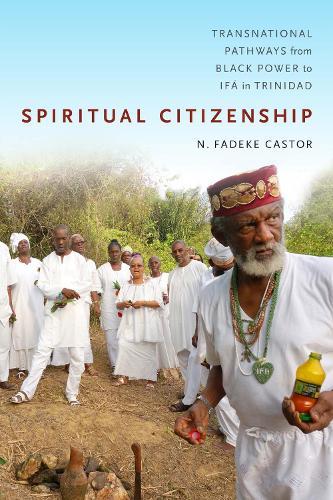
In Spiritual Citizenship N. Fadeke Castor employs the titular concept to illuminate how Ifa/Orisha practices informed by Yoruba cosmology shape local, national, and transnational belonging in African diasporic communities in Trinidad and beyond. Drawing on almost two decades of fieldwork in Trinidad, Castor outlines how the political activism and social upheaval of the 1970s set the stage for African diasporic religions to enter mainstream Trinidadian society. She establishes how the postcolonial performance of Ifa/Orisha practices in Trinidad fosters a sense of belonging that invigorates its practitioners to work toward freedom, equality, and social justice. Demonstrating how spirituality is inextricable from the political project of black liberation, Castor illustrates the ways in which Ifa/Orisha beliefs and practices offer Trinidadians the means to strengthen belonging throughout the diaspora, access past generations, heal historical wounds, and envision a decolonial future.
Full Product Details
Author: N. Fadeke Castor
Publisher: Duke University Press
Imprint: Duke University Press
Weight: 0.386kg
ISBN: 9780822368953
ISBN 10: 0822368951
Pages: 256
Publication Date: 28 November 2017
Audience:
Professional and scholarly
,
Professional & Vocational
Format: Paperback
Publisher's Status: Active
Availability: Manufactured on demand

We will order this item for you from a manufactured on demand supplier.
Reviews
Spiritual Citizenship is a groundbreaking ethnography. . . . With vivid, engaging and descriptive writing, Castor examines how Ifa/Orisha religious communities that were for decades persecuted and maligned have been re-evaluated in the context of the Black Power Movement in Trinidad-later defined as integral to the pluralistic and multicultural nation and simultaneously incorporated into transnational spiritual networks of priests and practitioners. -- Yolanda D. Covington-Ward * Transforming Anthropology * Spiritual Citizenship is an important text. . . . An essential teaching text on questions of multiculturalism, citizenship, race, and religion. Its engaging writing style on these timely issues and its focus on the under-studied (but fascinating) religious context of Trinidad make Spiritual Citizenship a must-read. -- J. Brent Crosson * Reading Religion * The author deftly describes the ritual practices of African-based religions in the African diaspora and highlights the role of international conferences in the formation of religious identity. Additionally, she successfully relates the contemporary Orisa movement in Trinidad to the 1970s Trinidad black power movement. . . . Castor does an outstanding job of portraying the flow of ritual and ritual performance. Highly recommended. -- S. D. Glazier * Choice *
Spiritual Citizenship is a tour-de-force of the twenty-first century kind. It proposes a reconceptualization of the way that scholars understand notions of cultural citizenship, insisting that we consider the spiritual epistemologies engaged in sacred meaning making. Through an examination of the complex ways that new domains of belonging are being negotiated and life worlds made meaningful, Spiritual Citizenship moves the anthropological scholarship on Orisha religious practices to a new level of engagement with spiritual ontologies of citizenship. It is a must read for those committed to decolonizing anthropology through the last bastion of the enlightenment--that of decolonizing our epistemologies of knowledge. --Kamari Maxine Clarke, author of Mapping Yoruba Networks: Power and Agency in the Making of Transnational Communities
Spiritual Citizenship is a tour-de-force of the twenty-first century kind. It proposes a reconceptualization of the way that scholars understand notions of cultural citizenship, insisting that we consider the spiritual epistemologies engaged in sacred meaning making. Through an examination of the complex ways that new domains of belonging are being negotiated and life worlds made meaningful, Spiritual Citizenship moves the anthropological scholarship on Orisa Religious Practices to a new level of engagement with spiritual ontologies of citizenship. It is a must read for those committed to decolonizing anthropology through the last bastion of the enlightenment--that of decolonizing our epistemologies of knowledge. --Kamari Maxine Clarke, author of Mapping Yoruba Networks: Power and Agency in the Making of Transnational Communities
Author Information
N. Fadeke Castor is Assistant Professor of Religion and Africana Studies at Northeastern University.