Overview
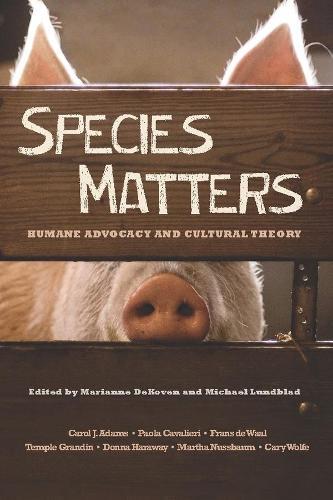
Why has the academy struggled to link advocacy for animals to advocacy for various human groups? Within cultural studies, in which advocacy can take the form of a theoretical intervention, scholars have resisted arguments that add ""species"" to race, class, gender, sexuality, disability, and other human-identity categories as a site for critical analysis. Species Matters considers whether cultural studies should pay more attention to animal advocacy and whether, in turn, animal studies should pay more attention to questions raised by cultural theory. The contributors to this volume explore these issues particularly in relation to the ""humane"" treatment of animals and various human groups and the implications, both theoretical and practical, of blurring the distinction between ""the human"" and ""the animal."" They address important questions raised by the history of representing humans as the only animal capable of acting humanely and provide a framework for reconsidering the nature of humane discourse, whether in theory, literary and cultural texts, or current advocacy movements outside of the academy.
Full Product Details
Author: Marianne DeKoven ,
Michael Lundblad
Publisher: Columbia University Press
Imprint: Columbia University Press
Dimensions:
Width: 14.00cm
, Height: 1.80cm
, Length: 21.00cm
Weight: 0.269kg
ISBN: 9780231152839
ISBN 10: 0231152833
Pages: 240
Publication Date: 20 December 2011
Audience:
General/trade
,
General
Format: Paperback
Publisher's Status: Active
Availability: Manufactured on demand

We will order this item for you from a manufactured on demand supplier.
Language: English
Reviews
<p>To date, there has been relatively little discussion about the possible connection between animal studies (a discourse that has recently emerged in the academy across several disciplines) and advocacy on behalf of the welfare and well-being of animals. This volume takes as its aim the discussion of such possible connections. This is an important question to pursue, as the discussion of politics, policy, and advocacy often remains implicit or in the background in much recent work on animal studies. By bringing this question to the foreground, the editors do a great service for readers who might be attracted to this literature in terms of its promise or usefulness for various kinds of activism. Likewise, it allows those authors and academics who are interested in animal studies to give further consideration to the possible political implications of work done in this field of inquiry.--Matthew Calarco, Matthew Calarco, author of Zoographies: The Question of the Animal from Heidegger to
To date, there has been little discussion about the possible connection between animal studies and advocacy on behalf of the welfare and well-being of animals. This volume takes as its aim the discussion of such possible connections -- an important investigation, as the relationship among politics, policy, and advocacy often remains implicit or in the background in much recent work on animal studies. By foregrounding this inquiry, Marianne DeKoven and Michael Lundblad do a great service to readers who might be attracted to this literature's promise or usefulness for various kinds of activism. Likewise, it allows authors and academics interested in animal studies to give further consideration to the possible political implications of work done in this field. -- Matthew Calarco, author of Zoographies: The Question of the Animal from Heidegger to Derrida Intellectually and politically challenging, this provocative collection provides a solid introduction to the field's breadth and a contribution to the debate for those already engaged with the question of the animal.Choice Choice 8/1/2012
To date, there has been little discussion about the possible connection between animal studies and advocacy on behalf of the welfare and well-being of animals. This volume takes as its aim the discussion of such possible connections--an important investigation, as the relationship among politics, policy, and advocacy often remains implicit or in the background in much recent work on animal studies. By foregrounding this inquiry, Marianne DeKoven and Michael Lundblad do a great service to readers who might be attracted to this literature's promise or usefulness for various kinds of activism. Likewise, it allows authors and academics interested in animal studies to give further consideration to the possible political implications of work done in this field. -- Matthew Calarco, author of Zoographies: The Question of the Animal from Heidegger to Derrida Intellectually and politically challenging, this provocative collection provides a solid introduction to the field's breadth and a contribution to the debate for those already engaged with the question of the animal.Choice Choice
To date, there has been relatively little discussion about the possible connection between animal studies (a discourse that has recently emerged in the academy across several disciplines) and advocacy on behalf of the welfare and well-being of animals. This volume takes as its aim the discussion of such possible connections. This is an important question to pursue, as the discussion of politics, policy, and advocacy often remains implicit or in the background in much recent work on animal studies. By bringing this question to the foreground, the editors do a great service for readers who might be attracted to this literature in terms of its promise or usefulness for various kinds of activism. Likewise, it allows those authors and academics who are interested in animal studies to give further consideration to the possible political implications of work done in this field of inquiry. -- Matthew Calarco, Matthew Calarco, author of Zoographies: The Question of the Animal from Heidegger to Derrida
Author Information
Marianne DeKoven is professor of English at Rutgers University and a recipient of both Guggenheim and Rockefeller fellowships. Her books include Utopia Limited: The Sixties and the Emergence of the Postmodern, which won the Perkins Award from the Society of Narrative Literature; Rich and Strange: Gender, History, Modernism; and A Different Language: Gertrude Stein's Experimental Writing. She is also the editor of the Norton Critical Edition of Stein's Three Lives. Michael Lundblad is assistant professor of English and director of animality studies at Colorado State University. His research focuses on twentieth-century American literature and culture, cultural studies, ecocriticism, and animal and animality studies. His work has appeared in American Literature, PMLA, American Quarterly, and ISLE: Interdisciplinary Studies in Literature and Environment.