Awards
- "Winner of Foreign Affairs ""Best Book"" 2019 (United States)"
- Winner of Foreign Affairs Best Book 2019 (United States)
- Winner of Foreign Affairs Outstanding New Book 2019 (United States)
- Winner of Foreign Affairs ""Best Book"" 2019 (United States)
Overview
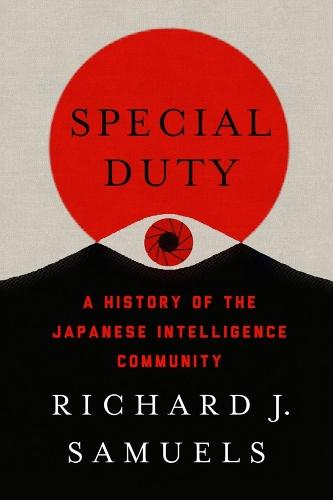
The prewar history of the Japanese intelligence community demonstrates how having power over much, but insight into little can have devastating consequences. Its postwar history-one of limited Japanese power despite growing insight-has also been problematic for national security. In Special Duty Richard J. Samuels dissects the fascinating history of the intelligence community in Japan. Looking at the impact of shifts in the strategic environment, technological change, and past failures, he probes the reasons why Japan has endured such a roller-coaster ride when it comes to intelligence gathering and analysis, and concludes that the ups and downs of the past century-combined with growing uncertainties in the regional security environment-have convinced Japanese leaders of the critical importance of striking balance between power and insight. Using examples of excessive hubris and debilitating bureaucratic competition before the Asia-Pacific War, the unavoidable dependence on US assets and popular sensitivity to security issues after World War II, and the tardy adoption of image-processing and cyber technologies, Samuels' bold book highlights the century-long history of Japan's struggles to develop a fully functioning and effective intelligence capability, and makes clear that Japanese leaders have begun to reinvent their nation's intelligence community.
Full Product Details
Author: Richard J. Samuels
Publisher: Cornell University Press
Imprint: Cornell University Press
Dimensions:
Width: 15.20cm
, Height: 3.20cm
, Length: 22.90cm
Weight: 0.907kg
ISBN: 9781501741586
ISBN 10: 1501741586
Pages: 384
Publication Date: 15 October 2019
Recommended Age: From 18 years
Audience:
General/trade
,
General
Format: Hardback
Publisher's Status: Active
Availability: To order

Stock availability from the supplier is unknown. We will order it for you and ship this item to you once it is received by us.
Reviews
Samuels has presented an ambitious study of Japanese intelligence. It is a history of expansion, accommodation, tinkering, reimaging, and reengineering. It is the story of the poor political leadership and lack of vision. The result is one of turmoil and change with minimal progress until very recently. Samuels' book is a study of the political process of creating a viable intelligence community - and the price of lacking political leadership. This is an important book that captures an important story of the eventual attempt to develop a Japanese intelligence community. * Intelligence and National Security * Samuels takes on on the bumpy and at times wacky of journey of Japanese intelligence. [It} provides an excellent, exhaustive insight into that which has gone before, and poses some unsettling questions as to the way forward. It is, indeed, a timely book of great value to policy makers, scholars, and students. * Journal of Military History * Richard Samuels, a professor at MIT and renowned Japanese expert, has written the definitive history of Japan's intelligence community -- or lack thereof. * Global Asia * Richard Samuels has produced an informative book about the evolution and current state of the Japanese intelligence community. * Survival: Global politics and strategy * Special Duty is an excellent study, meticulously researched and well written. It fills a vital gap in current scholarship, as there is a dearth of reliable historical accounts of Japanese intelligence, especially of the postwar period. The work is essential reading for historians of modern Japan, scholars of intelligence, and any reader interested in the Japanese intelligence community. * Monumenta Nipponica * Focusing on intelligence gathering by the modern Japanese state from 1895, the author's insights into pre-war hubris and debilitating bureaucratic competition and postwar reliance on the U.S. will attract fans of both geopolitical and military history. * Japan Times * This engrossing history of Japanese intelligence demonstrates how such changes have made Japan a better security partner for the United States while preparing the country to stand on its own if the U.S. security guarantee loses its credibility. * Foreign Affairs * A thorough, and thoroughly alarming, treatment of the subject matter, this book is a valuable contribution to the study of intelligence. * Choice *
With deep mastery of Japanese and American archival material and a raft of interviews with key players, Professor Samuels has captured in a single, valuable volume the successes and failures of Japanese intelligence since 1895 and, above all, the political cross-currents and unique restraints under which its agencies have operated since 1945. -- Joel Brenner, former head of US counterintelligence, Office of the Director of National Intelligence and former Inspector General of the National Security Agency This book is a masterpiece that incisively analyzes the Japanese intelligence community and its activities. I learned a lot from this book. I think that Japan wants to overcome the various problems facing its intelligence and become a part of the Five Eyes as soon as possible. -- Satoshi Morimoto, Former Minister of Defense, Japan Special Duty is a timely book, and a suitable next installment in Richard Samuels' influential oeuvre on modern Japanese security policy. -- Michael Green, Georgetown University, author of <I>Arming Japan</I> This is a truly wonderful book written by a leading and highly respected scholar in the field of Japanese security and politics. It offers much needed insight to academics and policymakers alike as they seek to understand the changes in Japan's security choices. -- Sheila Smith, Council on Foreign Relations, author of <I>Intimate Rivals</I>
Author Information
Richard J. Samuels is Ford International Professor of Political Science and Director of the Center for International Studies at the Massachusetts Institute of Technology, and Einstein Visiting Fellow at the Free University of Berlin. His books have won prizes from the American Political Science Association, the Association for Asian Studies, and the Society for Italian Historical Studies. His most recent book is 3.11. Follow him on X @dicksamuelsMIT.