Full Product Details
Author: Dr Neil Cohn (Tilburg University, The Netherlands)
Publisher: Bloomsbury Publishing PLC
Imprint: Bloomsbury Academic
Dimensions:
Width: 19.20cm
, Height: 2.20cm
, Length: 24.80cm
Weight: 0.840kg
ISBN: 9781350402171
ISBN 10: 1350402176
Pages: 328
Publication Date: 19 February 2026
Audience:
College/higher education
,
Professional and scholarly
,
Tertiary & Higher Education
,
Professional & Vocational
Format: Hardback
Publisher's Status: Active
Availability: To order

Stock availability from the supplier is unknown. We will order it for you and ship this item to you once it is received by us.
Reviews
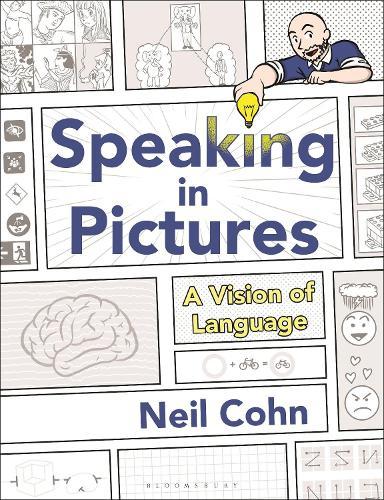
Understanding Comics by artist McCloud now has an even more ambitious scholarly competitor. In Speaking in Pictures Cohn pushes his claim that visuals are languages to the limit. No theorist of visual communication, multimodality, and cognition can afford to ignore the challenging ideas in this ingenious, intelligent, and experiment-supported monograph * Charles Forceville, Dept. of Media Studies/ACLC, University of Amsterdam * A visually stunning tour de force that redefines what we mean by language itself — essential reading for linguists, cognitive scientists, and anyone fascinated by language and comics. * Prof. Bodo Winter * Cartoonists often say that ""comics is a language."" Neil Cohn brings rigor and clarity to this notion, arguing that comics are more precisely an instance of visual language whose rules function the same way as spoken or signed language. I can't wait to see how cartoonists incorporate Cohn’s insights into their work in the future. * Matt Madden, author of 99 Ways to Tell a Story: Exercises in Style * Though I’ve been creating and editing comics for decades, every time I read Neil Cohn’s insights into the comics medium, I gain valuable new knowledge. His latest work, “Speaking in Pictures,” is clear and comprehensive. Reading it will be time well spent for anyone who loves comics * Adjunct Professor, School of Visual Arts. Author of “The DC Comics Guide to Creating Comics: Inside the Art of Visual Storytelling” * This is a book of immense scope, in which Cohn takes the reader on a whirlwind tour of Peircean semiotics, sensory perception, Gestalt psychology, conceptual metaphor theory, blending theory, construction grammar, empirical neuro-cognition, and theories of grammar, all leading to his own particular take on multimodality and the essential position of a visual graphic mode within that. Although written in comicbook form and also, in part, concerning comics, this is no simple 'update' of McCloud. It is instead a major contribution to the theory of multimodality and visual language, relevant for students and advanced researchers alike. Just like the subtly growing audience depicted by Cohn as his lectures gather pace, this book can similarly be expected to broaden awareness and interest in multimodality across the board. A veritable tour de force. * John Bateman * Speaking With Pictures pushes boundaries of how we disseminate scientific content in unprecedented ways. Cohn’s innovative use of the comic format to illustrate theory and research is truly unique. The format allows him to illustrate complex arguments as they are being made. It is a must read for cognitive scientists interested in the psychology of visual languages and anyone who loves comics. * Joe Magliano, Professor of Educational Psychology, Georgia State University. * I’ve read a ton of comics–and a small handful of prose books about teaching and studying comics in a classroom–but Neil Cohn’s Speaking in Pictures, a comic about teaching and studying comics in a classroom is a unique work, one that uses the author’s personal experiences in teaching and researching linguistics to dissect how comics work. In its investigation of comics, language, learning, and drawing, Speaking in Pictures leverages the comics medium’s extraordinary ability to make complex concepts accessible and comprehensible to craft a work that’s as thought-provoking as it is enjoyable to read. * Ben Towle *
Understanding Comics by artist McCloud now has an even more ambitious scholarly competitor. In Speaking in Pictures Cohn pushes his claim that visuals are languages to the limit. No theorist of visual communication, multimodality, and cognition can afford to ignore the challenging ideas in this ingenious, intelligent, and experiment-supported monograph * Charles Forceville, Dept. of Media Studies/ACLC, University of Amsterdam * A visually stunning tour de force that redefines what we mean by language itself — essential reading for linguists, cognitive scientists, and anyone fascinated by language and comics. * Prof. Bodo Winter * Cartoonists often say that ""comics is a language."" Neil Cohn brings rigor and clarity to this notion, arguing that comics are more precisely an instance of visual language whose rules function the same way as spoken or signed language. I can't wait to see how cartoonists incorporate Cohn’s insights into their work in the future. * Matt Madden, author of 99 Ways to Tell a Story: Exercises in Style * Though I’ve been creating and editing comics for decades, every time I read Neil Cohn’s insights into the comics medium, I gain valuable new knowledge. His latest work, “Speaking in Pictures,” is clear and comprehensive. Reading it will be time well spent for anyone who loves comics * Adjunct Professor, School of Visual Arts. Author of “The DC Comics Guide to Creating Comics: Inside the Art of Visual Storytelling” * This is a book of immense scope, in which Cohn takes the reader on a whirlwind tour of Peircean semiotics, sensory perception, Gestalt psychology, conceptual metaphor theory, blending theory, construction grammar, empirical neuro-cognition, and theories of grammar, all leading to his own particular take on multimodality and the essential position of a visual graphic mode within that. Although written in comicbook form and also, in part, concerning comics, this is no simple 'update' of McCloud. It is instead a major contribution to the theory of multimodality and visual language, relevant for students and advanced researchers alike. Just like the subtly growing audience depicted by Cohn as his lectures gather pace, this book can similarly be expected to broaden awareness and interest in multimodality across the board. A veritable tour de force. * John Bateman * Throughout his career, Neil Cohn pushed the boundaries of how scientific content is disseminated. He has been committed to making arguments to the scientific community, but in a manner that is accessible to the public. In using the format of a comic to convey what he has learned about visual languages, he pushes those boundaries yet again. It is a must read for cognitive scientists, students interested in the psychology of visual languages, and anyone who loves comics. * Joe Magliano *
Understanding Comics by artist McCloud now has an even more ambitious scholarly competitor. In Speaking in Pictures Cohn pushes his claim that visuals are languages to the limit. No theorist of visual communication, multimodality, and cognition can afford to ignore the challenging ideas in this ingenious, intelligent, and experiment-supported monograph * Charles Forceville, Dept. of Media Studies/ACLC, University of Amsterdam * A visually stunning tour de force that redefines what we mean by language itself — essential reading for linguists, cognitive scientists, and anyone fascinated by language and comics. * Prof. Bodo Winter * Cartoonists often say that ""comics is a language."" Neil Cohn brings rigor and clarity to this notion, arguing that comics are more precisely an instance of visual language whose rules function the same way as spoken or signed language. I can't wait to see how cartoonists incorporate Cohn’s insights into their work in the future. * Matt Madden, author of 99 Ways to Tell a Story: Exercises in Style * Though I’ve been creating and editing comics for decades, every time I read Neil Cohn’s insights into the comics medium, I gain valuable new knowledge. His latest work, “Speaking in Pictures,” is clear and comprehensive. Reading it will be time well spent for anyone who loves comics * Adjunct Professor, School of Visual Arts. Author of “The DC Comics Guide to Creating Comics: Inside the Art of Visual Storytelling” * This is a book of immense scope, in which Cohn takes the reader on a whirlwind tour of Peircean semiotics, sensory perception, Gestalt psychology, conceptual metaphor theory, blending theory, construction grammar, empirical neuro-cognition, and theories of grammar, all leading to his own particular take on multimodality and the essential position of a visual graphic mode within that. Although written in comicbook form and also, in part, concerning comics, this is no simple 'update' of McCloud. It is instead a major contribution to the theory of multimodality and visual language, relevant for students and advanced researchers alike. Just like the subtly growing audience depicted by Cohn as his lectures gather pace, this book can similarly be expected to broaden awareness and interest in multimodality across the board. A veritable tour de force. * John Bateman * Speaking With Pictures pushes boundaries of how we disseminate scientific content in unprecedented ways. Cohn’s innovative use of the comic format to illustrate theory and research is truly unique. The format allows him to illustrate complex arguments as they are being made. It is a must read for cognitive scientists interested in the psychology of visual languages and anyone who loves comics. * Joe Magliano, Professor of Educational Psychology, Georgia State University. *
Author Information
Neil Cohn is Associate Professor of Communication and Cognition at Tilburg University, the Netherlands. He is the author of The Visual Language of Comics (2013), Who Understands Comics? (2020), and editor of The Visual Narrative Reader (2016).