Overview
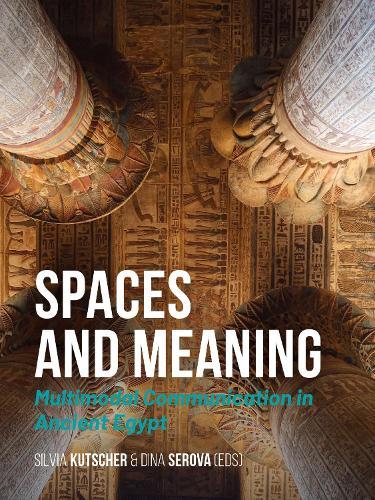
Multimodality – the integration of different semiotic resources in communication – plays a key role in the way people convey meaning. While much of the research has focused on multimodal communication in modern European and Anglo-Saxon cultures, the diverse visual and textual compositions of ancient civilizations have been less explored. This book presents the findings of a working group on multimodal communication in Ancient Egypt and explores the multimodal nature of Egyptian artifacts decorated with texts, images or text-image compositions through a new interdisciplinary perspective on their semiotic properties. Applying approaches from semiotics, linguistics and visual studies to these ancient materials opens up new perspectives that deepen our understanding of how space and spatial relationships contribute to the interpretation of decorated artifacts. The spatial arrangement of these artifacts within and interactions with their physical surroundings – whether on walls, on statues or within architectural complexes – offer crucial insights into communicative practices in Ancient Egypt and reveal the sophisticated ways in which space was used to convey complex messages. By examining the spatiality of different objects and groups of objects, this volume demonstrates that the multimodal approach not only enriches the interpretation of individual artifacts, but also leads to a more comprehensive analysis of communicative strategies within Ancient Egyptian culture.
Full Product Details
Author: Silvia Kutscher ,
Dina Serova
Publisher: Sidestone Press
Imprint: Sidestone Press
ISBN: 9789464271201
ISBN 10: 9464271205
Pages: 180
Publication Date: 31 August 2025
Audience:
Professional and scholarly
,
Professional & Vocational
Format: Paperback
Publisher's Status: Active
Availability: In Print

This item will be ordered in for you from one of our suppliers. Upon receipt, we will promptly dispatch it out to you. For in store availability, please contact us.
Author Information
Silvia Kutscher is a distinguished academic currently serving as a Professor of Theory and History of Multimodal Communication at the Institute for Archaeology at Humboldt-Universität zu Berlin. She pursued her studies in General Linguistics, German Studies, and History at the University of Cologne from 1989 to 1995. Kutscher completed her Ph.D. in 2000 and earned her habilitation in 2007, both at the University of Cologne. Her research primarily focuses on semiotics and the interplay of language, communication, and multimodal discourse, contributing significantly to the understanding of linguistic theories in archaeological contexts. Since 2016, she has been deeply involved in teaching and research at Humboldt-Universität zu Berlin, shaping the field with her interdisciplinary approach to communication and archaeology. She is PI in the Collaborative Research Center 1412 Register and head of the working group Multimodal Communication in Ancient Egypt. Dina Serova completed her PhD in Northeast African Archaeology and Cultural Studies at Humboldt-Universität zu Berlin in 2021. Currently, she is a postdoctoral researcher at Humboldt-Universität zu Berlin and teaches classes on Ancient Egyptian languages and written culture as well as their interpretation by means of theories and methods derived from sociolinguistics, cultural studies, and sociology. As Junior PI of the project Asymmetric Communication in Ancient Egypt within the Collaborative Research Center 1412 Register, she investigates register knowledge and variation in Ancient Egyptian narrative and mortuary texts from a linguistic perspective. She is an active member of several international research groups and projects, such as Multimodal Communication in Ancient Egypt with Silvia Kutscher and the Middle Kingdom Theban Project led by Antonio J. Morales, which emphasize her academic diversity and broad research interests.