Overview
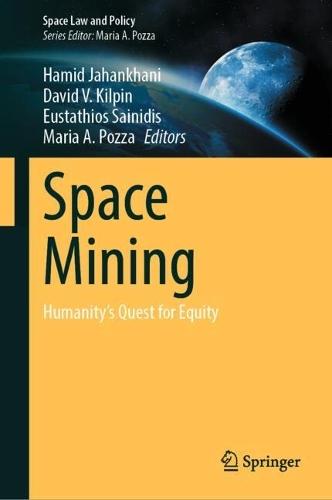
This book examines the emerging industry of extracting resources from celestial bodies, focusing on the ethical, legal, and technological challenges involved. As private companies and national agencies pursue the untapped potential of asteroids and the Moon, the book explores who stands to benefit and how this can be achieved responsibly and sustainably. It addresses critical questions surrounding equity in resource extraction and whether space will remain a shared domain or become a battleground for economic and geopolitical competition. The book also highlights the role of technologies such as blockchain, artificial intelligence, and quantum computing in improving transparency and accountability in space mining operations. In addition to technological insights, the book examines gaps in international space law and offers governance models to guide future activities, ensuring that the exploitation of space resources benefits all humanity. Ideal for policymakers, industry professionals, academics, and those curious about the future of space exploration, Space Mining: Humanity’s Quest for Equity provides a balanced analysis of the opportunities and risks involved in space mining. This book invites readers to consider how humanity’s role in the cosmos can align with principles of fairness, sustainability, and long-term stewardship.
Full Product Details
Author: Hamid Jahankhani ,
David V. Kilpin ,
Eustathios Sainidis ,
Maria A. Pozza
Publisher: Springer Verlag, Singapore
Imprint: Springer Verlag, Singapore
ISBN: 9789819555420
ISBN 10: 9819555426
Pages: 208
Publication Date: 16 February 2026
Audience:
Professional and scholarly
,
Professional & Vocational
Format: Hardback
Publisher's Status: Active
Availability: Not yet available

This item is yet to be released. You can pre-order this item and we will dispatch it to you upon its release.
Author Information
1. Professor Hamid Jahankhani Prof Jahankhani has taught at both the undergraduate and postgraduate level, full and part-time and supervised and examined research students at the MPhil, PhD levels and Doctorate in Professional Studies (DProf). Hamid’s teaching has covered a broad range of computing modules in particular Information Security Management, Information Security Risk and Audit, Digital Forensics, Systems Design & Development, Telecommunications and Networking, Computer Systems. Hamid’s principal research area for a number of years has been in the field of information security management and digital forensics. 2. Dr Kilpin is an accomplished entrepreneur, academic, and thought leader with expertise in digital transformation, specialising in leveraging emerging technologies like AI and blockchain in corporate and public sector ecosystems. With over 20 years of managerial experience and a strong foundation in hybrid and agile project management, he has led transformative projects across sectors. His expertise spans project and programme management, blockchain applications, cybersecurity, and AI-driven solutions, making him a key advisor to organisations seeking to enhance efficiency, sustainability, and profitability. Dr Kilpin is a postgraduate lecturer in the faculty of Business & Law at Northumbria University London, delivering courses on strategy, leadership and digital transformation. His work extends into consultancy and strategic advisory roles for multinational organisations. Dr Kilpin has also been a pivotal voice in academia, regularly contributing to book publications on socio-technical debates and advancing the discourse on blockchain and AI’s role in enhancing governance and transparency. His Doctor of Business Administration (DBA) research, focused on the digital transformation of land title management in Zimbabwe’s mining sector, underscores his commitment to leveraging technology for social good and economic impact. 3. Dr Eustathios Sainidis Dr Eustathios Sainidis is Associate Professor in Strategic Management at Northumbria University and Head of Educational Partnerships of the Northumbria University London Campus. He is an experienced academic and has taught extensively at undergraduate and postgraduate levels, and has supervised and examined a number of doctoral candidates. Eustathios is an active researcher in the subject of manufacturing strategy in SMEs and has a particular interest in the application of mixed methods in business and management research. He has published extensively in high quality, peer reviewed international journals and has also contributed chapters to a number of scholarly books and academic textbooks. 4. Dr Maria A Pozza Dr Maria A Pozza is the Director and Principal of Gravity Lawyers, a law firm that specialises in New Zealand’s space law, international space law, cybersecurity compliance over data, IT and system frameworks, as well as providing commercial and corporate in-house legal support. Dr Maria holds a PhD in international law and policy in outer space, she holds a Masters of International Studies with distinction, Masters in Business (Global Management and Marketing with distinction), New Zealand Law and Practice Exams, PGDip in Legal Skills, BVC, and an LL.B (Hons). Maria has co-edited the book Risk Management in Outer Space Activities as part of the Springer Space Law and Policy series, of which she is the editor.