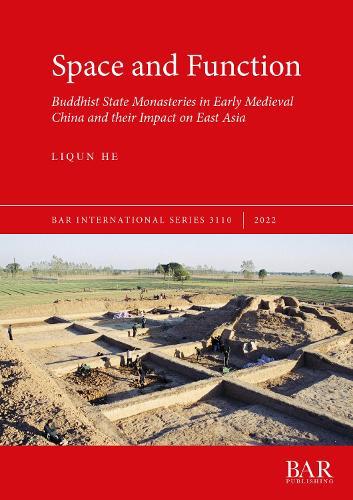
Space and Function: Buddhist State Monasteries in Early Medieval China and their Impact on East Asia

Author:   Liqun He
Publisher:   BAR Publishing
ISBN:  

9781407358147


Pages:   172
Publication Date:   30 November 2022
Format:   Paperback
Availability:   Available To Order   Availability explained
We have confirmation that this item is in stock with the supplier. It will be ordered in for you and dispatched immediately.

Our Price $174.64 Quantity:  
Add to Cart

Share |

Space and Function: Buddhist State Monasteries in Early Medieval China and their Impact on East Asia


Overview

Space and Function is a study of Buddhist State Monasteries in medieval East Asia. The research is based on archaeological evidence and focuses on how the monastery's layout developed with the evolution of Buddhist philosophy and practice. Building on earlier literature regarding the development of Buddhist monastery layouts, Dr He relies on his two decades of excavation experience of relevant monasteries in central China. His assessment of the development of state monasteries between the fifth and seventh century AD is examined in depth. Scholars interested in Buddhism, Chinese architecture, and the history of medieval China and East Asia will find this work informative and valuable.

Full Product Details

Author:   Liqun He
Publisher:   BAR Publishing
Imprint:   BAR Publishing
ISBN:  

9781407358147


ISBN 10:   1407358146
Pages:   172
Publication Date:   30 November 2022
Audience:   Professional and scholarly ,  Professional & Vocational
Format:   Paperback
Publisher's Status:   Active
Availability:   Available To Order   Availability explained
We have confirmation that this item is in stock with the supplier. It will be ordered in for you and dispatched immediately.

Table of Contents

List of Figures List of Colour Illustrations List of Tables Foreword Introduction Defining Buddhist Monasteries Defining Spatial and Temporal Boundaries Previous Research The Significance of the Topic Research Methods 1. Monastery Layout in Early Medieval China: Textual Evidence 1.1. The Introduction of Buddhism and the Establishment of Early Monasteries in China 1.2. Buddhist Monasteries in the Northern and Southern Dynasties 1.3. The Buddhist Monastery System during the Sui and Tang Dynasties 2. Monastery Layout in Early Medieval China: Archaeological Evidence 2.1. Monastery Layout in the Mid-Fifth Century: the Yungang Monastery in Pingcheng 2.2. Monastery Layout in the Late Fifth Century: the Siyuan Monastery in Pingcheng and the Siyan Monastery in Longcheng 2.2.1. Siyuan Monastery 2.2.2 Siyan Monastery 2.3. Monastery Layout in the Early Sixth Century: the Yongningsi Monastery in Luoyang 2.4. Monastery Layout in the Late Sixth Century: the Zhaopengcheng Monastery in Yecheng 2.5. Monastery Layout in the First Half of the Seventh Century: the Linggansi Monastery and the Qinglongsi Monastery in Chang'an 2.6. Monastery Layout in the Mid-Seventh Century: the Ximingsi Monastery in Chang'an 3. Monastery Layout in Early Medieval China: Development and Evolution 3.1. The Buddhist Monastery: Main Buildings and Auxiliary Buildings 3.1.1. Entrance 3.1.2. Perimeter wall, portico and roofed corridor 3.1.3. Pagoda 3.1.4. Buddha Hall 3.1.5. Lecture Hall 3.1.6. Auxiliary buildings 3.1.7. Compound 3.2. Monastery Layout: Types, Periodization and Distinctive Features 3.2.1. The 'Central Pagoda' monastery (mid-fifth century) 3.2.2. The 'Central Pagoda and One Hall in the Rear' monastery (late fifth to early sixth century) 3.2.3. The 'Central Pagoda and Halls on Different Axes' monastery (mid to late sixth century) 3.2.4. The 'Multi-compound and Multi-hall' monastery (after the mid-seventh century) 3.3. The Evolution of Monastery Layout from the Northern Wei to the Tang Dynasty 4. Monastery Layout in Early Medieval East Asia: Archaeological Evidence and Research 4.1. The Korean Peninsula: Monastery Layout during the Three Kingdoms and Unified Silla Periods 4.1.1. Goguryeo Kingdom: 'Central Pagoda and Three Halls' monastery layout 4.1.2. Baekje Kingdom: 'Central Pagoda and One Hall in the Rear' monastery layout 4.1.3. Silla Kingdom: 'Central Pagoda and One Hall in the Rear' and 'Central Pagoda and Three Halls' monastery layouts 4.1.4. Unified Silla: 'Central Hall and Twin Pagodas' and 'Multi-compound and Multi-hall' monastery layouts 4.2. The Japanese Archipelago: Monastery Layout during the Asuka and Nara Periods 4.2.1. Late sixth to first half of the seventh century: 'Central Pagoda and Three Halls' and 'Central Pagoda and One Hall in the Rear' monastery layouts 4.2.2. Mid-seventh century: 'One Pagoda and One Hall Side by Side' and 'One Pagoda and One Hall Side by Side with a Central Hall Behind' monastery layouts 4.2.3. Late seventh to mid-eighth century: 'Central Hall and Twin Pagodas', 'Central Hall and One Pagoda on Different Axes' and 'Multi-compound and Multi-hall' monastery layouts 5. Monastery Layout in East Asia between the Fifth and Eighth Centuries: a Comparative Analysis of Monastery Layouts 5.1. The 'Central Pagoda and One Hall in the Rear' Monastery Layout: Its Diffusion 5.2. The 'Central Pagoda and Three Halls' Monastery Layout: Its Origin and the Contacts between North China and the Korean Peninsula 5.3. 'One Pagoda and One Hall Side by Side' and Several Other Monastery Layouts in Japan: Their Origin and Meaning 5.4. The 'Central Hall and Twin Pagodas' Monastery Layout: Its Origin and Significance in Unified Silla and Japan 5.5. The Main Monastery Layout Types and their Evolution 6. Monastery Layout in Early Medieval China and East Asia: Form and Function 6.1. The Chinese Pavilion-Style Pagoda: Origin and Meaning 6.2. The Development of Buddha Hall: from India to Japan 6.3. The Relationship between Multi-compound Monastery Layout and Urban Layout in East Asia 6.4. The Interaction between Space and Function in the Layout of Buddhist Monasteries Conclusion Bibliography Primary Sources in Chinese, Korean and Japanese Secondary Sources

Reviews

'Dr He is one of the most prominent archaeologists in China in the field of Buddhist archaeology, excavating two state monasteries in the city of Ye in the period relevant to this research. His knowledge of the data, including the historical background and the development of Buddhism in China, is outstanding.' Professor Vignato Giuseppe, Peking University 'One of the greatest strengths of this study is the enormous amount of textual and material evidence the author has drawn together on the topic of early Buddhist monasteries. The author clearly knows many of these sites well, in some cases even having been involved in their excavations.' Dr Aurelia Campbell, Boston College


Author Information

Liqun He has a PhD from Heidelberg University and is an associate researcher at the Institute of Archaeology and Chinese Academy of Social Sciences. He is also a chief researcher of the Innovation Project and the Secretary General of the Professional Committee of Religious Archaeology of the Chinese Archaeological Society.

Tab Content 6

Author Website:  

Countries Available

All regions
Latest Reading Guide

April RG 26_2


Shopping Cart
Your cart is empty
Shopping cart
Mailing List