Awards
- Commended for Honorable mention for the 2017 American Anthropological Association Middle East Section Book Prize 2021
Overview
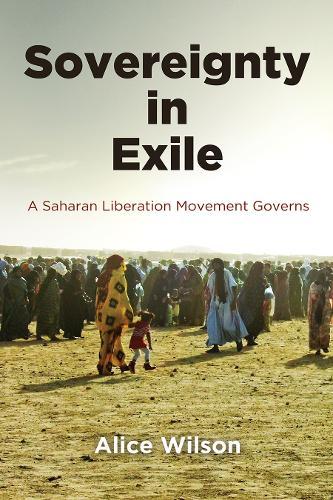
Traces social, political, and economic changes among Sahrawi refugees in North Africa Sovereignty in Exile explores sovereignty and state power through the case of a liberation movement that set out to make itself into a state. The Sahrawi Arab Democratic Republic (SADR) was founded by the Polisario Front in the wake of Spain's abandonment of its former colony, the disputed Western Sahara. Morocco laid claim to the same territory, and the conflict has locked Polisario and Morocco in a political stalemate that has lasted forty years. Complicating the situation is the fact that Polisario conducts its day-to-day operations in refugee camps near Tindouf, in Algeria, which house most of the Sahrawi exile community. SADR (a partially recognized state) and Polisario (Western Sahara's liberation movement) together form an unusual governing authority, originally premised on the dismantling of a perceived threat to national (Sahrawi) unity: tribes. Drawing on unprecedented long-term research gained by living with Sahrawi refugee families, Alice Wilson examines how tribal social relations are undermined, recycled, and have reemerged as the refugee community negotiates governance, resolves disputes, manages social inequalities, and improvises alternatives to taxation. Wilson trains an ethnographic lens on the creation of administrative categories, legal reforms, aid distribution, marriage practices, local markets, and contested elections within the camps. Tracing social, political, and economic changes among Sahrawi refugees, Sovereignty in Exile reveals the dynamics of a postcolonial liberation movement that has endured for decades in the deserts of North Africa while trying to bring about the revolutionary transformation of a society which identifies with a Bedouin past.
Full Product Details
Author: Alice Wilson
Publisher: University of Pennsylvania Press
Imprint: University of Pennsylvania Press
ISBN: 9781512828627
ISBN 10: 1512828629
Pages: 312
Publication Date: 12 August 2025
Audience:
College/higher education
,
Postgraduate, Research & Scholarly
Format: Paperback
Publisher's Status: Active
Availability: Out of stock

The supplier is temporarily out of stock of this item. It will be ordered for you on backorder and shipped when it becomes available.
Reviews
""This deeply researched ethnography takes the case of Western Sahara and the fusing of a liberation movement (Polisario) and a partially recognized Sahrawi state to make a major contribution to the anthropology of the state. Looking particularly at transformations in the social relations of sovereignty, Wilson offers a fascinating account of control, compromises, and the sometimes uneasy coexistence of revolutionary politics and tribal affinities.""-- ""Ilana Feldman, George Washington University"" ""Wilson has produced an impressive work of political ethnography based on over two years of field study of the Polisario refugee camps as the Bedouins attempt to replace tribal loyalties with integrated social relationships reflecting modern statehood...[A]n in-depth analysis of the search for sovereign existence of an exile community, as well as a significant contribution to the workings of refugee camps in general.""-- ""Choice"" ""Sovereignty in Exile is a rich and intriguing ethnography that makes a significant contribution not only to refugee studies but also to the anthropology of sovereignty, state power, and tribal identities.""-- ""Dawn Chatty, University of Oxford"" ""[A] perceptive ethnography of governance in refugee camps run by the Sahrawi Arab Democratic Republic...Sovereignty in Exile exemplifies one of political anthropology's longstanding strengths of providing a more elastic, and less normative, approach to understanding relations of authority, while taking this approach in new and exciting directions.""-- ""Allegra lab"" ""Based upon a diverse and well-developed social network in a context usually closed to foreign researchers, Sovereignty in Exile is an extraordinary work of ethnographic research. Through detailed empirical analysis and a fresh and informed analytical sensibility, Alice Wilson reopens an important, yet often all too narrow, discussion of what counts as democracy in Africa and other so-called developing regions and states.""-- ""Brenda Chalfin, University of Florida""
Author Information
Alice Wilson is Associate Professor in Anthropology at the University of Sussex.