Awards
- Nominated for Joseph Levenson Book Prize 2011
- Winner of Francis L.K. Hsu Book Prize 2010
Overview
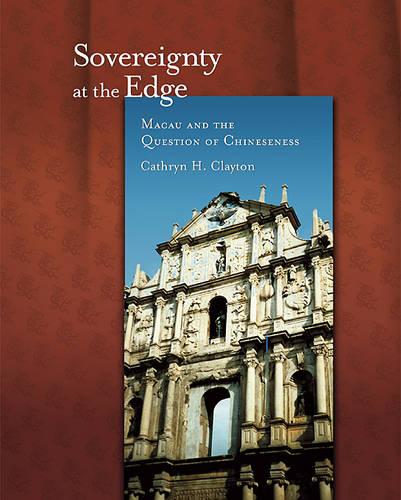
How have conceptions and practices of sovereignty shaped how Chineseness is imagined? This ethnography addresses this question through the example of Macau, a southern Chinese city that was a Portuguese colony from the 1550s until 1999. As the Portuguese administration prepared to transfer Macau to Chinese control, it mounted a campaign to convince the city's residents, 95 percent of whom identified as Chinese, that they possessed a ""unique cultural identity"" that made them different from other Chinese, and that resulted from the existence of a Portuguese state on Chinese soil. This attempt sparked reflections on the meaning of Portuguese governance that challenged not only conventional definitions of sovereignty but also conventional notions of Chineseness as a subjectivity common to all Chinese people around the world. Various stories about sovereignty and Chineseness and their interrelationship were told in Macau in the 1990s. This book is about those stories and how they informed the lives of Macau residents in ways that allowed different relationships among sovereignty, subjectivity, and culture to become thinkable, while also providing a sense of why, at times, it may not be desirable to think them.
Full Product Details
Author: Cathryn H. Clayton
Publisher: Harvard University, Asia Center
Imprint: Harvard University, Asia Center
Volume: No. 324
Dimensions:
Width: 15.60cm
, Height: 3.40cm
, Length: 23.50cm
Weight: 0.771kg
ISBN: 9780674035454
ISBN 10: 0674035453
Pages: 420
Publication Date: 01 March 2010
Audience:
Professional and scholarly
,
College/higher education
,
Professional & Vocational
,
Tertiary & Higher Education
Format: Hardback
Publisher's Status: Active
Availability: In Print

This item will be ordered in for you from one of our suppliers. Upon receipt, we will promptly dispatch it out to you. For in store availability, please contact us.
Reviews
Anthropologist Clayton examines how identity manifested itself in Macau in the years leading up to its reversion to China in 1999, as the Portuguese administration attempted to foster a unique Sino-Western character...Clayton's account is highly anecdotal and personal--the first-person pronoun is used liberally--as well as thoughtful and nuanced.--R. E. Entenmann Choice (01/01/2011)
Anthropologist Clayton examines how identity manifested itself in Macau in the years leading up to its reversion to China in 1999, as the Portuguese administration attempted to foster a unique Sino-Western character...Clayton's account is highly anecdotal and personal--the first-person pronoun is used liberally--as well as thoughtful and nuanced.-- (01/01/2011)
Author Information
Cathryn H. Clayton is Assistant Professor of Asian Studies at the University of Hawaii.