|
|
|||
|
||||
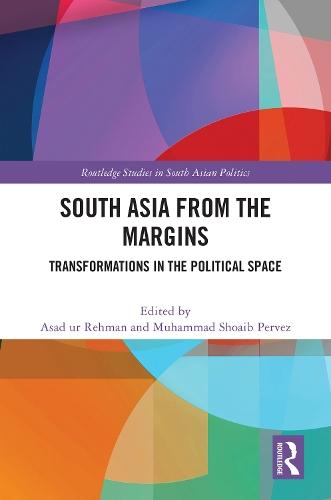
OverviewThis edited volume brings together a group of scholars examining the effects of social change on the politics in South Asia. It cobbles an inductive analytical framework of South Asian margins to comparatively study the political transformations across the region. This book envisages politics encompassing interests, imaginations, activities, and actions of numerous actors. Individual contributors analyze the collective choices made by national elites over the past few decades and their implications for development, democracy, and security of their respective country and the region. The resulting analytical framework provides a comparative political matrix of analysis that prioritizes the margins over the center. The matrix compares different countries around the axis of (1) Political Contestations and Engagements, (2) Decoloniality and Populism, and (3) Policy Frames and Visions. It is a contrapuntal analysis that establishes margins as a legitimate place to approach social scientific study of South Asia. An important and timely contribution to the field, this book will be of interest to researchers studying Asian politics, comparative politics, area studies, in particular South Asia and Pakistan, and international relations. Full Product DetailsAuthor: Asad ur Rehman (Habib University, Pakistan) , Muhammad Shoaib Pervez (University of Management and Technology, Pakistan)Publisher: Taylor & Francis Ltd Imprint: Routledge Weight: 0.625kg ISBN: 9781032868790ISBN 10: 1032868791 Pages: 232 Publication Date: 18 February 2025 Audience: College/higher education , Tertiary & Higher Education Format: Hardback Publisher's Status: Active Availability: In Print This item will be ordered in for you from one of our suppliers. Upon receipt, we will promptly dispatch it out to you. For in store availability, please contact us. Table of ContentsChapter 1. Introduction; Chapter 2. Deliberative Democracy at the local level in Nepal; Chapter 3. Politics around women’s landed inheritance in South Asia: The case of Punjab, Pakistan; Chapter 4. A Critical Analysis of Christians & Scheduled Castes in Pakistan; Chapter 5. Populism and diaspora politics: Imran Khan and the Pakistani diaspora in the West; Chapter 6. Populism(s) in Pakistan: The Comparative Analysis of PTI and People’s Rights Movement in AJK; Chapter 7. Challenging Decoloniality: Human Rights and Hindutva in contemporary India; Chapter 8. Bring decoloniality at home: a critical perspective on security discourse of Pakistan; Chapter 9. Overviewing the Regime of Practical Citizenship in Rural Pakistan; Chapter 10. Welfare Policy Initiatives and State-Society Relations: A case of Kerala’s Tribal Assistance Model; Chapter 11. Bringing agency back in: Disentangling the complexities of Sri Lanka’s default; Chapter 12. Ontological and epistemological considerations about the evolution of secularism in Bangladesh; Epilogue; IndexReviewsAuthor InformationAsad ur Rehman, PhD (Ecole Des Hautes Etudes en Sciences Social, EHESS, Paris France) is Assistant Professor in the School of Arts, Humanities and Social Sciences at Habib University Karachi, Pakistan. He is the author of Politics of Socio- Spatial Transformation in Pakistan (Routledge 2023). Muhammad Shoaib Pervez, PhD (Leiden University, Holland), Fulbright Post- doc (Columbia University New York, USA) is Associate Professor and the former Chair (2016– 2023) of the Department of Political Science and International Relations at the University of Management and Technology, Lahore, Pakistan. He is the author of the award- winning book, Security Community in South Asia (Routledge 2012) and the editor of Radicalization in Pakistan (Routledge 2020). Tab Content 6Author Website:Countries AvailableAll regions |
||||