Overview
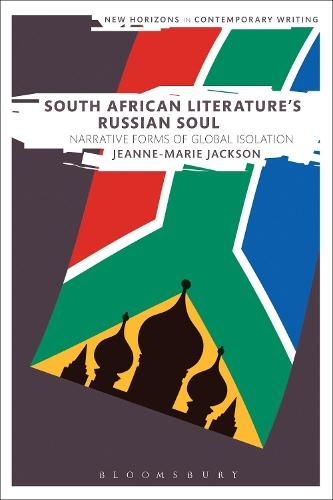
How do great moments in literary traditions arise from times of intense social and political upheaval? South African Literature’s Russian Soul charts the interplay of narrative innovation and political isolation in two of the world’s most renowned non-European literatures. In this book, Jeanne-Marie Jackson demonstrates how Russian writing’s “Golden Age” in the troubled nineteenth-century has served as a model for South African writers both during and after apartheid. Exploring these two isolated literary cultures alongside each other, the book challenges the limits of ""global"" methodologies in contemporary literary studies and outdated models of center-periphery relations to argue for a more locally involved scale of literary enquiry with more truly global horizons.
Full Product Details
Author: Dr Jeanne-Marie Jackson (Connecticut College, USA)
Publisher: Bloomsbury Publishing PLC
Imprint: Bloomsbury Academic
Dimensions:
Width: 15.60cm
, Height: 2.50cm
, Length: 23.40cm
Weight: 0.526kg
ISBN: 9781472592996
ISBN 10: 1472592999
Pages: 248
Publication Date: 22 October 2015
Audience:
College/higher education
,
Undergraduate
,
Postgraduate, Research & Scholarly
Format: Hardback
Publisher's Status: Active
Availability: Manufactured on demand

We will order this item for you from a manufactured on demand supplier.
Reviews
Jeanne-Marie Jackson's book examines the striking series of elective affinities between South African writers and their Russian precursors, from Tolstoy to Nabokov. Anyone with an interest in South African literature will want to read this book, not only for the questions of influence it deals with, but for the way it explores the manifold connections between the local and the global. Patrick Hayes, Teaching Fellow in English Literature, St John's College, University of Oxford, UK Jeanne-Marie Jackson's work breaks genuinely new ground in the study of the postcolonial novel-by reading the novels of apartheid-era South Africa not in relationship to Anglo-American literature, but by considering their relationship to the Russian realist novels of the nineteenth century. ...[It] is often dazzling in its analytic precision, its heft, its depth of analysis. Katie Trumpener, Professor of English and Comparative Literature, Yale University, USA In South African Literature's Russian Soul, Jeanne-Marie Jackson has written what is in many ways the most original and yet the most traditional study of this country's intellectual culture--original because it inspects and reworks the existing frameworks by which we understand the national and international dimensions of the written word, traditional because it does its conceptual work with the old-fashioned virtues of capacious historical learning and microscopic engagement with the details of language and imagination. It is the one book I'll recommend to writers as well as readers who are orienting themselves to this part of the world. Imraan Coovadia, novelist and Director of Creative Writing at the University of Cape Town, South Africa.
Jeanne-Marie Jackson's book examines the striking series of elective affinities between South African writers and their Russian precursors, from Tolstoy to Nabokov. Anyone with an interest in South African literature will want to read this book, not only for the questions of influence it deals with, but for the way it explores the manifold connections between the local and the global. * Patrick Hayes, Teaching Fellow in English Literature, St John's College, University of Oxford, UK * Jeanne-Marie Jackson's work breaks genuinely new ground in the study of the postcolonial novel-by reading the novels of apartheid-era South Africa not in relationship to Anglo-American literature, but by considering their relationship to the Russian realist novels of the nineteenth century. ...[It] is often dazzling in its analytic precision, its heft, its depth of analysis. * Katie Trumpener, Professor of English and Comparative Literature, Yale University, USA * In South African Literature's Russian Soul, Jeanne-Marie Jackson has written what is in many ways the most original and yet the most traditional study of this country's intellectual culture--original because it inspects and reworks the existing frameworks by which we understand the national and international dimensions of the written word, traditional because it does its conceptual work with the old-fashioned virtues of capacious historical learning and microscopic engagement with the details of language and imagination. It is the one book I'll recommend to writers as well as readers who are orienting themselves to this part of the world. * Imraan Coovadia, novelist and Director of Creative Writing at the University of Cape Town, South Africa. *
Author Information
Jeanne-Marie Jackson is Assistant Professor of World Anglophone literature at Johns Hopkins University, USA.