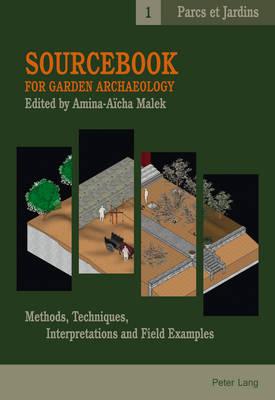
Overview
The Sourcebook for Garden Archaeology addresses the increasing need among archaeologists, who discover a garden during their own excavation project, for advice and update on current issues in garden archaeology. It also aims at stimulating broader interest in garden archaeology. Archaeologists with no specific training in garden archaeology will read about specific problems of soil archaeology with a handful of well-developed techniques, critical discussions and a number of extremely different uses. Methods are described in sufficient detail for any archaeologist to engage into field work, adapt them to their own context and develop their own methodology. While the Sourcebook aims at bringing together different disciplines related to garden archaeology and providing an overview of present knowledge, it also hopes to encourage development of new directions for the future.
Full Product Details
Author: Amina-Aïcha Malek , Amina-Aïcha Malek
Publisher: Peter Lang AG, Internationaler Verlag der Wissenschaften
Imprint: Peter Lang AG, Internationaler Verlag der Wissenschaften
Edition: New edition
Volume: 1
Dimensions:
Width: 16.50cm
, Height: 5.30cm
, Length: 24.00cm
Weight: 1.440kg
ISBN: 9783034305396
ISBN 10: 3034305397
Pages: 796
Publication Date: 11 March 2013
Audience:
Professional and scholarly
,
Professional & Vocational
Format: Paperback
Publisher's Status: Active
Availability: Out of stock 
The supplier is temporarily out of stock of this item. It will be ordered for you on backorder and shipped when it becomes available.
Table of Contents
Contents: Didier Wirth: Preface – Amina-Aïcha Malek: Gardens for Archaeologists – Amina-Aïcha Malek: Preamble. What do Archaeologists Look for when Looking for Gardens? – Kenkichi Ono/Amina-Aïcha Malek: Garden Archaeology in Japan – Amina-Aïcha Malek: Wilhelmina F. Jashemski and the Gardens of the Roman Empire – Amina-Aïcha Malek: Christopher Taylor and British Garden Archaeology – Amina-Aïcha Malek: American Garden Archaeology and the Chesapeake Bay – Amina-Aïcha Malek: Conclusion – Kathryn L. Gleason/Mark P. Leone: Apprehending the Garden: Non-destructive Approaches to Detecting Gardens – Bruce Bevan/Rinita Dalan: Geophysical Exploration of Gardens – Lawrence B. Conyers: Ground-penetrating Radar Exploration and Mapping Techniques for Garden Archaeology – Kathryn L. Gleason: Special Considerations in Excavating a Garden – Kathryn L. Gleason: Detecting and Documenting. Archaeological Features of a Garden through Excavation – Kathryn L. Gleason: Coordinating the Study of Environmental Remains in the Garden Soils – Kathryn L. Gleason/Michele Palmer: Synthesis & Interpretation: The Garden as a Built Environment – Kathryn L. Gleason/Michele Palmer/John E. Foss: Glossary – John E. Foss: Garden Soils – Mark Horrocks: Macroremains of Plants – Eberhard Grüger: Microbotanical Remains: Pollen Analysis – Mark Horrocks: Phytoliths – Hiram Larew: Invertebrates: Insects – James L. Wescoat Jr.: Water and Waterworks in Garden Archaeology – Stefano De Caro/Wilhelmina F. Jashemski: Physical Evidence of the Garden. A. The Gardens of Pompeii and the other Vesuvian Sites – Elizabeth Kryder-Reid: B. The Physical Evidence of the American Garden – Wilhelmina F. Jashemski: Cultural Elaboration of Nature. A. Interpreting the Gardens of Pompeii – Elizabeth Kryder-Reid: B. Interpreting the American Garden – Giorgio Galletti: Preservation, Conservation, and Garden Archaeology – Giorgio Galletti: Experiences in Garden Archaeology – Christopher Currie: Castle Bromwich Hall Gardens, West Midlands, England, UK – Brian Dix: The Gardens at Kirby Hall, Northamptonshire, England, UK – Paul Everson: Stow Park, Lincolnshire, England, UK. Palace and Hunting Park of the Medieval Bishops of Lincoln – Anne Allimant: The Garden of Vallery, Yonne, France – Michel E. Fuchs/Jacques Monnier: Vallon/Sur Dompierre, Canton of Fribourg, Switzerland – Wilhelmina F. Jashemski: The Courtyard Garden in the House of Bacchus and Ariadne at Thuburbo Maius, Zaghouan, Tunisia – Wilhelmina F. Jashemski: The Garden of Hercules at Pompeii, Campania, Italy – Kathryn L. Gleason: The «Villa of Horace» at Licenza, Latium, Italy – Dorota Sikora: Branickis’ Garden in Bialystok, Podlaskie, Poland – Leigh-Ann Bedal/Lawrence B. Conyers/John E. Foss/Kathryn L. Gleason: The Petra Garden and Pool-Complex, Ma’an, Jordan – Dominique Beyer: Sacred Gardens in the Old Town of Emar, Meskene, Syria – Abdul Rehman: Garden of Hasan Abdal (Wah Garden), Punjab, Pakistan – Elizabeth B. Moynihan: The Mahtab Bagh, Agra, Uttar Pradesh, India – Hongxun Yang: The Palace Garden of the Nanyue State, Guangzhou, Guangdong, China – Kenkichi Ono: The Garden at Block 6, East Second Ward on Third Street At the Nara Capital Site, Nara Prefecture, Japan – Mark Horrocks/Robert B. Rechtman: Ancient Gardening in the Kona Field System, Island of Hawai, US – Christian Isendahl: Maya Urban Gardens at Xuch, Campeche, Mexico – Payson Sheets: The Gardens of Ceren, El Salvador – Barbara J. Heath: Landscape Archaeology at Thomas Jefferson’s Poplar Forest, Virginia, US – Mark P. Leone: William
Reviews
Il n'est pas permis de douter que ce riche ouvrage saura trouver son public : etudiants et professionnels de l'archeologie profiteront de sa qualite en termes de contenu et de conceptualisation (cet ouvrage remplit sa fonction de manuel), en termes de presentation formelle (l'objet est beau, les planches couleurs sont de qualite) et de style redactionnel (les traductions de langues etrangeres vers l'anglais sont bonnes). Pour les chercheurs des jardins non archeologues, issus de l'histoire ou de l'histoire de l'art par exemple, les aspects techniques et methodologiques pourront etre maitrises grace a la didactique soignee de l'ouvrage ; mais peut-etre que les elements theoriques concernant les diverses approches du jardin dans le monde seront plus interessants encore pour eux. En tous les cas, l'exhaustivite de l'ouvrage, associee a sa philosophie generale (proposer des modeles et encourager la nouveaute), doit promettre un role decisif a ce Sourcebook dans la diffusion des sciences des jardins . (Ilse Hilbold, Histara - les compte rendus 2015) Read the full review here
Il n'est pas permis de douter que ce riche ouvrage saura trouver son public : etudiants et professionnels de l'archeologie profiteront de sa qualite en termes de contenu et de conceptualisation (cet ouvrage remplit sa fonction de manuel), en termes de presentation formelle (l'objet est beau, les planches couleurs sont de qualite) et de style redactionnel (les traductions de langues etrangeres vers l'anglais sont bonnes). Pour les chercheurs des jardins non archeologues, issus de l'histoire ou de l'histoire de l'art par exemple, les aspects techniques et methodologiques pourront etre maitrises grace a la didactique soignee de l'ouvrage ; mais peut-etre que les elements theoriques concernant les diverses approches du jardin dans le monde seront plus interessants encore pour eux. En tous les cas, l'exhaustivite de l'ouvrage, associee a sa philosophie generale (proposer des modeles et encourager la nouveaute), doit promettre un role decisif a ce Sourcebook dans la diffusion des sciences des jardins . (Ilse Hilbold, Histara - les compte rendus 2015) Read the full review here
Author Information
Amina-Aïcha Malek is researcher at the CNRS laboratory « Archéologies d’Orient et d’Occident et textes anciens » (AOROC) of the École Normale Supérieure (UMR 8546 CNRS-ENS) in Paris, France. Special Garden Archaeology Fellow at Dumbarton Oaks from 1999 to 2002, she has collaborated to several garden excavations, such as the Petra Pool and Garden Project in Jordan, and the garden at the Villa Arianna in Stabiae and the garden of Horace’s Villa in Licenza, Italy. She is co-founder and current vice-chair of the Society for Garden Archaeology.
Tab Content 6
Author Website:
Countries Available
All regions
|