Overview
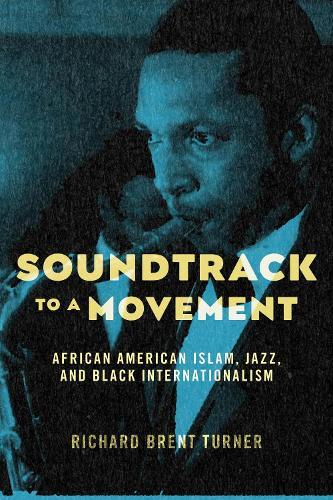
**FINALIST for the 2022 PROSE Award in Music & the Performing Arts** **Certificate of Merit, Best Historical Research on Recorded Jazz, given by the 2022 Association for Recorded Sounds Collection Awards for Excellence in Historical Sound Research** Explores how jazz helped propel the rise of African American Islam during the era of global Black liberation Amid the social change and liberation of the civil rights and Black Power movements, the tenor saxophonist Archie Shepp recorded a tribute to Malcolm X's emancipatory political consciousness. Shepp saw similarities between his revolutionary hero and John Coltrane, one of the most influential jazz musicians of the era. Later, the esteemed trumpeter Miles Davis echoed Shepp's sentiment, recognizing that Coltrane's music represented the very passion, rage, rebellion, and love that Malcolm X preached. Soundtrack to a Movement examines the link between the revolutionary Black Islam of the post-WWII generation and jazz music. It argues that from the late 1940s and '50s though the 1970s, Islam rose in prominence among African Americans in part because of the embrace of the religion among jazz musicians. The book demonstrates that the values that Islam and jazz shared—Black affirmation, freedom, and self-determination—were key to the growth of African American Islamic communities, and that it was jazz musicians who led the way in shaping encounters with Islam as they developed a Black Atlantic ""cool"" that shaped both Black religion and jazz styles. Soundtrack to a Movement demonstrates how by expressing their values through the rejection of systemic racism, the construction of Black notions of masculinity and femininity, and the development of an African American religious internationalism, both jazz musicians and Black Muslims engaged with a global Black consciousness and interconnected resistance movements in the African diaspora and Africa.
Full Product Details
Author: Richard Brent Turner
Publisher: New York University Press
Imprint: New York University Press
Weight: 0.517kg
ISBN: 9781479871032
ISBN 10: 1479871036
Pages: 256
Publication Date: 27 April 2021
Audience:
Professional and scholarly
,
Professional & Vocational
Format: Hardback
Publisher's Status: Active
Availability: Manufactured on demand

We will order this item for you from a manufactured on demand supplier.
Reviews
Muslim jazz artists inspired interest in Sunni, Ahmadi, and the Nation of Islam communities, but the Islam of swing, bebop, hard bop, and free jazz was often not so much a theology as it was a politics, a poetry, a culture of cool. Richard Brent Turner's book reveals how Islam breathed the spirit of supreme love and international Black liberation into America's greatest music. It is required reading for everyone interested in the entangled story of jazz and Islam. -- Edward E. Curtis IV, William M. and Gail M. Plater Chair of the Liberal Arts, Indiana University, Indianapolis A tour de force of interdisciplinary research that identifies, explains, and analyzes previously underexplored links between expressive culture and social identities. For both expert and novice readers, African American Islam and Jazz is filled with delightful surprises. Turner's chapters on Black urban life in Boston and Philadelphia delineate the rich social and historical contexts out of which the musical texts of bebop music emerged. His careful attention to empirical detail reveals southern and Caribbean migrants to these cities to have been neither ruthlessly uprooted nor seamlessly transplanted, but instead positioned inside complex struggles for self-defense, self-determination, and self-activity. -- George Lipsitz, author of How Racism Takes Places Turner's powerful and well-written book taught me new things on just about every single page, new things about jazz much, about Islam in America, and about how those two spheres intersected in the lives and experiences of African Americans. Spanning several decades in the exploits and activities of various Islamic groups, as well as some canonical African American figures, this book provides us with a distinctively new soundtrack for the stories we tell ourselves about black political and religious life. This outstanding offering that will be valued by readers interested in religion, popular music, and/or African American life. -- John L. Jackson, Jr., co-author of Televised Redemption: Black Religious Media and Racial Empowerment Richard Brent Turner's new book greatly expands our knowledge of the rise of Islam as an alternative religious vision among African Americans in the twentieth century. This much-needed study cogently depicts the invention and recrafting of Black notions of masculinity and Black Atlantic coolness that gave structure and shape to both Black militancy and jazz styles during the 1940s and postwar period. Very importantly, Turner contextualizes the intermingling of jazz and Islam against the backdrop of a burgeoning Black internationalism that still powerfully informs contemporary diasporic consciousness. -- Claude A. Clegg III, author of An Original Man: The Life and Times of Elijah Muhammad
Muslim jazz artists inspired interest in Sunni, Ahmadi, and the Nation of Islam communities, but the Islam of swing, bebop, hard bop, and free jazz was often not so much a theology as it was a politics, a poetry, a culture of cool. Richard Brent Turner's book reveals how Islam breathed the spirit of supreme love and international Black liberation into America's greatest music. It is required reading for everyone interested in the entangled story of jazz and Islam. --Edward E. Curtis IV, William M. and Gail M. Plater Chair of the Liberal Arts, Indiana University, Indianapolis Richard Brent Turner's new book greatly expands our knowledge of the rise of Islam as an alternative religious vision among African Americans in the twentieth century. This much-needed study cogently depicts the invention and recrafting of Black notions of masculinity and Black Atlantic coolness that gave structure and shape to both Black militancy and jazz styles during the 1940s and postwar period. Very importantly, Turner contextualizes the intermingling of jazz and Islam against the backdrop of a burgeoning Black internationalism that still powerfully informs contemporary diasporic consciousness. --Claude A. Clegg III, author of An Original Man: The Life and Times of Elijah Muhammad Turner's powerful and well-written book taught me new things on just about every single page, new things about jazz much, about Islam in America, and about how those two spheres intersected in the lives and experiences of African Americans. Spanning several decades in the exploits and activities of various Islamic groups, as well as some canonical African American figures, this book provides us with a distinctively new soundtrack for the stories we tell ourselves about black political and religious life. This outstanding offering that will be valued by readers interested in religion, popular music, and/or African American life. --John L. Jackson, Jr., co-author of Televised Redemption: Black Religious Media and Racial Empowerment A tour de force of interdisciplinary research that identifies, explains, and analyzes previously underexplored links between expressive culture and social identities. For both expert and novice readers, African American Islam and Jazz is filled with delightful surprises. Turner's chapters on Black urban life in Boston and Philadelphia delineate the rich social and historical contexts out of which the musical texts of bebop music emerged. His careful attention to empirical detail reveals southern and Caribbean migrants to these cities to have been neither ruthlessly uprooted nor seamlessly transplanted, but instead positioned inside complex struggles for self-defense, self-determination, and self-activity. --George Lipsitz, author of How Racism Takes Places
Author Information
Richard Brent Turner is Professor in the Department of Religious Studies and the African American Studies Program at the University of Iowa. He is the author of Jazz Religion, The Second Line, and Black New Orleans, New Edition, and Islam in the African-American Experience, Second Edition. Turner is a 2020 American Council of Learned Societies Fellow.