Overview
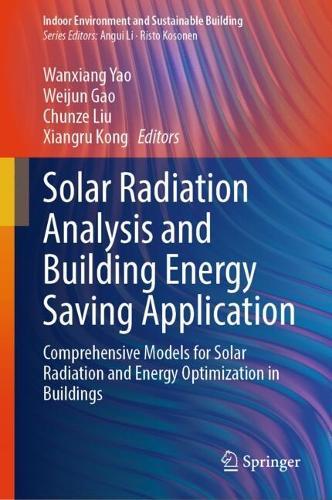
This book provides a comprehensive exploration of solar radiation modeling and its applications in building energy efficiency, offering readers practical tools to reduce energy consumption while maximizing renewable energy use. It introduces innovative models, including anisotropic diffuse radiation methods, haze-corrected frameworks, and photothermal integration approaches, supported by extensive data validation and advanced computational techniques. Special features such as clear illustrations, comparative analyses, and case-based evaluations bridge theory and engineering practice. The book also examines real-world challenges, from the effects of dust and rainfall on photovoltaic performance to the impact of air pollution on solar energy utilization. Readers will gain both theoretical understanding and practical strategies for optimizing solar applications in building design and renewable energy systems. It will appeal to graduate students, researchers, architects, engineers, and professionals engaged in solar energy and building performance optimization.
Full Product Details
Author: Wanxiang Yao ,
Weijun Gao ,
Chunze Liu ,
Xiangru Kong
Publisher: Springer Verlag, Singapore
Imprint: Springer Verlag, Singapore
ISBN: 9789819575718
ISBN 10: 9819575710
Pages: 398
Publication Date: 26 April 2026
Audience:
College/higher education
,
Professional and scholarly
,
Postgraduate, Research & Scholarly
,
Professional & Vocational
Format: Hardback
Publisher's Status: Forthcoming
Availability: Not yet available

This item is yet to be released. You can pre-order this item and we will dispatch it to you upon its release.
Author Information
Prof. Wanxiang Yao is a distinguished academic in the field of building energy efficiency, renewable energy, and human thermal comfort. He is currently serving as a Professor at the College of Architecture and Urban Planning, Qingdao University of Technology, where he has been since September 2023. He holds a Ph.D. in Heat, Gas Supply, Ventilating, and Air Conditioning Engineering from Tongji University, China, where he also completed his Master’s degree. Prior to his current position, he was an Associate Professor at Tianjin Chengjian University, where he contributed significantly to research on building environmental systems and energy-efficient technologies. Prof. Yao’s research interests are centered around building energy efficiency, the use of renewable energy, indoor thermal environment and human thermal comfort, and the control of indoor pollutants. His work also extends to studying the impacts of climate change on building performance and exploring strategies to improve building energy management systems. Professor Yao has led several research projects, including those funded by the National Natural Science Foundation of China, and has published over 90 papers, with numerous patents to his name. His research has had a significant impact on improving energy efficiency in buildings and developing innovative technologies for integrating renewable energy systems in the built environment. In recognition of his outstanding contributions, Professor Yao has received several prestigious awards, including the First Prize of the Invention and Entrepreneurship Award (2025) and multiple national and provincial awards for his research in solar energy and intelligent building energy control technologies. He has also been honored as a Young Expert of the Taishan Scholars of Shandong Province. Additionally, he serves as an editorial board member for Scientific Reports and Progress in Energy & Fuels. Prof. Weijun Gao received his B.E. degree in Mechanical Engineering from Tongji University in 1982, M.E. degree in Building Environment from Zhejiang University in 1987, and Ph.D. degree in Urban Environmental Engineering from Waseda University, Japan, in 1996. He is currently a Professor at The University of Kitakyushu, Japan, and a Foreign Academician of the Engineering Academy of Japan. He also serves as a Distinguished Professor at Qingdao University of Technology. Prof. Gao’s research interests include environmental architecture, circular architecture, smart buildings, and marine architecture. He has published over 160 SCI papers and led more than ten national and regional research projects in Japan. He has served in academic organizations such as the Asian Urban Environmental Society and the Asian Low-Carbon Society. Mr. Chunze Liu obtained a bachelor's degree in Building Environment and Energy Application Engineering from Hebei Institute of Architecture and Engineering in 2018, and a master's degree in Civil Engineering and Water Conservancy from Tianjin Chengjian University of in 2022. He is currently pursuing a doctoral degree at Qingdao University of Technology. Mr. Liu's main research interests are in the efficient use of solar energy and passive building energy-saving technologies. Mr. Xiangru Kong received his Master’s degree in Heating, Gas Supply, Ventilation, and Air Conditioning Engineering from Tianjin Chengjian University in 2024 and began his doctoral studies in Environmental Engineering at The University of Kitakyushu in the same year. In 2025, he was awarded a full scholarship from the China Scholarship Council (CSC). His research focuses on building energy conservation and the efficient utilization of solar energy, with particular attention to the integration of renewable energy in buildings.