Overview
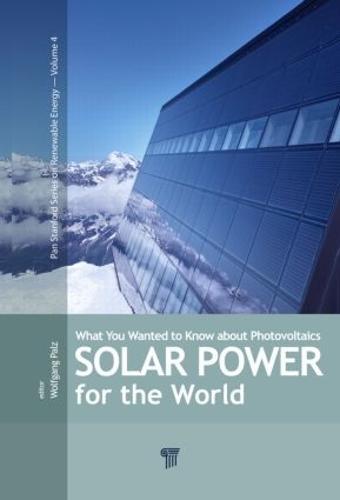
The book describes the industrial revolution associated with the implementation of electric power generation by photovoltaics (PV). The book’s editor and contributing authors are among the leading pioneers in PV from its industrial birth in 1954 all the way up to the stormy developments during the first decade of the new century. The book describes the dramatic events in industry between 2009 and 2013 and puts all this into perspective. It concludes that solar power is yet to strengthen its role in technology and in mainstream of the world’s economy.
Full Product Details
Author: Wolfgang Palz
Publisher: Pan Stanford Publishing Pte Ltd
Imprint: Pan Stanford Publishing Pte Ltd
Dimensions:
Width: 15.20cm
, Height: 3.80cm
, Length: 22.90cm
Weight: 1.576kg
ISBN: 9789814411875
ISBN 10: 9814411876
Pages: 800
Publication Date: 21 October 2013
Audience:
College/higher education
,
Professional and scholarly
,
Tertiary & Higher Education
,
Professional & Vocational
Format: Hardback
Publisher's Status: Active
Availability: In Print 
This item will be ordered in for you from one of our suppliers. Upon receipt, we will promptly dispatch it out to you. For in store availability, please contact us.
Table of Contents
"List of Contributors Hymn to the Sun Introduction to Solar Power for theWorld PARTI ALIFE FOR PV: WOLFGANG PALZ’S NOTABLE ROLE IN DEVELOPMENT FROM THE EARLY DAYS UNTIL NOW 1 The Rising Sun in a Developing World Wolfgang Palz 1.1 Electric Power, a Pillar of Modern Society 1.1.1 Electricity in Today’s Life 1.1.2 The ConventionalWorld of Electricity 1.1.3 Solar PV: A Part of the New Semiconductor World 1.2 Looking Back to Light the Future 1.2.1 The Emergence of Electricity 1.2.2 From the ""Voltaic Pile"" to the Photovoltaic Cell 1.2.3 Photovoltaic Power: The First Steps 1.3 Solar Power for Space Satellites 1.4 First Ideas about Lighting with Solar Power 1.4.1 Mutations of the Societies in the US and Europe 1.4.2 A New Awareness for Solar Power 1.4.3 The Oil-Price Shocks and the Nuclear Disaster of 1986 1.5 After the Vision: A Mountain of Challenges 1.5.1 PV in the Starting Blocks in 1973 1.5.2 The Cost Problem: Technological Challenges 1.5.3 The Chicken and Egg Problem: Mass Production 1.5.4 Entrenched Energy Strategies and Politics 1.5.5 Against Dominant Allocations of State Budgets 1.5.6 Administrations 1.5.7 Energy Pay-Back Time and Module Lifetime 1.5.8 Intermittency of Supply 1.5.9 Environmental Challenges 1.6 Leadership 1.6.1 The Pioneering Role of the US 1.6.2 France: A European Solar Pioneer 1.6.3 PV Start-Up in Germany 1.6.4 PV Ups and Downs in Japan 1.6.5 UNESCO 1.6.6 The European Union 1.6.7 The G8 1.6.8 The Energy Empire Fights Back 2 Solar Power for the World Wolfgang Palz 2.1 Basics for a New Solar Age 2.1.1 The Ethical Imperative of Photovoltaics 2.1.2 Cost and Social Acceptance: Ingredients for a Viable Energy Strategy 2.1.3 PV as Part of a Holistic Approach towards Renewable Energy Implementation and Energy Conservation 2.1.4 What about the Power Plants on the Road? 2.1.4.1 Car drivers and their power plants 2.1.4.2 Mobilising PV for transport 2.2 Driving Forces 2.2.1 Aspirations of the People 2.2.2 Preserving Nature and Alleviating Climate Change 2.2.3 Peak Oil 2.2.4 Energy Security of Supply 2.3 The Role of Stakeholders in Society 2.3.1 Governments and Administrations 2.3.2 Industry and Finance 2.3.3 PV Costs and Benefits for Society: A Special Role for the Grid Operators 2.4 A New Energy Paradigm 2.4.1 Centralised or Decentralised PV 2.4.2 What Role Can Conventional Power Utilities Play? 2.4.3 Communities and Regions Mastering Their Own Energy Supply 2.4.4 The Autonomous Energy House: Solar Architecture and the Building Industry 2.5 Power for the People 2.5.1 Starting a Global Strategy: 10Watts per Head 2.5.2 PV for the People in the IndustrialisedWorld 2.5.3 PV for the People in the Solar Belt 2.6 Power for the Poor 2.6.1 Getting Involved 2.6.2 PV Power for the Poor in the Developing Countries 2.6.3 Power for the Poor in the Industrialised Countries 2.7 Power for Peace 3 PV Today and Forever Wolfgang Palz 3.1 Solar Power 2009–10: AWealth of Achievements 3.1.1 The Global PV Markets 2009–10 3.1.2 Political, Financial, and Industrial Environment 3.1.3 The Technology Boom Goes On 3.2 Outlook 3.2.1 On the Threshold of Commercial Viability 3.2.2 Outlook towards 2020 3.2.3 PV as Part of a 100 Percent Renewable Energy World 3.3 Conclusions PART II THE BEGINNING OF PV IN THE UNITED STATES 4 EarlyWork on Photovoltaic Devices at the Bell Telephone Laboratories Morton B. Prince 5 Terrestrial Photovoltaic Industry: The Beginning Peter F. Varadi 6 Bringing the Oil Industry into the Picture Karl Wolfgang B¨oer 7 The Story of SunPower Richard M. Swanson 7.1 Introduction 7.2 The Beginnings of Terrestrial PV 7.3 My Early Years 7.4 Formation of SunPower 7.5 Concentrators 7.6 Race Cars 7.7 Optical Detectors 7.8 The PV Business Takes Off 7.9 Airplanes 7.10 Project Mercury 7.11 A New Plan 7.12 Cypress 7.13 Goodbye Concentrators 7.14 Becoming a Manufacturer 7.15 Polarization 7.16 IPO 7.17 PowerLight 7.18 Epilog 8 History of Technologies, Development for Solar Silicon Cost Reduction Frederick Schmid 8.1 Introduction 8.2 Development of HEM and FAST for Reducing the Cost of SiliconWafers 8.3 FAST Development 8.4 Development of Technology for Reducing Silicon Meltstock 8.5 Summary 9 Solar Cell Development Work at COMSAT Laboratories (1967–1975) Denis J. Curtin 10 The IEEE Photovoltaic Specialists Conference Americo F. (Moe) Forestieri 10.1 Brief History of the US IEEE PVSC and the William R. Cherry Committee 10.2 8th PVSC: The 1970 PVSC in Seattle,Washington, by Joseph Loferski 10.3 12th PVSC: 1976 Baton Rouge, Louisiana, by Americo Forestieri PART III PV STARTING A SOLAR AGE IN EUROPE 11 Initiating a Solar Revolution in Germany Hermann Scheer 12 My Solar Age Started with Tchernobyl Franz Alt 12.1 Solar Policy Is Social Policy 13 Will This Work? Is It Realistic? Thoughts and Acts of a Political Practitioner with a Solar Vision Hans-Josef Fell 13.1 MyWay of Solar Thinking 13.2 Being Called a Solar Do-Gooder and Unrealistic Politician 13.3 Some Important Steps of My Life Illustrate the Persistence of My SolarWay 13.4 And How Is It Today? 14 The Role of Research Institutes for the Promotion of PV: The Case of Fraunhofer ISE (Institute of Solar Energy Systems) Adolf Goetzberger 15 PV in Berlin—How it All Began: The Story of Solon, Q-Cells. PV in Brazil Stefan Krauter 16 The Kick-Off PV Programme in Germany: The One Thousand PV Roofs Programme Walter Sandtner 17 The Story of Developing Solar Glass Fac¸ades Joachim Benemann 18 PV in Europe, from 1974 to 2009: A Personal Experience Helmut Kiess 18.1 Insight Period: 1974–1988 18.2 Innovation Period during the Decade 1988–1998 18.2.1 State of the Art in 1988: Some Details 18.2.2 The Decade between 1988 and 1998 18.2.3 State of the Art in 1998: Some Details 18.3 Innovation and Industrial Production during the Decade between 1998 and 2008 18.3.1 State of the Art in 2008: Some Details 18.4 Epilogue 19 France Did NotWant to Look for the Sun Alain Li´ebard and Yves-Bruno Civel 20 More Electricity for Less CO2 Yves Bamberger 20.1 Electric Eco-Efficient End-Uses 20.2 Achieving an Ever Lower-Carbon Electricity Mix with Nuclear and Renewables 20.3 Networks: A Tool for Pooling Production and Integrating Renewable Energies 20.4 Carbon-Free Electric Mix as an Opportunity to Develop New Industrial Facilities 21 The History of Renewable Energies in the Canary Islands, Especially in Tenerife Ricardo Melchior and Manuel Cendagorta 22 WhyWas Switzerland Front-Runner for PV in the 90s but Lost the Leadership after 2000? Thomas Nordmann 23 Solar Power in Geneva, Switzerland Philippe Verburgh 23.1 A First-Class Solar Potential 23.2 The ""5 MW Solar"" Project and the ""SIG Vitale Range"" 23.3 A Sunny Future for Geneva 24 The PV World Conference in Vienna Wolfgang Hein 25 Abandoning Nuclear in Favor of Renewable Energies: The Life Story of Giuliano Grassi—Florence, Italy Giuliano Grassi 25.1 First Period: Beginning of My Professional Activity as Engineer 25.2 Second Period: Transition from Electro-Mechanical to Nuclear Activity 25.3 Third Period: Renewable Energies 25.4 Concluding Remarks PART IV PV IN ASIA: A DRAGON ISWAKING UP 26 PV in Japan: Yesterday, Today and Tomorrow 417 Osamui Ikki and Izumi Kaizuka 26.1 History 26.2 Current Status of PV in Japan 26.3 New Support Framework for PV 26.4 Conclusion 27 Leaders of the Early Days of the Chinese Solar Industry Qin Haiyan 27.1 Turning a Dream into a Reality: The Story of Huang Ming 27.2 The Richest Man in China: The Story of Shi Zhengrong 27.3 Internationalization and a Traditional Chinese Soul: The Story of Miao Liansheng 27.4 Development Led by Technology: The Story of Gao Jifan 28 Review of China’s Solar PV Industry in 2009 Gao Hu 29 Lighting theWorld: Yesterday, Today and Tomorrow Biswajit Ghosh 29.1 Light and Energy 29.2 Path toward Initiatives on PV Research 29.3 PV in India and International Scientific Cooperation 29.4 Lighting the Remote 29.5 Views of the Author PARTV PVFOR A BETTER DEVELOPING WORLD 30 Photovoltaics in the World Bank Group Portfolio Anil Cabraal 30.1 World Bank Group Photovoltaics Projects 30.2 Business Models for Off-Grid Service 30.3 Key Lessons of Experience 30.4 Guidelines for Designing Sustainable Off-Grid Projects 30.5 Future Support for Photovoltaics 31 Illiterate Rural Grandmothers Solar-Electrifying Their Own Villages Bunker Roy 31.1 Ground-Breaking Innovation in the Field of Technology 31.2 Sustainable Development: Now and in the Future 31.3 Innovation and Its Practical Application 31.4 Demystifying of 21st Century Technology in 19th Century Conditions—Management, Control and Ownership in the Hands of the Rural Poor around theWorld 31.5 Present and Future Impact of Innovation: Number of People Affected 31.5.1 Renewable Energy 31.5.2 Continent of Africa 31.5.3 Global 31.5.3.1 Providing an answer to a major challenge-tackling global climate change from the community level 32 Early PV Markets and Solar Solutions in South Asia Neville Williams 33 Photovoltaic Power Systems for Lifting Women Out of Poverty in Sub-Saharan Africa Dominique Campana 33.1 Solar Energy against the ""Energy Poverty"" Trap 33.2 In Conclusion 34 Promoting PV in Developing Countries Bernard McNelis 34.1 Looking at Solar 34.2 Into PV 34.3 Into All Things Solar 34.4 Into Intermediate Technology 34.5 Into Africa 34.6 Global Solar Pumping Programme 34.7 IT Power 34.8 Mali 34.9 Dominican Republic 34.10 China 34.11 Robert Hill 34.12 EPIA 34.13 World Bank,Washington, Corruption 34.14 Other Countries, People, Institutions 34.15 Where DoWe Go from Here? PART VI PV FOR THEWORLD 35 On the International Call for Photovoltaics of 2008 Daniel Lincot 36 AWorld Network for Solar R&D: ISES Monica Oliphant 37 Three Steps to a Solar System: From 1% to 40% and 100% Harry Lehmann 37.1 Equal Treatment 37.2 A Further Step: Coming Out of the Niche 37.3 Full Solar Supply or the ""Great Transformation"" 37.4 Scenarios: A Look into the Present and the Future 37.5 To Sum Up I Can Say: 100% Solar System Is Possible! 38 SolarBank Michael T. Eckhart 38.1 Landmark Solar PV Study in 1978 38.2 Away from PV for 15 Years 38.3 Return to Solar PV in 1995 38.4 World Bank 1996–1998 38.5 India 1996–2001 38.6 South Africa 1997–2002 38.7 Europe 1997–2004 38.8 ACORE 2001–Present 38.9 Bonn 2004, WIREC 2008, and IRENA 38.10 SolarBank Looking Forward 39 Solar Power in Practice Stefan Behling 40 AWorld in Blue Bernd Melchior 40.1 From Butterflies to aWorld in ""Blue"": How Did This Happen? 40.2 New Treatment for Porous Materials to Conserve Monuments Like the Dome of Cologne 40.3 Process Steps for a Treatment with the Autoclave 40.4 Translucent Insulation Material 40.5 My Start into Photovoltaic 40.6 Changing DC Current into AC Current 40.7 Diffuse Light Concentrator 40.8 Tracking and Concentration Systems 40.9 The ADS Concept: Autonomous, Decentralized, Sustainable 40.10 The Blue Mountain 40.11 ADS Robinson Club on Fuerteventura 40.12 First Bungalow in theWorld Realized in ADS: ""Casa Solar"", Almunecar, Spain 40.13 Solar Powered Container: 3000 km Trip to 7th EU Photovoltaic Solar Conference and Exhibition in Seville, Spain, October 1986 40.14 A Solar Powered OrthopedicWorkshop Container for a Hospital in Tanzania 40.15 Integration of Photovoltaic into Roofs: ""Sunflate"" 40.16 SUNCLAY + SUNERGY: A Two-Component Photovoltaic System for the Harmonic, Aesthetic and Flexible Integration into the Architecture of Roof 40.17 Next Generation Photovoltaic 40.18 New Generation of Solar Clay Tiles 40.19 The Combination of Solar and Wind BSWT 41 Factory for Sale, or the Long and StonyWay to Cheap Solar Energy: The Story of the Thin-Film CdTe Solar Cells; First Solar and Others—A Semi-Autobiography Dieter Bonnet 42 High Efficiency Photovoltaics for a SustainableWorld Antonio Luque 42.1 Introduction 42.2 The 2008 Spanish Boom 42.3 A Market Forecast Model 42.4 The FULLSPECTRUM Project and the ISFOC 42.5 Summary 43 Nonconventional Sensitized Mesoscopic (Gr¨atzel) Solar Cells Michael Gr¨atzel 44 Solar Bicycles, Mercedes, Handcuffs—PlusEnergy Buildings Gallus Cadonau 44.1 AWorldwide Unique Solar Decision: Tour de Sol 44.1.1 CO2-free Hotel Ucliva in the Swiss Alps: 1st Solarcar Race of theWorld 44.1.2 Tour de Sol 1985: Solar Bicycles and Mercedes Benz 44.1.3 First Solarcar Driving Past an Atomic Power Plant 44.1.4 Geneva—Final Stage of the 1st Tour de Sol 1985: The Power of the Sun 44.1.5 Tour de Sol 2 in 1986: Massachusetts Institute of Technology in the Roadside Ditch 44.1.6 Welding and Sweating Instead of Champagne 44.1.7 Strong Solar Teams from Germany and the Swiss School of Engineering Biel 44.1.8 Solar Cells for ""Independency"" or Terrestrial PV Utilisation? 44.1.9 Tour 3 in 1987: Huge Interest and ""Chermobiles"" 44.1.10 Huge International Media Coverage 44.1.11 Tour Organisation and Its Regulations 44.1.12 Tour de Sol Protests and Appeals in Court? 44.1.13 Solar Mountain Race: Through 360 Curves to Arosa/GR 44.2 World’s First Energy Feed-in System in Burgdorf/BE 44.2.1 Tour de Sol in France: Solar Energy Instead of Air Pollution 44.2.2 World’s First Energy Feed-in System in Burgdorf/BE: ""Grid Interconnection"" 44.2.3 The Principles of Solar Energy Use: Best Technology or Self-Sufficiency? 44.2.4 Tour de Sol 4 in 1988: PV Innovation and Financing Are Getting Broader 44.2.5 PV on Land and onWater 44.2.6 Solar Energy Is Getting Increasingly Popular Also for Groups and Managers 44.2.7 Safety, Recuperation and Road Capability in Winter 44.2.8 Solar Power: A Friendly Alternative 44.2.9 Tour de Sol: ""A Hotbed for Solar-Electric Mobility"" 44.2.10 Car Makers, What Have You Done in the Past? 44.2.11 Tour de Sol and the International Solarcar Federation (ISF) 44.2.12 Rail 2000 and Solarcars in Double-Deck Coaches 44.2.13 The Ideal SOLARCAR 2000: Emission-Free Traffic Circulation in the 21st Century 44.3 The Solar Alternative in Road Traffic:World Solar Challenge 44.3.1 The Solar Alternative in Road Traffic 44.3.1.1 Two hundred years after the French Revolution: The Solar Revolution (1989) 44.3.1.2 California’s Clean Air Act, Zero-Emission Vehicles, PV Program for 1000 kW Roofs 44.3.1.3 First alpine crossing with solarcars: The Sun conquers the Gotthard Pass in 1989 44.3.1.4 Solarcar: A danger for 150 pigs? 44.3.1.5 Alpine tests at the 1st European Championship of Alpine Solarcars (ASEM) in 1989 44.3.1.6 Bea Vetterli’s solarcar in the mountains: downhill with more than 100 km/h 44.3.1.7 St. Moritz: 1st ASEM finish and 1st electric light in Switzerland 44.3.1.8 The British and St. Moritz: Inventors of winter tourism 44.3.1.9 Clean Energy St. Moritz: The overall energy concept 44.3.1.10 Last Tour de Sol in 1991 44.3.1.11 Solarcar world record: 148 km/h at the ASEM 1995 44.3.2 World Solar Challenge in Australia and the US 44.3.2.1 FirstWorld Solar Challenge in 1987: 3005 km across Australia 44.3.2.2 Japan’sWaterloo at the 1st WSC: Detlef Schmitz Missed the Start 44.3.2.3 The SecondWorld Solar Challenge and its dangers in the Australian desert 44.3.2.4 The ""GREATEST RACE on EARTH, Creating a SOLUTION not POLLUTION"" 44.3.2.5 International Solar High-Tech Competition across Australia 44.3.2.6 What technology and strategy was responsible for the victory? 44.3.2.7 ""Spirit of Biel"": 1.8 dl (Solar) fuel for 100 km—55 times more efficient 44.3.2.8 Great suspense and an odd cup in McLarens on the lake 44.3.2.9 Detlef Schmitz: the friendly ""Suitcase Man"" 44.3.2.10 Detlef: veteran and misadventurer at each WSC 1987, 1990, 1993, 1996, 1999 44.3.2.11 World Solar Challenge 1993: Japan invests millions in solarcars 44.3.2.12 Honda changes its strategy for the WSC 1993 44.3.2.13 WSC and Sunrayce in the US and other solar races in 1996 44.4 Solar Prize, Handcuffs and PlusEnergy Buildings 44.4.1 Swiss Solar Prize and Handcuffs 44.4.1.1 Solar utilisation: from traffic to building sector 44.4.1.2 ""Solar 91: for an energyindependent Switzerland"" 44.4.1.3 First Solar Prize 1991 for world’s biggest solar surface per inhabitant 44.4.1.4 Federal Councillor Adolf Ogi: initiative, courage and solar installations 44.4.1.5 Handcuffs, excavators and solar electricity 44.4.1.6 Ren´e B¨ artschi: ""most successful Swiss governing councillor"" 44.4.1.7 Four times too much solar energy and a winter bathe 44.4.1.8 European Commission, US Department of Energy and Japanese Industry 44.4.1.9 Best integrated solar installations: without overbuilding cultural land 44.4.1.10 The solar mission of the Federal Minister of Energy 44.4.2 Solar Energy on the Rise 44.4.2.1 European PV Conference in and popular initiative for solar energy 44.4.2.2 European Parliament: Swiss Solar Prize—model for European Solar Prize 44.4.2.3 Bonn-Cologne-Brussels- Amsterdam: more solar electricity than in Australia 44.4.2.4 Federal Chancellor Vranitzky awards 1st European Solar Prize in Vienna 44.4.2.5 Chancellor Vranitzky: ""Central Europe free of nuclear power plants"" 44.4.2.6 First European Solar Prize goes to successful opponent of EDF 44.4.2.7 City/Charter: implementation of the goals of Rio on municipality level 44.4.2.8 Breakthrough in Parliament in 1997: one CHF billion for solar energy 44.4.2.9 Ucliva Agreement: first European Shell Solar factory in Switzerland 44.4.3 Mephisto & Co against Solar Energy 44.4.3.1 The wisdom of Arthur Schopenhauer and solar energy 44.4.3.2 J.W. Goethe and ""a very good dinner""—instead of solar energy 44.4.3.3 Combat against renewable energies 44.4.3.4 Millions for deception of citizens 44.4.3.5 Economic war against innovative businesses 44.4.3.6 Swiss economical functionaries: best work for the Chinese Communist Party 44.4.3.7 Do authorities harass citizens that are loyal to the constitution? 44.4.3.8 Solar energy instead of unconstitutional bureaucracy 44.4.3.9 Constitutional right for solar building permit: new law within three months 44.4.4 Market-Based Compensation for Renewable Energies 44.4.4.1 Market-based compensation for billions of fossil-nuclear subsidies 44.4.4.2 Prof. Dr. Ren´e Rhinow: best usage of revenues for measures 44.4.4.3 European Court of Justice 2001: grid feed-in is not tax 44.4.4.4 Democratic decision of the electricity consumer on energy investments 44.4.5 Best Innovative Entrepreneurs for Sustainable Economy 44.4.5.1 Small- and medium-sized entrepreneurs are the most innovative 44.4.5.2 Biogas—compo-gas: 1 kg of banana peel = 1 km of car drive 44.4.5.3 Solar house on the Federation Square: built in 22 hours 44.4.5.4 Swiss Solar Prize for first PlusEnergy Building 44.4.5.5 Shell’s solar factory in Gelsenkirchen: ""we want to earn money"" 44.4.5.6 Lord Norman Foster on the 15th Swiss Solar Prize 2005 44.4.5.7 PlusEnergy Buildings for Alpine resort: 175% Self-Supply 44.4.5.8 Energy-intensive industrial PlusEnergy Building: 125% self-supply 44.4.5.9 Installed PV performance: world leader in 1992—last in 2008 44.4.5.10 Sustainable economy: amateur becomes world champion 44.4.5.11 China could outrun all— economically and ecologically 44.5 PEB Cover 75% ofWorld’s Energy Demand 44.5.1 From Solar Collectors to PlusEnergy Buildings 44.5.1.1 Conclusion of Tour de Sol, WSC as well as Swiss and European Solar Prize 44.5.1.2 Energy efficiency: ""Sine qua non"" of PlusEnergy Buildings 44.5.1.3 PlusEnergy Buildings (PEB) with a self-supply between 100% and 200% 44.5.1.4 PV and refurbishment of a 6-family house: energy needs reduced by 90% 44.5.1.5 PV on PlusEnergy Buildings: the level of building technology of 2010 44.5.1.6 PV and refurbishment of a 12-family house: energy needs reduced by 93% 44.5.1.7 Energy-intensive business buildings as PlusEnergy Buildings 44.5.2 PV-PEB Cover 75% ofWorld’s Energy Consumption 44.5.3 Stanford: ""Clearly, Enough Renewable Energy Exists"" 44.5.4 First European Award for PlusEnergy Buildings of CHF(≈$) 100000 Index"
Reviews
This book brings together a collection of lively, easy-to-read articles written by notable global leaders involved in the research and development of photovoltaic (PV) systems. The book is the inspiration of its editor, Prof. Wolfgang Palz, himself a true solar pioneer. In the opening chapters, Prof. Walz provides the historical context and a future vision of the world of solar power. This is followed by a compilation of contributions from numerous experts who provide entertaining and thought-provoking perspectives on PV's history and development, including the early days of research and the gradual and, more recent, explosive growth of the technology as a global clean energy source. There are abundant stories and anecdotes about the many unique applications of PV technologies, the many scientists working to develop and market these technologies, and the key milestones in the history of this technology. This book is must reading for all who are working in the photovoltaic field and for all who are curious about the major role this technology is coming to play in our renewable energy future. -Dave Renne, President, International Solar Energy Society Solar Power for the World is quite a remarkable book as it details from many of the original pioneers the development of solar, and in particular PV, from its early beginnings to the current time. Initially photovoltaics was thought to be, by those outside of academic circles, just an interesting phenomenon of low efficiency and expensive and suitable only for use by space vehicles. However, the early visionaries laid the foundations for the multi-billion dollar industry it is now and helped develop solar to become a mainstream power source. Without the policy contributions from people like Hermann Scheer and the extension of the technologies to take in transport and storage the vision of towards 100 percent renewables for future power could not even be envisaged. This book is a great reference on the transition of thought from research to widespread public use of solar and all the different insights necessary to make the shift to low carbon energy. It is a very useful reference. -Monica Oliphant, Research Scientist, Specialising in Renewable Energy and Residential End Use Efficiency
This book brings together a collection of lively, easy-to-read articles written by notable global leaders involved in the research and development of photovoltaic (PV) systems. The book is the inspiration of its editor, Prof. Wolfgang Palz, himself a true solar pioneer. In the opening chapters, Prof. Walz provides the historical context and a future vision of the world of solar power. This is followed by a compilation of contributions from numerous experts who provide entertaining and thought-provoking perspectives on PV's history and development, including the early days of research and the gradual and, more recent, explosive growth of the technology as a global clean energy source. There are abundant stories and anecdotes about the many unique applications of PV technologies, the many scientists working to develop and market these technologies, and the key milestones in the history of this technology. This book is must reading for all who are working in the photovoltaic field and for all who are curious about the major role this technology is coming to play in our renewable energy future. -Dave Renne, President, International Solar Energy Society Solar Power for the World is quite a remarkable book as it details from many of the original pioneers the development of solar, and in particular PV, from its early beginnings to the current time. Initially photovoltaics was thought to be, by those outside of academic circles, just an interesting phenomenon of low efficiency and expensive and suitable only for use by space vehicles. However, the early visionaries laid the foundations for the multi-billion dollar industry it is now and helped develop solar to become a mainstream power source. Without the policy contributions from people like Hermann Scheer and the extension of the technologies to take in transport and storage the vision of towards 100 percent renewables for future power could not even be envisaged. This book is a great reference on the transition of thought from research to widespread public use of solar and all the different insights necessary to make the shift to low carbon energy. It is a very useful reference. -Monica Oliphant, Research Scientist, Specialising in Renewable Energy and Residential End Use Efficiency
This book brings together a collection of lively, easy-to-read articles written by notable global leaders involved in the research and development of photovoltaic (PV) systems. The book is the inspiration of its editor, Prof. Wolfgang Palz, himself a true solar pioneer. In the opening chapters, Prof. Walz provides the historical context and a future vision of the world of solar power. This is followed by a compilation of contributions from numerous experts who provide entertaining and thought-provoking perspectives on PV's history and development, including the early days of research and the gradual and, more recent, explosive growth of the technology as a global clean energy source. There are abundant stories and anecdotes about the many unique applications of PV technologies, the many scientists working to develop and market these technologies, and the key milestones in the history of this technology. This book is must reading for all who are working in the photovoltaic field and for all who are curious about the major role this technology is coming to play in our renewable energy future. -Dave Renne, President, International Solar Energy Society Solar Power for the World is quite a remarkable book as it details from many of the original pioneers the development of solar, and in particular PV, from its early beginnings to the current time. Initially photovoltaics was thought to be, by those outside of academic circles, just an interesting phenomenon of low efficiency and expensive and suitable only for use by space vehicles. However, the early visionaries laid the foundations for the multi-billion dollar industry it is now and helped develop solar to become a mainstream power source. Without the policy contributions from people like Hermann Scheer and the extension of the technologies to take in transport and storage the vision of towards 100 percent renewables for future power could not even be envisaged. This book is a great reference on the transition of thought from research to widespread public use of solar and all the different insights necessary to make the shift to low carbon energy. It is a very useful reference. -Monica Oliphant, Research Scientist, Specialising in Renewable Energy and Residential End Use Efficiency
Author Information
Wolfgang Palz
Tab Content 6
Author Website:
Countries Available
All regions
|