Overview
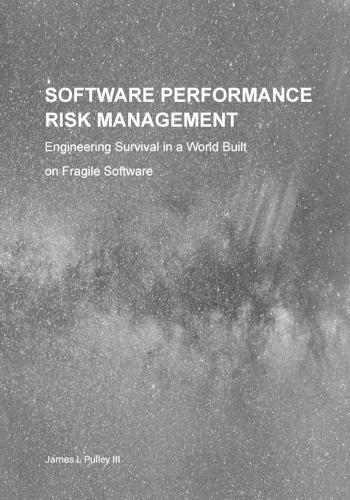
Most software failures are not caused by code defects. They are caused by risks no one measured. Software Performance Risk Management: Engineering Survival in a World Built on Fragile Software introduces a new approach to governing the survivability of modern software systems. As digital infrastructure becomes more complex and more critical to business operations, performance failures no longer represent technical inconveniences-they represent operational and financial risk. For decades, performance engineering has focused on speed, scalability, and capacity. These practices made systems faster, but not necessarily safer. Outages continue to grow larger, recovery becomes more difficult, and hidden dependencies create failure paths that traditional testing and monitoring cannot reveal. This book defines Software Performance Risk Management (SPRM), a discipline focused on identifying and governing the structural risks that threaten software-dependent organizations. Instead of treating performance as a late-stage testing activity, SPRM treats performance as a continuous risk surface that exists across the entire lifecycle of a system-from architecture through production operations. SPRM_optimized Readers will learn why widely adopted practices such as performance testing, observability, monitoring, and reliability engineering remain essential yet incomplete. The book introduces practical concepts including blast radius analysis, dependency mapping, passive risk intelligence, and governance models that allow organizations to understand how failures propagate and how they can be contained before they occur. Through real-world examples and practical frameworks, this book shows how organizations can move beyond dashboards and reactive tuning toward proactive survivability governance. The goal is not simply to improve performance, but to reduce fragility and prevent large-scale failure. Written for performance engineers, architects, technology leaders, and executives responsible for digital continuity, this book provides a structured framework for managing performance risk as a business responsibility rather than a technical afterthought. SPRM_optimized If your organization depends on software to operate, performance is not just an engineering concern-it is a matter of survival. This book is not about tuning code or selecting tools. It is about understanding where software systems are exposed-and how to govern them before failure becomes inevitable.
Full Product Details
Author: James L Pulley ,
Dennis C Hayes
Publisher: Journeyman Publishing LLC
Imprint: Journeyman Publishing LLC
Dimensions:
Width: 17.80cm
, Height: 1.90cm
, Length: 25.40cm
Weight: 0.640kg
ISBN: 9781964222561
ISBN 10: 1964222567
Pages: 272
Publication Date: 01 April 2026
Audience:
General/trade
,
General
Format: Paperback
Publisher's Status: Active
Availability: In Print

This item will be ordered in for you from one of our suppliers. Upon receipt, we will promptly dispatch it out to you. For in store availability, please contact us.
Author Information
James L. Pulley III is a software performance engineer, author, and consultant with more than three decades of experience working with large-scale software systems. His work focuses on understanding how software behaves under real-world demand and helping organizations prevent performance failures before they reach production environments.Pulley began his career working with operating systems and network infrastructure and later specialized in software performance engineering. Over the course of his career he has worked with enterprises and public-sector organizations to improve the reliability and scalability of critical systems.He is widely recognized in the performance engineering community as a long-time practitioner and educator and is known for his contributions to performance testing and engineering practices. Pulley is a host of the PerfBytes podcast, which explores performance engineering and system reliability topics for technical practitioners and managers.Pulley's writing focuses on the relationship between system performance, measurement, and operational risk. Through his books and technical work, he advocates treating performance engineering as a discipline grounded in measurement and governance rather than testing alone.He lives in South Carolina. Dennis C. Hayes is an American inventor and technology entrepreneur best known as the founder of Hayes Microcomputer Products and a pioneer in personal computer data communications. He is widely recognized for his role in the development and commercialization of the personal computer modem and for introducing the Hayes ""AT"" command set, which became the industry standard for modem control and influenced generations of communications hardware and software.In the late 1970s, Hayes co-developed early modem products designed specifically for personal computers, helping to make remote data communication accessible to a broad community of users. Under his leadership, Hayes Microcomputer Products became a leading supplier of modems during the growth of the personal computer industry in the 1980s and early 1990s. The company's products played an important role in the expansion of bulletin board systems, early online services, and networked computing.Hayes studied engineering at the Georgia Institute of Technology and built his career in the field of data communications and technology entrepreneurship. His work helped establish practical standards and widely adopted technologies that supported the development of modern digital communications.Dennis C. Hayes is recognized as a pioneer of personal computer connectivity whose contributions helped enable the widespread adoption of networked personal computing.