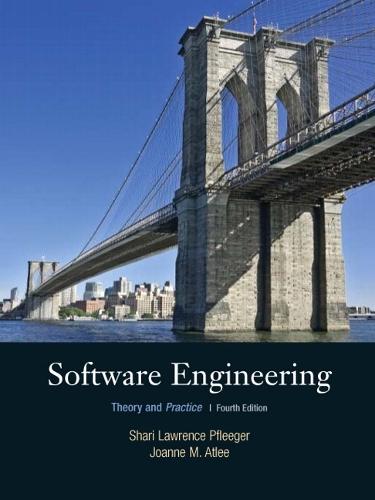
Software Engineering: Theory and Practice

Author:   Shari Pfleeger ,  Joanne Atlee ,  Joanne Atlee ,  Joanne Atlee
Publisher:   Pearson Education (US)
Edition:   4th edition
ISBN:  

9780136061694


Pages:   800
Publication Date:   30 July 2009
Replaced By:   9780138141813
Format:   Hardback
Availability:   Awaiting stock   Availability explained
The supplier is currently out of stock of this item. It will be ordered for you and placed on backorder. Once it does come back in stock, we will ship it out for you.

Our Price $369.60 Quantity:  
Add to Cart

Share |

Software Engineering: Theory and Practice


Overview

For introductory courses in Software Engineering. This introduction to software engineering and practice addresses both procedural and object-oriented development. The book applies concepts consistently to two common examples -- a typical information system and a real-time system. It combines theory with real, practical applications by providing an abundance of case studies and examples from the current literature. This revision has been thoroughly updated to reflect significant changes in software engineering, including modeling and agile methods.

Full Product Details

Author:   Shari Pfleeger ,  Joanne Atlee ,  Joanne Atlee ,  Joanne Atlee
Publisher:   Pearson Education (US)
Imprint:   Pearson
Edition:   4th edition
Dimensions:   Width: 18.60cm , Height: 4.60cm , Length: 24.30cm
Weight:   1.450kg
ISBN:  

9780136061694


ISBN 10:   0136061699
Pages:   800
Publication Date:   30 July 2009
Audience:   College/higher education ,  Tertiary & Higher Education
Replaced By:   9780138141813
Format:   Hardback
Publisher's Status:   Active
Availability:   Awaiting stock   Availability explained
The supplier is currently out of stock of this item. It will be ordered for you and placed on backorder. Once it does come back in stock, we will ship it out for you.

Table of Contents

Preface         1          Why Software Engineering?          1.1     What Is Software Engineering?       1.2     How Successful Have We Been?      1.3     What Is Good Software?      1.4     Who Does Software Engineering?    1.5     A Systems Approach 1.6     An Engineering Approach      1.7     Members of the Development Team 1.8     How Has Software Engineering Changed?   1.9     Information Systems Example         1.10    Real-Time Example    1.11    What this Chapter Means for You    1.12    What this Chapter Means for Your Development Team     1.13    What this Chapter Means for Researchers  1.14    Term Project  1.15    Key References        1.16    Exercises       2          Modeling the Process and Life Cycle       2.1     The Meaning of Process       2.2     Software Process Models     2.3     Tools and Techniques for Process Modeling 2.4     Practical Process Modeling   2.5     Information System Example 2.6     Real-Time Example    2.7     What this Chapter Means for You    2.8     What this Chapter Means for Your Development Team     2.9     What this Chapter Means for Researchers  2.10    Term Project  2.11    Key References        2.12    Exercises       3          Planning and Managing the Project         3.1     Tracking Progress     3.2     Project Personnel      3.3     Effort Estimation       3.4     Risk Management      3.5     The Project Plan       3.6     Process Models and Project Management   3.7     Information System Example 3.8     Real-Time Example    3.9     What this Chapter Means for You    3.10    What this Chapter Means for Your Development Team     3.11    What this Chapter Means for Researchers  3.12    Term Project  3.13    Key References        3.14    Exercises       4          Capturing the Requirements         4.1     The Requirements Process    4.2     Requirements Elicitation       4.3     Types of Requirements        4.4     Characteristics of Requirements      4.5     Modeling Notations    4.6     Requirements and Specification Languages 4.7     Prototyping Requirements     4.8     Requirements Documentation          4.9     Validation and Verification    4.10    Measuring Requirements       4.11    Choosing a Specification Technique 4.12    Information Systems Example         4.13    Real-Time Example    4.14    Term Project  4.15    Key References        4.16    Exercises       5          Designing the Architecture            5.1     The Design Process   5.2     Decomposition and Views     5.3     Modeling Architectures        5.4     Architectural Styles and Strategies 5.5     Achieving Quality Attributes 5.6     Collaborative Design  5.7     Architecture Evaluation and Refinement     5.8     Documenting Software Architectures 5.9     Architecture Design Review 5.10    Software Product Lines        5.11    Information System Example 5.12    Real-Time Example    5.13    What this Chapter Means for you    5.14    What this Chapter Means for Your Development Team     5.15    What this Chapter Means for Researchers  5.16    Term Project  5.17    Key References        5.18    Exercises       6          Designing the Modules       6.1     Design Methodology  6.2     Design Principles       6.3     Object-Oriented Design       6.4     Representing Object-Oriented Designs in the UML           6.5     Object-Oriented Design Patterns     6.6     Other Design Considerations 6.7     Object-Oriented Measurement 6.8     Design Documentation                   6.9     Information Systems Example         6.10    Real-Time Example    6.11    What this Chapter Means for You    6.12    What this Chapter Means for your Development Team      6.13    What this Chapter Means for Researchers  6.14    Term Project  6.15    Key References        6.16    Exercises       7          Writing the Programs          7.1     Programming Standards and Procedures     7.2     Programming Guidelines        7.3     Documentation         7.4     The Programming Process     7.5     Information Systems Example         7.6     Real-Time Example    7.7     What this Chapter Means for You    7.8     What this Chapter Means for Your Development Team     7.9     What this Chapter Means for Researchers  7.10    Term Project  7.11    Key References        7.12    Exercises       8          Testing the Programs         8.1     Software Faults and Failures 8.2     Testing Issues          8.3     Unit Testing   8.4     Integration Testing   8.5     Testing Object-Oriented Systems    8.6     Test Planning 8.7     Automated Testing Tools     8.8     When to Stop Testing         8.9     Information Systems Example         8.10    Real-Time Example    8.11    What this Chapter Means for You    8.12    What this Chapter Means for Your Development Team     8.13    What this Chapter Means for Researchers  8.14    Term Project  8.15    Key References        8.16    Exercises       9          Testing the System 9.1     Principles of System Testing 9.2     Function Testing       9.3     Performance Testing  9.4     Reliability, Availability, and Maintainability   9.5     Acceptance Testing  9.6     Installation Testing   9.7     Automated System Testing  9.8     Test Documentation  9.9     Testing Safety-Critical Systems      9.10    Information Systems Example         9.11    Real-Time Example    9.12    What this Chapter Means for You    9.13    What this Chapter Means for Your Development Team     9.14    What this Chapter Means for Researchers  9.15    Term Project  9.16    Key References        9.17    Exercises       10        Delivering the System        10.1    Training         10.2    Documentation         10.3    Information Systems Example         10.4    Real-Time Example    10.5    What this Chapter Means for You    10.6    What this Chapter Means for your Development Team      10.7    What this Chapter Means for Researchers  10.8    Term Project  10.9    Key References        10.10  Exercises       11        Maintaining the System     11.1    The Changing System          11.2    The Nature of Maintenance  11.3    Maintenance Problems         11.4    Measuring Maintenance Characteristics      11.5    Maintenance Techniques and Tools 11.6    Software Rejuvenation        11.7    Information Systems Example         11.8    Real-Time Example    11.9    What this Chapter Means for You    11.10  What this Chapter Means for Your Development Team     11.11  What this Chapter Means for Researchers  11.12  Term Project  11.13  Key References        11.14  Exercises       12        Evaluating Products, Processes, and Resources          12.1    Approaches to Evaluation     12.2    Selecting an Evaluation Technique  12.3    Assessment vs. Prediction    12.4    Evaluating Products   12.5    Evaluating Processes 12.6    Evaluating Resources 12.7    Information Systems Example         12.8    Real-Time Example    12.9    What this Chapter Means for You    12.10  What this Chapter Means for Your Development Team     12.11  What this Chapter Means for Researchers  12.12  Term Project  12.13  Key References        12.14  Exercises       13        Improving Predictions, Products, Processes, and Resources            13.1    Improving Prediction  13.2    Improving Products   13.3    Improving Processes  13.4    Improving Resources  13.5    General Improvement Guidelines      13.6    Information Systems Example         13.7    Real-Time Example    13.8    What this Chapter Means For You   13.9    What this Chapter Means for your Development Team      13.10  What this Chapter Means for Researchers  13.11  Term Project  13.12  Key References        13.13  Exercises       14        The Future of Software Engineering        14.1    How Have We Done? 14.2    Technology Transfer  14.3    Decision-Making in Software Engineering    14.4    The Professionalization of Software Engineering: Licensing, Certification, and Ethics    14.5    Term Project  14.6    Key References        14.7    Exercises       Annotated Bibliography        Index   

Reviews

Author Information

Shari Lawrence Pfleeger (Ph.D., Information Technology and Engineering, George Mason University; M.S., Planning, The Pennsylvania State University; M.A., Mathematics, The Pennsylvania State University; B.A., Mathematics with high honors, Harpur College, Binghamton, NY) is a senior researcher at RAND’s Arlington, VA office where she helps organizations and government agencies understand whether and how information technology supports their mission and goals.  Dr. Pfleeger began her career as a mathematician and then a software developer and maintainer for real-time, business-critical software systems. From 1982 to 2002, Dr. Pfleeger was president of Systems/Software, Inc., a consultancy specializing in software engineering and technology. From 1997 to 2000, she was also a visiting professor at the University of Maryland's computer science department. In the past, she was founder and director of Howard University's Center for Research in Evaluating Software Technology (CREST), and was a visiting scientist at the City University (London) Centre for Software Reliability, principal scientist at MITRE Corporation's Software Engineering Center, and manager of the measurement program at the Contel Technology Center (named by the Software Engineering Institute as one of the best such programs in the country). Dr. Pfleeger is well-known for her work in software quality, software assurance, and empirical studies of software engineering; she is particularly known for her multi-disciplinary approach to solving information technology problems.   She is also well-known for her publications, many of which are required reading in software engineering curricula, including ""Software Engineering: Theory and Practice"" (3rd edition, with Joanne Atlee, 2005, Prentice Hall), ""Security in Computing"" (3rd edition, with Charles P. Pfleeger, 2003, Prentice Hall), ""Solid Software"" (2001, with Les Hatton and Charles Howell, Prentice Hall), and ""Software Metrics:  A Rigorous and Practical Approach"" (2nd edition, with Norman Fention, 1996, Boyd and Fraser Publishers).  Dr. Pfleeger is book review editor for IEEE Security and Privacy. For several years, she was the associate editor-in-chief of IEEE Software, where she edited the Quality Time column, and then associate editor of IEEE Transactions on Software Engineering. From 1998 to 2002, she was a member of the editorial board of Prentice Hall's Software Quality Institute series. She is a senior member of IEEE, the IEEE Computer Society, and the Association for Computing Machinery.   Joanne M. Atlee is an Associate Professor in the School of Computer Science at the University of Waterloo. Her research program focuses on software modeling, documentation, and analysis, with a particular emphasis on what she calls practical formalisms:  specification and design notations that are practitioner-friendly but have a precise semantics suitable for automated analysis.  More recently, she has been working on configurable model-driven development, whereby modeling notations, analysis tools, and code generators can be configured via semantics parameters.   Atlee was the founding Director of Waterloo’s Software Engineering degree program. She served on the Steering Committee for the Computing Curricula Software Engineering volume, co-sponsored by IEEE-CS and ACM.  She is the vice chair of the International Federation for Information Processing (IFIP) Working Group 2.9 on software requirements engineering.  Atlee was the program-committee chair for the International Conference on Requirements Engineering in 2005 (RE'05), and will be co-chair of the program committee for the International Conference on Software Engineering in 2009 (ICSE'09).  She is a co-author with Shari Lawrence Pfleeger on the textbook ""Software Engineering - Theory and Practice.""

Tab Content 6

Author Website:  

Countries Available

All regions
Latest Reading Guide

NOV RG 20252


Shopping Cart
Your cart is empty
Shopping cart
Mailing List