Overview
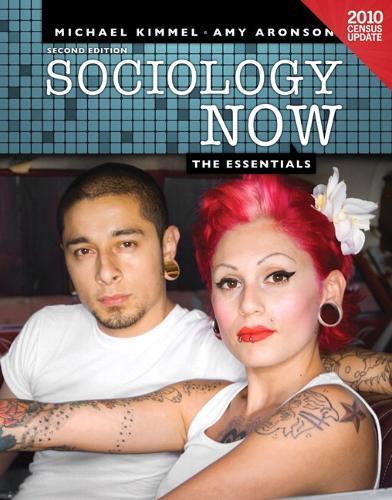
Exploring the questions of today Sociology Now reflects the discipline today and explores the big questions about multiculturalism and globalization that sociologists ask. It explains how the classic concerns of sociology—social order, social conflict, social interaction—have been reshaped by new insights about multiculturalism and globalization. Sociology has always offered a way to make sense of the complex and sometimes contradictory forces that shape our social lives in any era. As Sociology Now explains sociology as both a body of knowledge and a ""way of seeing,"" it shows how the forces of globalization and multiculturalism have come to preoccupy sociologists and influence the way they look at the events and experiences of the early twenty first century. Michael Kimmel, a leading sociologist and gender researcher, and co-author Amy Aronson, a journalist and media scholar, address questions regarding these forces head-on as they make a compelling case for the importance of sociology in the contemporary world. The Census Update program incorporates 2010 Census data into a course–simply and easily. The components of the Census Update Program include an updated census edition with all charts and graphs–to reflect the results of the 2010 Census. In addition, A Short Introduction to the U.S. Census is available and an updated MySocLab. Teaching & Learning Experience Personalize Learning – MySocLab delivers proven results in helping students succeed, provides engaging experiences that personalize learning, and comes from a trusted partner with educational expertise and a deep commitment to helping students and instructors achieve their goals. Improve Critical Thinking – Each chapter opener asks students to consider a paradox that illustrates the complexity of sociology. Engage Students – Unique pedagogical features help students see sociology as a science and understand how sociologists use research data. Explore Theory – Theory is discussed in context of multiculturalism and globalization. Understand Diversity – Race, class, and gender are discussed both as the foundations of our identity and as sources of inequality. Support Instructors – The test bank is edited by the authors. Note: MySocLab does not come automatically packaged with this text. To purchase MySocLab, please visit: www.mysoclab.com or you can purchase a valuepack of the text + MySocLab (at no additional cost). ValuePack ISBN-10: 0205171397 / ValuePack ISBN-13: 9780205171392
Full Product Details
Author: Michael S. Kimmel , Amy Aronson
Publisher: Pearson Education (US)
Imprint: Pearson
Edition: 2nd edition
Dimensions:
Width: 21.30cm
, Height: 1.80cm
, Length: 27.20cm
Weight: 1.020kg
ISBN: 9780205181056
ISBN 10: 0205181058
Pages: 576
Publication Date: 14 December 2011
Audience:
College/higher education
,
Tertiary & Higher Education
Format: Paperback
Publisher's Status: Out of Print
Availability: In Print 
Limited stock is available. It will be ordered for you and shipped pending supplier's limited stock.
Table of Contents
"IN THIS SECTION: 1.) BRIEF 2.) COMPREHENSIVE BRIEF TABLE OF CONTENTS: Chapter 1: What Is Sociology? Chapter 2: Culture and Society Chapter 3: Society: Interactions, Groups, And Organizations Chapter 4: How Do We Know What We Know? The Methods Of The Sociologist Chapter 5: Socialization Chapter 6: Deviance and Crime Chapter 7: Stratification and Social Class Chapter 8: Race and Ethnicity Chapter 9: Sex and Gender Chapter 10: The ""Sociological Body"": Age, Health, and Sexuality Chapter 11: The Family Chapter 12: Economy and Work Chapter 13: Politics and Media Chapter 14: Education, Religion, and Science Chapter 15: Sociology Of Environments: The Natural, Physical, and Human Worlds COMPREHENSIVE TABLE OF CONTENTS: Chapter 1: What is Sociology? Sociology as a Way of Seeing Doing Sociology Where Did Sociology Come From? Contemporary Sociology Sociology in the 21st Century, Sociology and You Chapter 2: Culture and Society Culture Elements of Culture Cultural Expressions Cultural Change Culture in the 21st Century Chapter 3: Society: Interactions, Groups, and Organizations Society: Putting Things in Context The Social Construction of Reality Elements of Social Structure Groups Social Networks Organizations Groups ‘R’ Us: Groups and Interactions in the 21st Century Chapter 4: How Do We Know What We Know? The Methods of the Sociologist Why Sociological Methods Matter Types of Sociological Research Methods Social Science and the Problem of “Truth” Doing Sociological Research Issues in Conducting Research Social Science Methods in the 21st Century: Emergent Methodologies Chapter 5: Socialization Socialization and Biology Socialization in Action Models of Socialization Agents of Socialization Socialization and the Life Course Socialization in the 21st Century Chapter 6: Deviance and Crime What Is Deviance? Conformity and Social Control Deviance and Social Coherence Sociological Theories of Deviance and Crime Types of Crimes Crime in the United States The Criminal Justice System Globalization and Crime Deviance and Crime in the 21st Century Chapter 7: Stratification and Social Class What Is Social Stratification? Social Class Poverty in the United States and Abroad Social Mobility Global Inequality Class Identity and Class Inequality in the 21st Century Chapter 8: Race and Ethnicity The Sociology of Race and Ethnicity Prejudice, Discrimination, and Racism Ethnic Groups in the United States Ethnicity, Identity, and Conflict Race and Ethnicity in the 21st Century Chapter 9: Sex and Gender Sex and Gender: Nature and Nurture Becoming Gendered: Learning Gender Identity Gender Inequality on a Global and Local Scale Gender Inequality in the United States The Politics of Gender Gender Inequality in the 21st Century Chapter 10: The ""Sociological Bosdy:"" Age, Health, and Sexuality The Social Body Age: Identity and Inequality Youth and Inequality The Body in Sickness and Health Studying Sexuality: Behaviors and Identities American Sexual Behavior and Identities Sexual Inequality Age and Sexuality in the 21st Century Chapter 11: The Family The Family Tree Family and Ethnicity Forming Families Parenting Family Transitions Violence in Families The Family in the 21st Century: “The Same as It Ever Was” Chapter 12: Economy and Work The Economy and Society The American Economy Work, Identity, and Inequality Diversity in the Workplace Work and Economy in the 21st Century Chapter 13: Politics and Media Politics: Power and Authority Political Systems The Political System of the United States Political Change What Are the Mass Media Media Production and Consumption Globalization of the Media Politics and Media in the 21st Century Chapter 14: Education, Religion, and Science Education in Social Context The Sociology of Education Religion and Science Religion, Globally and Locally Science in Sociological Perspective Education, Religion, and Science in the 21st Century Chapter 15: Sociology of Environments: The Natural, Physical, and Human Worlds The Human Environment Theories of Global Population Growth The Urban Environment Sociology and the City The Natural Environment Environments in the 21st Century"
Reviews
Author Information
Michael S. Kimmel is a Professor of Sociology at SUNY at Stony Brook. He is the author of Guyland: The Perilous World Where Boys Become Men (HarperCollins, 2008) which was featured on the Today Show, Good Morning America and featured on over one hundred radio and newspaper and blog reviews. His other books include Changing Men (1987), Men’s Lives(8th edition, 2009) Against the Tide: Profeminist Men in the United States, 1776-1990 (1992), The Politics of Manhood (1996),Manhood: A Cultural History (1996, 10th anniversary second edition, 2006), and The Gendered Society (3rd edition, 2008). He co-edited The Encyclopedia on Men and Masculinities (2004) and Handbook of Studies on Men and Masculinities (2004). He is the founder and editor of Men and Masculinities, the field’s premier scholarly journal, a book series on Gender and Sexuality at New York University Press, and edited the Sage Series on Men and Masculinities. He lectures extensively in corporations and on campuses in the U.S. and abroad. He lives in Brooklyn, New York with his wife and co-author, Amy Aronson, and their 10 year old son, Zachary. Amy Aronson is Assistant Professor of Journalism and Media Studies at Fordham University. She is the author of Taking Liberties: Early American Women's Magazines and Their Readers and an editor of the international quarterly, Media History. She has co-edited several books, including a centennial edition of Charlotte Perkins Gilman's Women and Economics and the two-volume Encyclopedia of Men and Masculinities, which was honored by the New York Public Library with a Best of Reference Award in 2004. A former editor at Working Woman and Ms., her work has also appeared in publications including Business Week, Global Journalist and the Sunday supplement of The Boston Globe.
Tab Content 6
Author Website:
Countries Available
All regions
|